


The plan fee is the smallest part of the bill. Here is what transaction fees, payment gateways and apps add up to as your sales grow, with a worked example in rupees.
Shopify Payments isn’t available in India, so most Indian merchants pay Shopify’s third-party transaction fee on top of their payment gateway’s own charge, plus app subscriptions that grow with orders. For a store taking ₹60 lakh a month in prepaid payments through Razorpay, Shopify’s own charges on the best-fit plan come to about ₹58,680 a month (₹7.04 lakh a year), and the gateway adds another ₹1.42 lakh a month. This guide shows where the money goes, how it grows with sales, and the point at which owning more of your platform could cost less. It is not an argument that Shopify is expensive. For many stores it is still the most economical choice.
Key takeaways
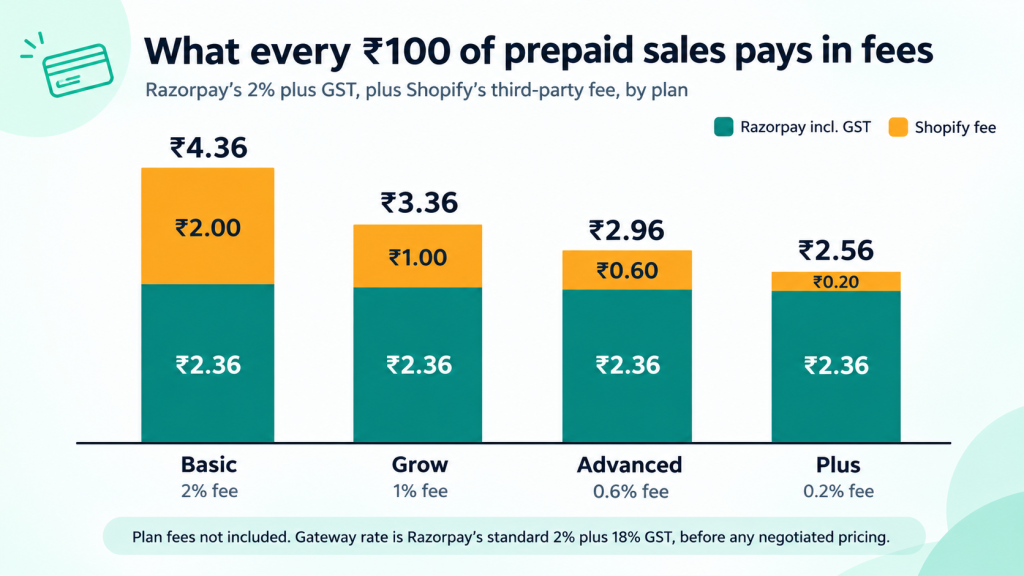
- Shopify adds a fee on prepaid gateway payments. In India it is 2% (Basic), 1% (Grow), 0.6% (Advanced) or 0.2% (Plus), on top of the gateway’s own fee. Manual methods such as COD and bank transfers are exempt.
- Apps add variable costs. Many are billed in US dollars and step up as orders grow, which exposes your margin to exchange-rate swings.
- There is a break-even point, and it depends on your running costs. For example, at ₹1 lakh a month it is about ₹1.29 crore in prepaid monthly sales.
What is actually on your Shopify bill?
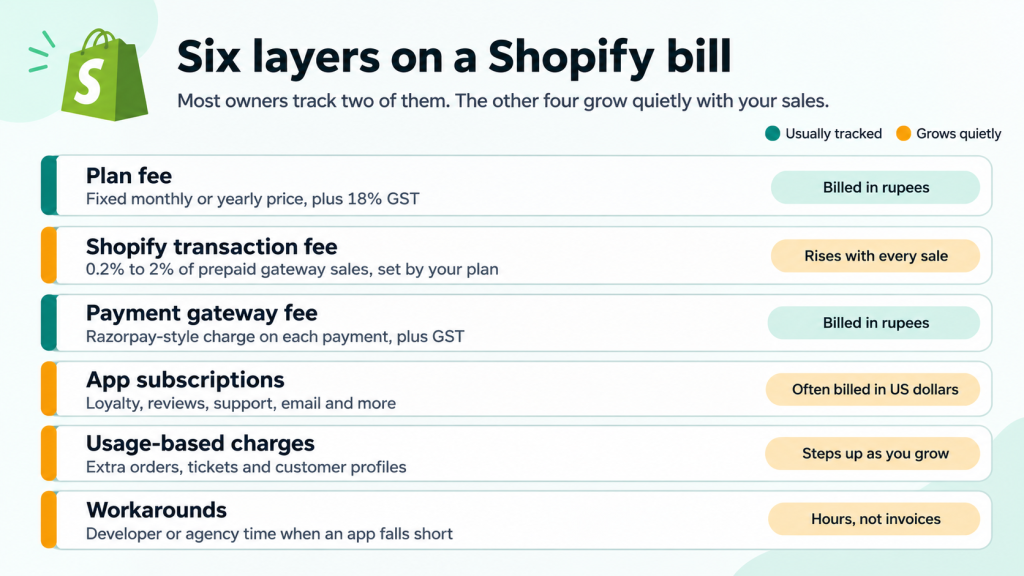
Think of renting a shop in a busy mall. The rent is fixed, but the landlord also takes a percentage of every sale, charges for each extra service and bills some of them in a foreign currency. A Shopify store works much the same way. The total usually has six layers:
- The plan fee, billed in rupees, plus 18% GST.
- Shopify’s third-party transaction fee, charged on each sale that goes through an outside payment gateway.
- The gateway’s own fee, plus GST.
- App subscriptions, often billed in US dollars.
- Usage-based charges that rise with orders, tickets or customer profiles.
- Developer or agency time spent on workarounds when an app can’t do exactly what you need.
Most owners track the plan fee and the gateway fee. The transaction fee and the app charges are where bills grow quietly.
Hidden Costs of Shopify App Subscriptions (The App Stack)
Many stores add apps for loyalty, reviews, support and email. The table shows illustrative examples, not required purchases. Free plans exist for some of them.
| Need | Example app | Monthly price (USD) | What to watch |
|---|---|---|---|
Loyalty and rewards
| Smile.io Growth
| $199
| Includes 2,500 orders a month; extra orders cost $20 per 100. VIP tiers need this plan.
|
Product reviews
| Judge.me Awesome
| $15
| Flat price; a free plan also exists.
|
Customer support
| Gorgias Pro
| $360
| Includes 2,000 tickets; extra tickets cost about $36 per 100.
|
Email marketing
| Klaviyo
| Based on profiles and sends
| Grows as your customer list grows.
|
The three priced apps come to $574 a month, or $6,888 a year, before email, search, subscriptions or returns tools. Two things make this worse than it looks. First, prices step up as you grow: a store moving from 2,000 to 3,000 orders a month pays $100 more for Smile.io alone. Second, dollar billing means your rupee cost moves with the exchange rate.
The bigger issue is that each app holds a piece of your business rules. When loyalty, promotions and customer data sit in separate tools, every change means checking several of them. We cover that pattern in Beyond Shopify: How to Tell When Your Commerce Platform Becomes a Bottleneck.
Shopify Third-Party Transaction Fees Explained
When you use an outside gateway such as Razorpay, Shopify charges its own fee on every online payment. The rate depends on your plan.
| Shopify plan | Plan fee (billed yearly, before GST) | Third-party transaction fee |
|---|---|---|
Basic
| ₹1,499 | 2% |
Grow | ₹5,599 | 1% |
Advanced
| ₹22,680
| 0.6% |
Plus | Quoted by Shopify
| 0.2% |
This is separate from the gateway’s fee. Razorpay’s standard domestic rate is 2% plus 18% GST, an effective 2.36%. On Grow, the two together take about 3.36% of every online sale.
Two notes before you do your own sums. First, Shopify’s help pages say manual payment methods such as cash on delivery and bank transfers don’t carry the third-party fee. For many Indian stores COD is a large share of orders, so a high COD mix lowers your effective Shopify fee compared with a fully prepaid store. If you use the Advanced Cash on Delivery app, check it for separate charges. Second, if you are GST-registered, ask your accountant whether input tax credit lets you claim back the GST charged on these business fees.
One more detail: Shopify doesn’t return the third-party transaction fee when you refund an order, so a high return rate raises your effective cost.
A worked example: ₹60 lakh a month
Take a growing store with 2,000 orders a month at an average of ₹3,000. That is ₹60 lakh in monthly sales, or ₹7.2 crore a year. Assume all of it is prepaid through Razorpay at 2% plus GST, with no COD orders.
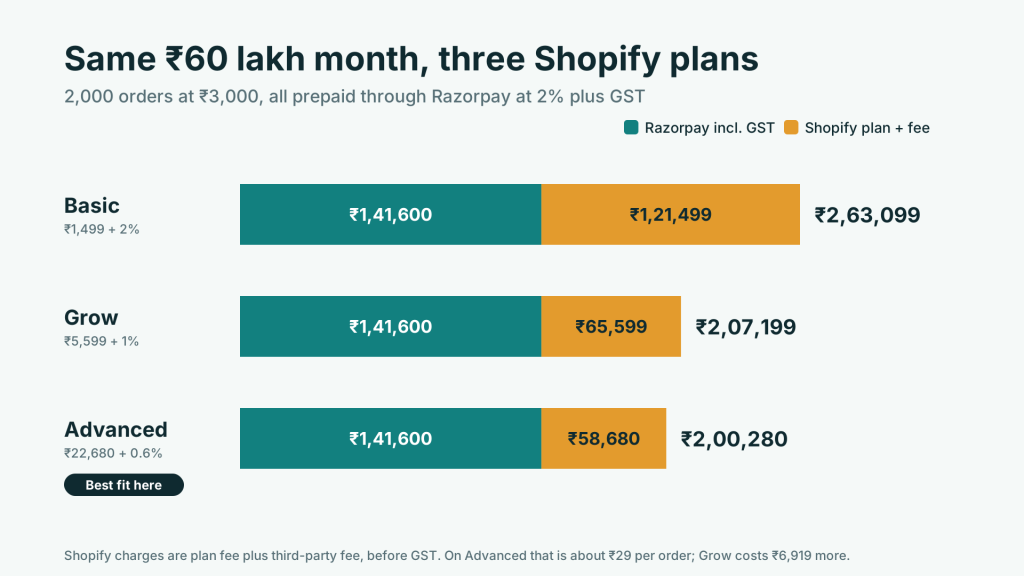
The gateway cost is the same on every plan: 2% of ₹60 lakh is ₹1,20,000, plus ₹21,600 GST, a total of ₹1,41,600. What changes is Shopify’s share.
| Shopify plan | Plan fee | Transaction fee | Shopify charges | Gateway (with GST) | Total |
|---|---|---|---|---|---|
Basic
| ₹1,499
| 2% = ₹1,20,000
| ₹1,21,499
| ₹1,41,600
| ₹2,63,099
|
Grow
| ₹5,599
| 1% = ₹60,000
| ₹65,599
| ₹1,41,600
| ₹2,07,199
|
Advanced
| ₹22,680
| 0.6% = ₹36,000
| ₹58,680
| ₹1,41,600
| ₹2,00,280
|
At this volume the best-fit plan is Advanced. Choosing the right plan matters: on Grow, the same month costs ₹6,919 more in Shopify charges.
On Advanced, the numbers break down like this:
- Shopify’s charges: ₹58,680 a month, about ₹7.04 lakh a year, or roughly ₹29 per order.
- Razorpay’s charges: ₹1,41,600 a month with GST, or roughly ₹71 per order.
- Together: about ₹100 on a ₹3,000 order, or 3.3% of every sale.
What if half your orders are COD? Only the prepaid half carries Shopify’s fee. On ₹30 lakh of prepaid sales, Grow becomes the best-fit plan at ₹35,599 a month (Advanced would be ₹40,680), and the gateway costs ₹70,800 with GST. That is about ₹1.06 lakh a month in total instead of ₹2 lakh. COD has its own costs, such as courier handling fees and return-to-origin losses, so lower platform fees are not the whole picture.
How Shopify’s charges grow with sales
Shopify’s plan fee and transaction fee together, on the cheapest plan for each level of monthly prepaid sales:
| Monthly prepaid sales | Best-fit plan | Shopify charges per month | Per year |
|---|---|---|---|
₹10 lakh
| Grow
| ₹15,599
| ₹1.87 lakh
|
₹25 lakh
| Grow
| ₹30,599
| ₹3.67 lakh
|
₹50 lakh
| Advanced
| ₹52,680
| ₹6.32 lakh |
₹1 crore | Advanced
| ₹82,680
| ₹9.92 lakh |
₹2 crore | Advanced
| ₹1,42,680 | ₹17.12 lakh |
These figures exclude GST, gateway fees and apps. Plus has the lowest percentage but a much higher plan price, so it tends to suit larger volumes than this table covers.
The pattern is what matters. Shopify’s charge rises with every rupee of sales. Most of the costs of running your own platform do not.
What changes with a self-managed platform
If you run your own commerce platform, such as an open-source one like Medusa, you connect directly to Razorpay or another supported gateway. The gateway fee still applies. The Shopify plan fee and transaction fee disappear.
What you take on instead is hosting, security, backups, monitoring, upgrades and developer support. These costs are mostly fixed rather than tied to sales. They are also real, and they are the reason this is not automatically cheaper. We compare the architecture options in Monolithic vs Headless vs Composable Commerce.
Some app costs can be replaced too, but only where the capability is truly yours. A loyalty programme with your own tiers and rules is the usual example. See our loyalty solutions.
When does owning the platform start to pay off?
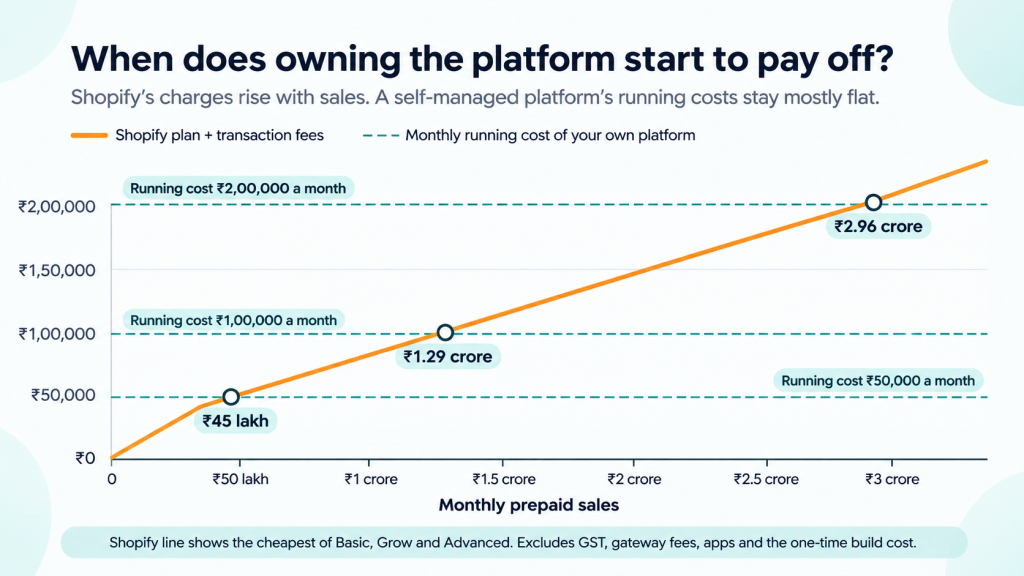
Because Shopify’s charges rise with sales and self-managed running costs are mostly fixed, there is a break-even point. The table shows the monthly prepaid sales at which Shopify’s plan and transaction fees (Advanced: ₹22,680 plus 0.6% of sales) equal your own running costs.
| If running your own platform costs this much a month | Shopify’s charges match it at about |
|---|---|
₹50,000 | ₹45 lakh in monthly prepaid sales
|
₹1,00,000 | ₹1.29 crore in monthly prepaid sales
|
₹2,00,000 | ₹2.96 crore in monthly prepaid sales
|
Three cautions:
- Apps are extra. If you replace paid apps with your own modules, that saving adds to the picture.
- The build is a one-time cost. Payback in months equals the one-time build and migration cost divided by your monthly savings.
- Below break-even, stay. If your sales sit well under the line, Shopify is usually the cheaper and lower-risk choice.
Are your sales approaching these break-even numbers?
If your platform fees are scaling faster than your revenue, it may be time to look at a custom architecture. Talk to the Mindster team about a cost review
A fair comparison
| Cost area | Shopify and apps | Self-managed platform |
|---|---|---|
Platform | Plan fee | Hosting and infrastructure |
Transaction fee | 0.2% to 2% by plan | None
|
Payment gateway | Gateway fee plus GST | Gateway fee plus GST |
Specialised features | App subscriptions | Custom development or external services |
Maintenance | Mostly handled by Shopify | Your responsibility |
Cost behaviour | Rises with sales and orders | Mostly fixed |
Should you stay or look at alternatives?
Stay on Shopify if your sales are below your break-even, your workflows are standard, you have no engineering team, and your apps work without workarounds.
Look at alternatives if your sales are well above break-even, your fees are growing faster than your margins, several apps are patching one workflow, or you need deeper ERP and CRM links. Our guide to ERP integration for e-commerce covers that side.
A 30-minute cost audit you can do this week
- Pull the last three months of Shopify invoices, gateway statements and app invoices.
- Add them up and divide by your online sales to get your true cost as a percentage.
- List which apps exist only to cover gaps, and how many developer hours go on workarounds.
- Project your sales 12 to 24 months ahead and read the break-even table.
Conclusion
Don’t judge a platform by its monthly subscription. Judge it by what the whole stack costs per order as you grow. For many stores, staying on Shopify and choosing the right plan is the right answer. For stores with high online volumes and growing app dependence, owning more of the platform can change the economics.
Is your Shopify bill growing faster than your sales?
Share your monthly sales and apps, and we’ll map your fees and your break-even point.
Talk to Our TeamDisclaimer: Prices checked on 18 November 2026 from Shopify India, Razorpay, Smile.io, Judge.me and Gorgias pricing information. Vendors change prices often, so confirm current figures before you decide. The examples are illustrations, not quotes.

Akhila drives the content strategy at Mindster, combining analytical clarity with a passion for digital product innovation. With a deep focus on mobile app strategy and software solutions, she bridges the gap between engineering complexity and intuitive user experiences. She thoughtfully articulates tech concepts, transforming frameworks, case studies, and digital transformation trends into actionable insights for product teams and business leaders.