

How e-commerce businesses can respond to real customer behaviour, and how to choose between a managed platform like Klaviyo and an open-source platform like Mautic.
Event-driven marketing triggers customer journeys from real behaviour, such as an abandoned cart, a loyalty milestone or a lapse in purchasing, instead of a fixed campaign calendar. Klaviyo delivers this as a managed, proprietary SaaS platform that is ready for e-commerce. Mautic delivers it as an open-source platform that can be self-hosted and connected directly to a custom commerce backend, loyalty engine or CRM, at the cost of more engineering and operational effort.
In business terms: a customer who leaves a full basket at 9 pm should hear from you that evening, not in next Friday’s newsletter. A loyal customer who is drifting away should get a timely, relevant offer before they stop buying. Event-driven marketing does this automatically, which means fewer abandoned sales, stronger repeat purchases and less manual campaign work for your team.
What is event-driven marketing?
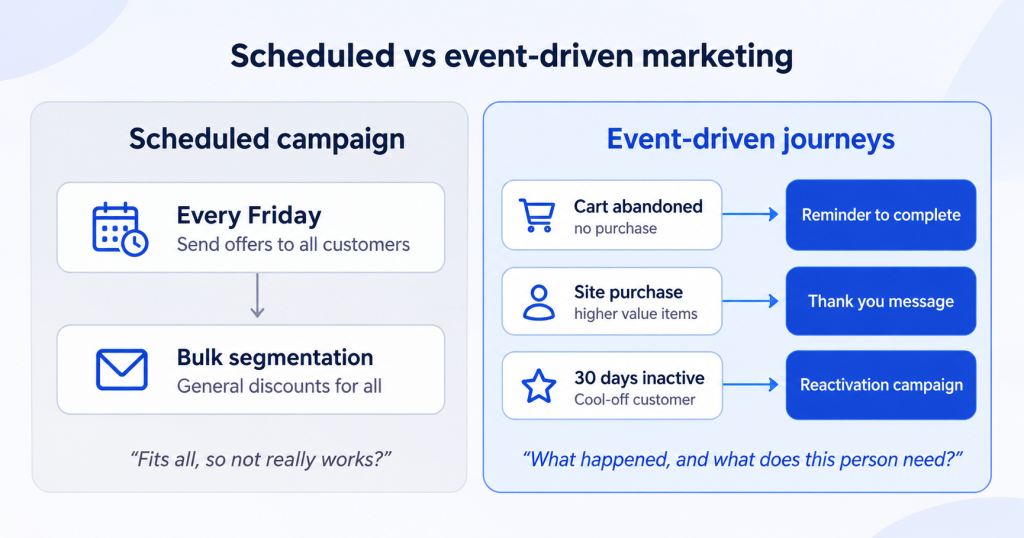
Event-driven marketing responds to what a customer has just done, instead of what the calendar says. Every action in a commerce journey is a signal of intent: a product view, an add-to-cart, a purchase, a second order, a loyalty tier change or a long period of inactivity.
Think of a shop assistant. A scheduled campaign is a flyer handed to every passer-by. An event-driven journey is the assistant who notices you holding a jacket at the till and walks over to help.
Compare two approaches:
- Scheduled: a promotional email goes to all customers every Friday, with basic segmentation.
- Event-driven:
- A customer adds a product to the cart and does not buy. An abandoned-cart journey starts.
- A customer completes a third purchase. A loyalty milestone message follows.
- A Gold-tier customer has not bought from a category in 90 days. A relevant campaign is triggered.
- A previously active customer passes their usual purchase cycle. A re-engagement journey begins.
The planning question changes from “What campaign do we send this week?” to “What has happened in this customer’s journey, and what should happen next?”
Is Klaviyo event-driven?
Yes. Event-based automation is one of Klaviyo’s core strengths. It offers customer profiles, event tracking, segmentation, automated flows, commerce platform integrations and predictive features. Product activity, orders and fulfilment events can trigger workflows, and custom events support more specific journeys.
The trade-off is control. Klaviyo is a managed, proprietary platform, so the data model, feature set, integration patterns, pricing and extensibility are set by the vendor. For most businesses that is a sound trade for a ready-to-use product.
It becomes a constraint when a business has:
- A highly customised commerce backend
- An independent loyalty and rewards engine
- Multiple customer data sources
- Complex ERP and CRM integrations
- Business rules that do not fit standard marketing workflows
- A need to choose and control its own AI infrastructure
In those cases, the real question is how easily the marketing platform can work with the systems you already run. If loyalty points, orders and customer records sit in different places, every gap between them is a campaign you cannot send or a customer you cannot recognise.
Is Mautic a good alternative to Klaviyo for e-commerce?
Mautic is a good fit when control and integration flexibility matter more than a ready-made e-commerce experience. It is an open-source marketing automation platform with contact management, segmentation, campaign journeys, APIs and webhooks. It can be self-hosted and customised.
Instead of depending on a predefined commerce connector, a business can pass commerce events straight to Mautic, enrich the customer record with loyalty or CRM data, and trigger campaigns from the combined information.
Mautic is not a feature-for-feature replacement for Klaviyo. Reaching a comparable e-commerce experience usually needs additional engineering. The business also takes on hosting, maintenance, security, email deliverability, upgrades and integration monitoring. Open source does not automatically mean lower total cost. It means more control over how the solution is built and run.
A simple way to picture the difference: Klaviyo is like renting a fully fitted shop unit. You move in quickly, but the layout is the landlord’s. Mautic is like building your own premises. You get exactly the layout you need, and you also take on the building work and the upkeep.
Klaviyo vs Mautic at a glance
| Factor | Klaviyo | Mautic |
|---|---|---|
Model | Managed, proprietary SaaS | Open source, self-hosted or managed by a provider |
E-commerce readiness | Specialised, ready-made | Needs additional engineering |
Customisation
| Within vendor limits | Extensive, via APIs and webhooks
|
Data and infrastructure control | Vendor-governed | Business-controlled
|
AI integration
| Built-in predictive features
| Bring and integrate your own AI services
|
Operational burden
| Low | Hosting, security, deliverability, upgrades
|
Cost drivers
| Platform pricing and usage
| Infrastructure, engineering, maintenance
|
Best fit
| Teams wanting fast, standard e-commerce automation | Teams with custom systems and technical capacity |
Not sure whether Klaviyo or Mautic fits your store?
Our engineers review your commerce, loyalty and CRM setup and recommend the platform that fits.
Book an architecture reviewWhat does an event-driven marketing architecture look like?
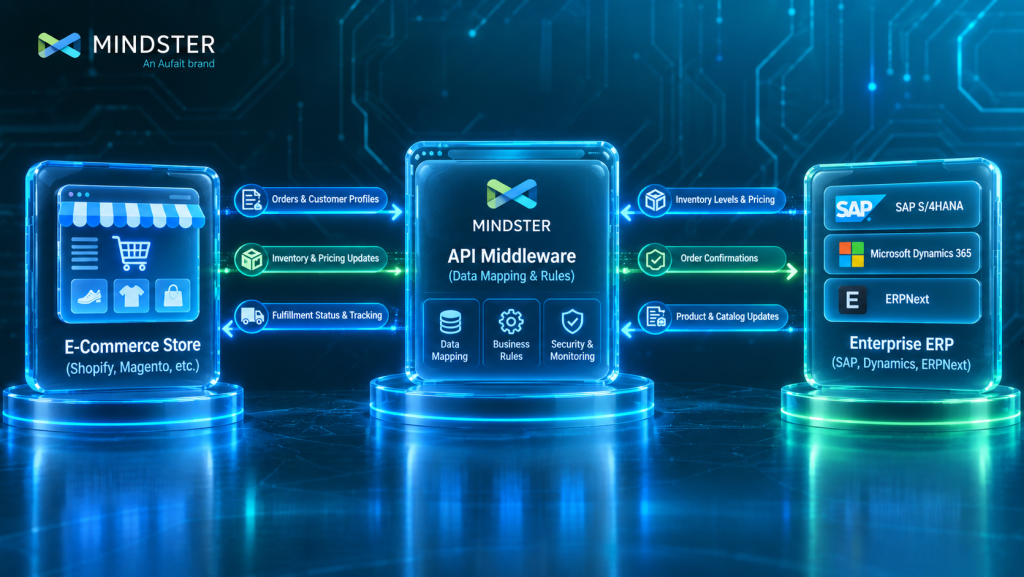
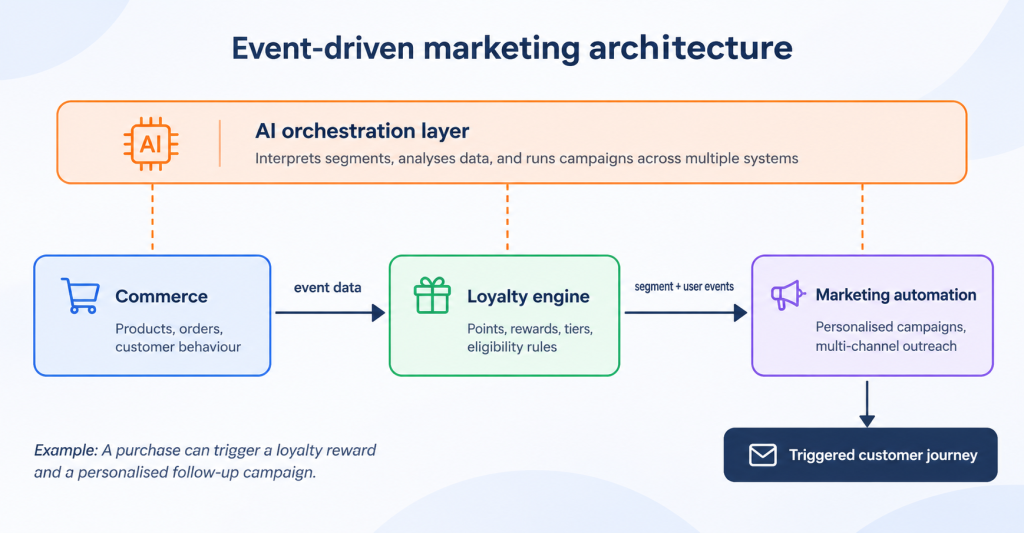
Consider a business built on a modular commerce platform such as Medusa. Four components share the work:
- Commerce platform (Medusa): products, carts, orders, customers and core commerce operations.
- Loyalty engine: points, rewards, tiers, eligibility and loyalty-specific rules.
- Marketing automation (Mautic): segments, campaign journeys, email communication and marketing workflows.
- AI orchestration layer: the software layer that interprets business requests, analyses data, prepares campaign configurations and coordinates actions across the other systems.
The components stay loosely coupled. When a customer completes an order, the commerce platform publishes an order event. The loyalty engine updates points or tier. The relevant customer and loyalty data is then shared with Mautic, which triggers the matching journey.
Because each component can change independently, you can upgrade or swap one system, such as your loyalty programme, without rebuilding everything else. For a business, that means lower switching risk and faster change.
How can AI make open-source marketing tools easier to use?
AI can act as the interface and orchestration layer, which narrows the usability gap that has favoured commercial SaaS. SaaS platforms have led on polished interfaces and built-in workflows. Open-source tools offered flexibility but needed technical expertise. An AI assistant connected through APIs reduces the manual configuration that complex systems require.
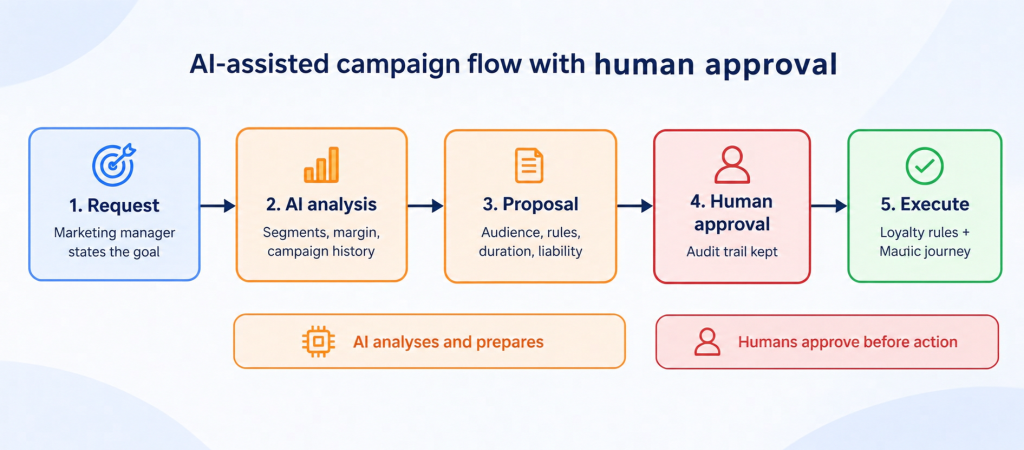
A marketing manager might ask: “I want to increase sales in our premium skincare category. Which customer segment should we target with a loyalty campaign?”
An assistant connected to the commerce platform and loyalty engine could analyse purchase frequency and recency, customer lifetime value, loyalty tier, category history, average order value and past campaign engagement. It might surface recently active Gold-tier customers who buy regularly but rarely buy premium skincare.
The manager then asks for a two-week campaign with bonus loyalty points on eligible products. The assistant prepares a proposal covering target segment, objective, eligible products, bonus points, duration, estimated audience size and potential reward liability. It can check margin and historical campaign data to test whether the incentive makes commercial sense.
Once approved, it configures the loyalty rules, prepares the journey in Mautic and activates the campaign.
The systems keep their roles. Mautic runs the journey. The loyalty engine calculates points and enforces eligibility. The commerce platform manages orders and products. AI handles the interaction between them.
For a marketing manager, the practical change is speed and confidence. A request that would normally pass between an analyst, a developer and a campaign specialist becomes a single conversation, with the commercial impact checked before any money is committed.
Where humans stay in control
AI does not remove engineering. Mautic has no built-in AI orchestration service that understands every business system. It lets organisations choose and integrate their own AI, and that integration has to be designed.
A production setup needs:
- Data and API access scoped to what the AI layer needs
- Clear system responsibilities so the AI knows which system owns which decision
- Permissions and approval gates: the AI can analyse segments and prepare a campaign, while activating a campaign or changing a loyalty rule requires human approval
- Audit trails for every action taken
- Consent and privacy controls that respect customer communication preferences
The gain is less custom interface-building and less manual configuration. Capabilities are exposed through APIs, and AI provides a natural way to use them.
How to choose between Klaviyo and Mautic
The choice is not SaaS versus open source. It depends on the whole architecture. Ask:
- How complex are our customer journeys and business rules?
- How much does marketing need to know about orders, loyalty points and CRM data as they happen?
- How much control do we need over customer data and where it is stored?
- What will this cost over three years, including licences, hosting and engineering time?
- Do we have, or can we hire, a team to run an open-source platform?
- Do we want to plug in our own AI tools, or use what the platform provides?
Klaviyo suits a business that wants to launch quickly, runs a fairly standard online store and prefers not to manage servers. Mautic suits a business with its own commerce backend, a separate loyalty engine or strict data requirements, and a technical team able to run the platform.
How Mindster builds connected, event-driven systems
Mindster designs software where one business event triggers the right action across systems. Our work on C3Pay/Edenred UAE, a WPS-compliant payroll platform, and ONEIC, an Oman MPCSS-integrated digital wallet, involved connecting transaction events to downstream processing within regulated environments. The same principle applies in commerce: define clear system ownership, expose APIs, and add automation and AI only where approval and audit controls exist.
Our teams build mobile and web applications, loyalty platforms, fintech solutions, AI/ML capabilities and cloud-native architectures that connect to marketing automation tools such as Klaviyo and Mautic.
Conclusion
Marketing automation is moving past scheduled emails and fixed segments. Events provide the signals, business data provides the context, marketing automation runs the journeys, and AI helps interpret signals and coordinate the systems involved.
For e-commerce businesses, the question is no longer only which platform to use. It is how commerce, customer, loyalty and marketing systems should work together to respond to every meaningful customer interaction. Klaviyo answers that for teams that want speed and a managed experience. Mautic answers it for teams that need control and have the capability to build on it.
Ready to build marketing that responds to every customer action?
Talk to Mindster about connecting your commerce, loyalty and marketing systems into one event-driven setup.
Talk to the Mindster team
Akhila drives the content strategy at Mindster, combining analytical clarity with a passion for digital product innovation. With a deep focus on mobile app strategy and software solutions, she bridges the gap between engineering complexity and intuitive user experiences. She thoughtfully articulates tech concepts, transforming frameworks, case studies, and digital transformation trends into actionable insights for product teams and business leaders.