
Retailers today are trapped in a paradox: they are managing 2026-level consumer demands of real-time omnichannel shopping, flash sales, and instant delivery, using technology built for a different era. When core systems like POS and inventory weren’t designed to scale, growth doesn’t just slow down; it creates a fragile infrastructure that threatens your bottom line.
This guide explores how to break free from legacy constraints by adopting a phased microservices migration, helping you transform your architecture from a rigid monolith into a flexible, high-performance engine for growth.
The Problem No One Likes to Admit
Most retailers are running software that was never designed for what retail looks like today. Their core systems — inventory, POS, pricing, order management — were built in an era of predictable store hours and seasonal spikes. Now those same systems are expected to handle real-time omnichannel demand, flash sales, marketplace integrations, and same-day delivery orchestration. They’re failing quietly.
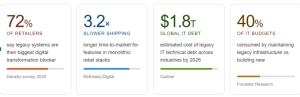
These numbers aren’t abstractions. They translate directly to slower promotions, inventory mismatches, checkout failures during peak traffic, and development teams spending most of their time on maintenance instead of growth.
“The question in 2026 is no longer whether to modernize — it’s whether you can afford to do it slowly enough to avoid disruption.”
Where Legacy Systems Break Down in Retail
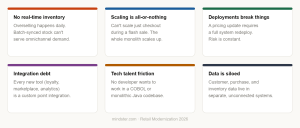
No real-time inventoryOverselling happens daily.Batch-synced stock can’tserve omnichannel demand.Scaling is all-or-nothingCan’t scale just checkoutduring a flash sale. The whole monolith scales up.Deployments break thingsA pricing update requires a full system redeploy.Risk is constant.Integration debtEvery new tool (loyalty,marketplace, analytics)is a custom point integration.Tech talent frictionNo developer wants to work in a COBOL or monolithic Java codebase.Data is siloedCustomer, purchase, andinventory data live inseparate, unconnected systems.
What Microservices Actually Mean for Retail
Microservices is an architectural approach where a single large application is broken into small, independently deployable services — each responsible for one specific business function. In a retail context, that means a dedicated service for product catalog, another for inventory, another for pricing, another for checkout, and so on.
These services communicate via APIs. Each can be written in a different language, scaled independently, and deployed without touching any other service. The contrast with a monolith is stark.
Monolith vs. Microservices Architecture
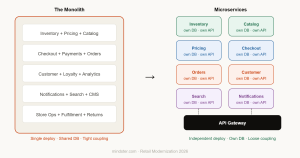
Notice the key difference: in the microservices model, each service owns its data. There’s no shared database that becomes a bottleneck. Each team can deploy their service on their own schedule without coordinating a “release window” with the whole organization.
The Core Retail Services to Break Out First
Not all services are equal candidates for early extraction. These are the ones that deliver the most value quickly — either because they’re the most frequently changed, the most load-sensitive, or the most likely to need external integrations.
- Product Catalog
Manages SKUs, attributes, images, and descriptions. High read volume, frequent marketing changes, needs CDN caching.
- Inventory Management
Real-time stock levels across warehouses, stores, and channels. Must be accurate — overselling kills trust.
- Pricing Engine
Promotions, rules-based pricing, customer-tier discounts. Changes constantly; can’t touch checkout on every update.
- Cart & Checkout
The most traffic-sensitive service. Needs horizontal scaling independently during peak hours and sales events.
- Order Management
Order state machine — placed, confirmed, picked, shipped, delivered, returned. Integrates with WMS and logistics.
- Customer Profile
Identity, preferences, address book, purchase history. The data source for personalization and loyalty programs.
- Search & Discovery
Elasticsearch or Solr-backed service. Decoupled from catalog so indexing doesn’t block browsing.
- Notifications
Email, SMS, push. Event-driven — subscribes to order and inventory events. No business logic, just delivery.
A Phased Migration Strategy That Actually Works
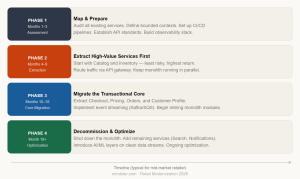
The biggest mistake in legacy modernization is trying to rebuild everything at once. The strangler fig pattern gradually replacing parts of the monolith, while keeping it running is the safest approach for retail, where downtime is measured in lost revenue per second.
4-Phase Retail Modernization Roadmap
Why the strangler fig approach works in retail
You’re not replacing the system — you’re routing traffic away from it, one service at a time. A new route for product catalog goes through the new microservice while everything else stays in the monolith. Once stable, you expand. The old system “dies” as new services take over its responsibilities. No big bang. No single high-risk cutover weekend.
Before and After: What Changes
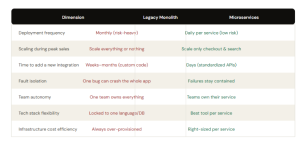
Operational Reality: Legacy vs. Microservices
Design Principles That Keep You From Building a Distributed Monolith
Microservices done wrong just move the problem — instead of a tightly coupled monolith, you get tightly coupled distributed services that are harder to debug. These principles separate a real microservices migration from one that just looks different on a diagram.
01 Each service owns exactly one domain
Inventory doesn’t know about pricing. Pricing doesn’t know about customers. The moment a service talks to another service’s database directly, you’ve rebuilt the monolith in disguise.
02 Communicate through events, not direct calls
When a customer places an order, publish an “OrderPlaced” event. Inventory, notifications, and loyalty programs subscribe to it independently. No service waits on another to respond.
03 Build for failure from day one
Assume the payment service will time out. Assume the inventory check will fail. Circuit breakers, retries with exponential backoff, and graceful degradation are not optional extras.
04 Centralize observability, not logic
Every service should emit structured logs and traces to a single place. You need to be able to trace a single customer order across 8 services in under 30 seconds.
05 API contracts are non-negotiable commitments
Treat API version breaks like production incidents. Services that change their contracts without notice turn a decoupled architecture back into a coordination problem.
A Reference Tech Stack for 2026
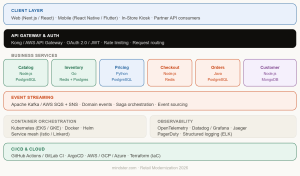
Tools change, but the categories don’t. Here’s a realistic technology map for a retail microservices architecture — organized by function rather than vendor preference.
Retail Microservices Tech Stack Map
What Goes Wrong (and How to Avoid It)
Microservices create new problems in exchange for solving old ones. Most teams hit the same issues. Here’s where projects typically stall and what the mitigation looks like:
Distributed data consistency
When checkout and inventory are separate services, how do you ensure overselling doesn’t happen? Use the saga pattern — a sequence of local transactions with compensating rollbacks on failure. Avoid distributed transactions (2PC) at all costs.
Debugging across services
A customer reports their order is stuck. You have 8 services to check. Without distributed tracing (correlation IDs on every request), this is a nightmare. Set up OpenTelemetry before you extract your first service.
Over-decomposition
Breaking services too small — a “tax rounding” microservice — creates more overhead than it eliminates. A good rule: if two services always change together, they should be one service.
Service-to-service latency
A product page that requires 6 synchronous API calls will be slow. Use caching aggressively, prefer async event-driven communication, and consider API aggregation patterns (BFF) for client-facing calls.
Retail Modernization Is What We Do
Mindster is a software product engineering company that specializes in helping retail and e-commerce businesses move from legacy architectures to scalable, modern platforms. We don’t just consult — we build, migrate, and operate.
When retailers come to Mindster, they’re typically dealing with one of three situations: a monolith that can’t scale for their current traffic, a patchwork of point integrations that break every time something changes, or a failed modernization attempt they need rescued. We’ve worked across all three.
Our approach is phased and outcome-driven — we start with an architecture audit, identify the highest-leverage services to extract first, and build out the migration with your team. The goal isn’t to produce a new set of services for their own sake. It’s to give your engineering team the ability to ship faster and your business the infrastructure to grow without friction.

Akhila drives the content strategy at Mindster, combining analytical clarity with a passion for digital product innovation. With a deep focus on mobile app strategy and software solutions, she bridges the gap between engineering complexity and intuitive user experiences. She thoughtfully articulates tech concepts, transforming frameworks, case studies, and digital transformation trends into actionable insights for product teams and business leaders.