
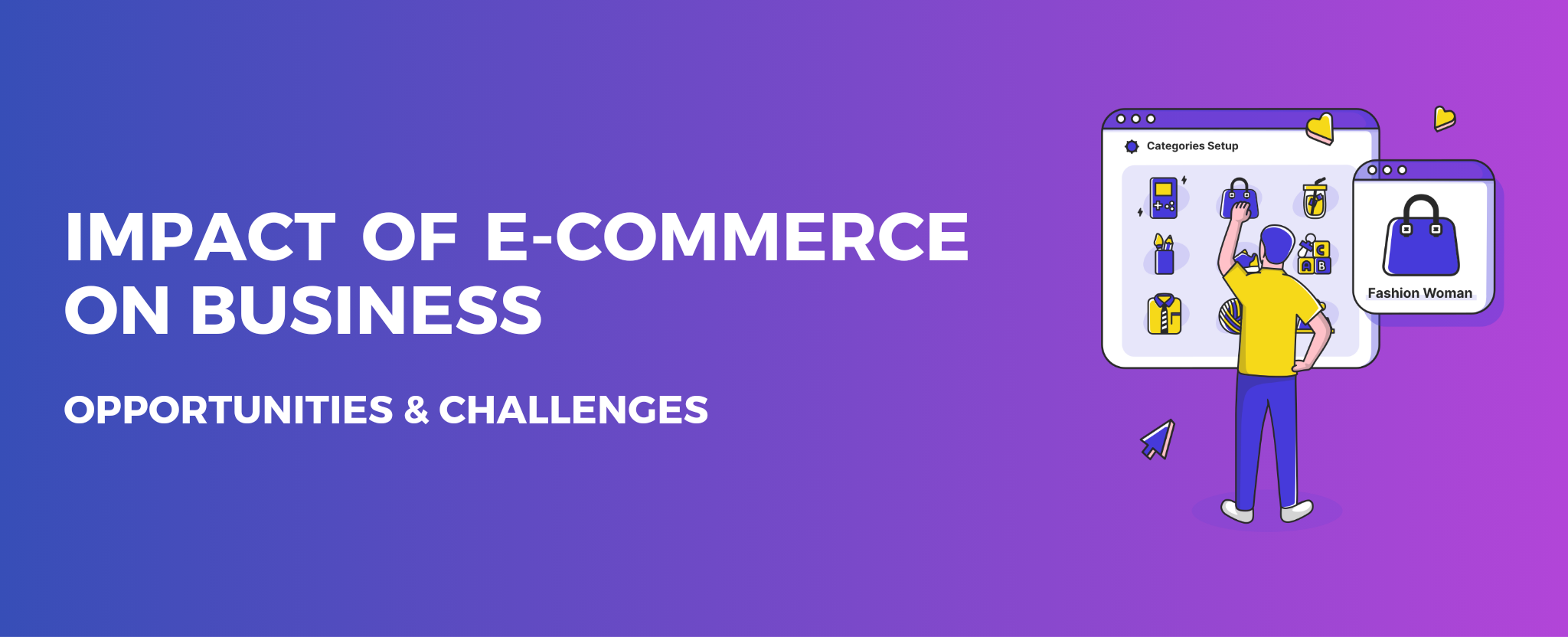
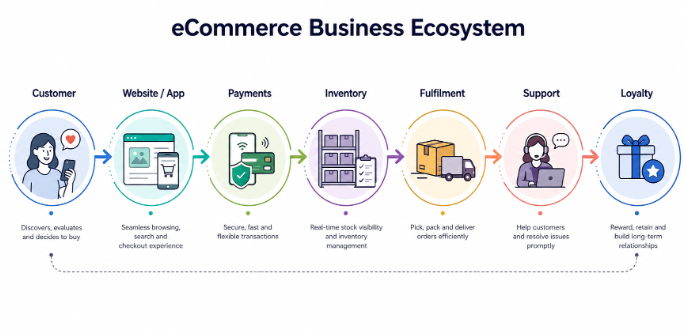
The impact of eCommerce on business goes far beyond enabling customers to buy products online. Today, eCommerce influences how businesses reach new markets, collect customer insights, manage inventory, process payments, deliver orders, and build long-term customer relationships.
For startups, retailers, manufacturers, distributors, and service-led businesses, eCommerce can create scalable opportunities without requiring a large physical-store footprint. At the same time, it introduces new operational responsibilities—from cybersecurity and customer-data protection to fulfilment, returns, digital marketing, and customer support.
A successful eCommerce business strategy is therefore not just about launching an online store. It is about creating a connected digital commerce experience that supports business growth, customer trust, and efficient operations.
eCommerce Growth by the Numbers
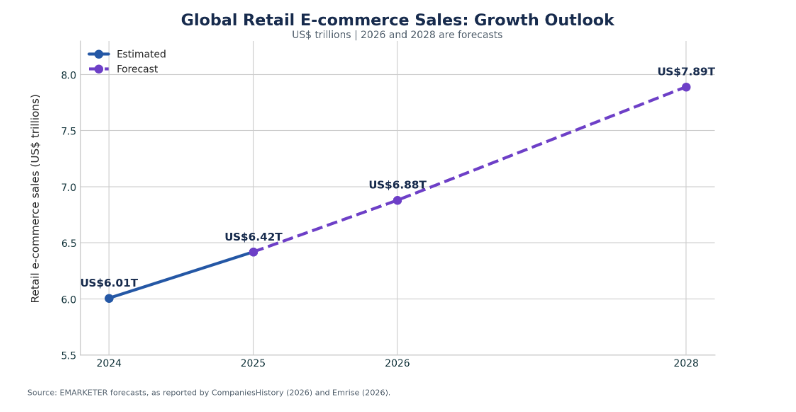
- Global retail eCommerce sales were estimated at US$6.42 trillion in 2025, accounting for approximately 20.5% of worldwide retail sales.ecommercestatistics+1
- Global retail eCommerce sales are forecast to reach US$6.88 trillion in 2026, representing an estimated 7.2% year-on-year increase.ecommercestatistics+1
- By 2028, global retail eCommerce sales are projected to rise to US$7.89 trillion.cartflows+1
- When B2B transactions are included, eCommerce operates at an even larger scale: business eCommerce sales across 45 developed and developing economies reached US$28 trillion in 2024, according to UNCTAD.
- India remains a fast-growing market example. Its retail eCommerce sales reached US$79.4 billion in 2024 and are forecast to reach US$157.7 billion by 2029.
What Is the Impact of eCommerce on Business?
eCommerce, or electronic commerce, refers to the buying and selling of products or services through digital channels. These channels can include brand websites, mobile applications, online marketplaces, social commerce platforms, and B2B purchasing portals.
The e-commerce impact on businesses is significant because it changes the traditional relationship between a company and its customers. Instead of relying only on a physical location, sales representatives, or distributors, a business can create digital touchpoints that are accessible at any time.
The impact of ecommerce on business can be seen across several areas:
- Businesses can reach customers outside their immediate geographic location
- Customers can compare products, prices, reviews, and delivery options more easily
- Brands can use customer data to improve marketing, product decisions, and service
- Companies can automate parts of order processing, customer support, and inventory planning
- B2B buyers can place repeat orders through self-service portals instead of relying entirely on manual sales processes
- Businesses can test products, offers, and campaigns more quickly than in traditional retail environments
However, eCommerce also raises customer expectations. Buyers expect fast websites, easy product discovery, secure payments, transparent delivery updates, flexible returns, and responsive support. Businesses that do not meet these expectations may struggle to convert visitors or retain customers.
Benefits and Opportunities
Benefits of eCommerce for Businesses
One of the key benefits of eCommerce for businesses is the ability to sell beyond the limitations of a physical location. A digital store can serve customers across cities, states, or countries, provided the business has the right payment, logistics, tax, and fulfillment processes in place.
Unlike a traditional store, an online business can remain accessible around the clock. This does not mean a business can operate without people or processes, but it does mean customers can discover products, compare options, place orders, and access support information at their convenience.
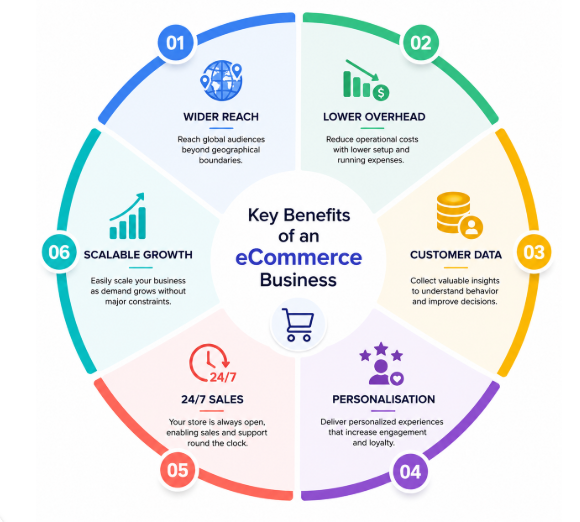
Other advantages of online business include:
- Lower dependence on physical retail space and in-store infrastructure
- Better visibility into customer preferences and purchase patterns
- More flexible marketing through search, social media, email, marketplaces, and content
- Easier testing of product bundles, promotions, pricing, and landing pages
- Greater ability to automate routine commerce workflows
- More opportunities to build direct customer relationships
The opportunities of e-commerce are especially valuable for businesses that want to expand their customer base while maintaining better visibility over sales performance and customer behaviour.
Lower Physical Overhead, Flexible Operations
An eCommerce model can reduce some of the costs associated with physical stores, including rent, displays, utilities, and front-office staffing. However, businesses should not assume that online selling is cost-free.
A successful digital operation still requires investment in areas such as:
- Website or mobile-app development
- Product catalogue management
- Payment processing
- Digital marketing
- Customer support
- Inventory management
- Fulfilment and returns
- Cybersecurity and data protection
The real opportunity of e-commerce is flexibility. Businesses can select an operating model that fits their products, margins, and growth plans. For example, they may manage their own inventory, partner with third-party logistics providers, use marketplace fulfillment, adopt dropshipping for selected products, or sell digital products and services.
Customer Data and Better Decisions
eCommerce platforms generate valuable first-party data across browsing behaviour, purchases, search queries, support requests, product returns, and repeat orders. When collected with appropriate consent and managed securely, this information can help businesses make better decisions.
For example, a retailer can identify products with high demand, understand why customers abandon carts, improve product descriptions, personalise campaigns, or plan inventory based on sales trends.
This is one reason why the impact of e-commerce on business is not limited to online sales. It can also improve planning across marketing, merchandising, operations, and customer service.
Personalised Customer Experiences
Personalisation is one of the most important e-commerce opportunities for businesses. Customers are more likely to engage with relevant product recommendations, useful content, timely replenishment reminders, and offers that match their needs.
Personalisation can include:
- Recommended products based on browsing or purchase history
- Relevant emails and retention campaigns
- Location-aware delivery information
- Account-specific pricing for B2B customers
- Product suggestions based on preferences or past orders
- Loyalty offers for repeat customers
Personalisation should always be balanced with customer privacy. Businesses need to be transparent about how they use data and ensure that marketing communication remains useful rather than intrusive.
eCommerce Business Benefits for Startups
For startups, eCommerce can provide a faster route to market than opening a physical retail location. A startup can validate demand, test products, build an audience, and learn from customer behaviour without making a large initial investment in retail infrastructure.
The eCommerce business benefits for startups include:
- Launching to a targeted customer segment or niche
- Testing product-market fit through digital campaigns
- Using marketplaces to access early demand
- Building a direct-to-consumer channel over time
- Gathering customer feedback quickly
- Using cloud-based tools to scale operations as demand grows
- Creating subscription, repeat-order, or loyalty models
Startups should choose their technology carefully. A basic platform may be enough in the early stage, while a custom eCommerce application or marketplace may become necessary when the business requires advanced workflows, unique customer journeys, multi-vendor capabilities, loyalty integration, or complex operational systems.
Launch an eCommerce Experience Built to Scale
Create a high-performing online store with secure integrations, seamless journeys, and technology for scalable growth.
Build Your Online StoreeCommerce Opportunities for Industries
The e-commerce opportunities for industries vary depending on the customer journey, sales model, product complexity, and fulfilment requirements.
|
Industry |
eCommerce opportunity |
|
Direct selling, subscriptions, loyalty programmes, social commerce and personalised offers |
|
|
B2B distribution |
Self-service ordering, account-specific pricing, bulk purchasing and repeat orders |
|
Manufacturing |
Dealer portals, spare-parts sales, procurement workflows and product catalogues |
|
Product discovery, recommendations, loyalty, subscriptions and returns optimisation |
|
|
Delivery scheduling, recurring orders, local fulfilment and customer retention |
|
|
Product education, secure purchasing journeys, subscriptions and customer support |
These e-commerce opportunities for industries show that digital commerce is not restricted to consumer retail. It can support procurement, distribution, services, spare parts, memberships, subscriptions, and complex B2B buying journeys.
Risks, Challenges and Technology
eCommerce Business Risks and Challenges
The benefits of eCommerce are substantial, but businesses must also prepare for the operational and financial risks. The most successful digital commerce businesses treat security, fulfilment, customer service, and data management as core parts of their business model.
Key eCommerce business risks
Cybersecurity and Customer Data Protection
Online businesses process sensitive information, including names, addresses, email IDs, payment details, purchase history, and sometimes identity-related data. A security incident can lead to financial losses, customer distrust, reputational damage, and compliance issues.
Businesses should prioritise secure payment gateways, role-based access, regular updates, secure hosting, data encryption, fraud monitoring, and staff awareness. If you are building a custom platform, security requirements should be addressed from the beginning—not added later.
Customer Acquisition Costs and Margin Pressure
An online store can reach more people, but reaching the right people profitably is challenging. Paid advertising, marketplace commissions, discounts, shipping costs, payment fees, and returns can reduce margins quickly.
A strong eCommerce business strategy should track:
- Customer acquisition cost
- Conversion rate
- Average order value
- Repeat-purchase rate
- Customer lifetime value
- Return rate
- Cost of fulfilment
- Contribution margin by product or channel
This helps businesses understand whether revenue growth is also creating sustainable profitability.
Inventory, Fulfilment and Returns
Customers expect accurate stock information, reliable delivery, simple return processes, and timely updates. Poor inventory visibility can lead to overselling, delayed orders, cancellations, and dissatisfied customers.
Returns are another major challenge. A clear return and refund policy should explain eligibility, timelines, product conditions, refund options, and return-shipping responsibilities. The goal is to make the process fair and easy without creating avoidable operational losses.
Changing Customer Expectations
Customer behaviour changes quickly. Buyers may move between marketplaces, social platforms, search engines, mobile apps, and direct brand websites before making a purchase. This makes a connected experience increasingly important.
Businesses need to decide which channels genuinely serve their customers instead of trying to be present everywhere. Multichannel selling can create growth opportunities, but it also requires consistent product information, inventory data, pricing, support, and fulfilment across channels.
Mobile-First Commerce
Mobile shoppers expect pages to load quickly, product information to be easy to scan, and checkout to work without friction. A mobile-first eCommerce experience should include responsive design, simple navigation, fast search, secure payment options, clear delivery information, and accessible support.
For some businesses, a mobile app can improve repeat ordering, loyalty, push notifications, and personalised experiences. However, an app should solve a genuine customer or operational need rather than being built only because competitors have one.
eCommerce Technology Trends
The most useful eCommerce technology trends are not isolated features. They are systems that help businesses create better customer experiences while reducing operational friction.
Important trends include:
- API-first and composable commerce architecture
- Unified inventory and order management
- Headless commerce for more flexible customer experiences
- Digital wallets and low-friction checkout
- Customer-data platforms and lifecycle marketing automation
- Marketplace and social-commerce integration
- Fraud-prevention and payment-risk systems
- Better product-information management
- AI-enabled search, service, forecasting, and merchandising
The right technology stack depends on the business model. A B2B distributor may prioritise account-based pricing and ERP integration, while a D2C brand may focus more on subscriptions, loyalty, product discovery, and retention marketing.
Turn Digital Commerce Into Growth
Transform customer journeys with integrated payments, intelligent automation, and technology built for your business ambitions.
Start Your eCommerce ProjectAI in eCommerce
AI in eCommerce is becoming increasingly important because it can help businesses improve discovery, customer service, forecasting, operations, and retention. Its value comes from solving practical problems—not from adding automation for its own sake.
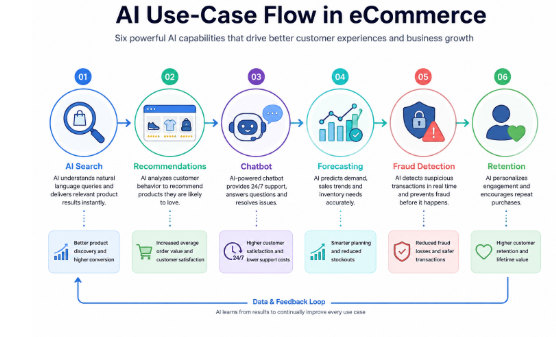
Common AI applications include:
|
AI use case |
Potential business value |
|
Product recommendations |
Helps customers discover relevant items |
|
AI-powered search |
Improves product discovery through natural-language queries |
|
Customer support assistants |
Handles routine questions and directs complex issues to people |
|
Demand forecasting |
Supports inventory and replenishment planning |
|
Fraud detection |
Identifies unusual payment or account activity |
|
Product-content support |
Assists with product descriptions, tags and catalogue enrichment |
|
Customer segmentation |
Improves campaign relevance and retention efforts |
|
Returns analysis |
Identifies recurring product, sizing or delivery issues |
Businesses should apply human oversight to AI-generated content, customer interactions, pricing guidance, and high-impact decisions. AI systems need accurate product data, reliable inventory information, clear brand rules, and secure customer-data practices to perform effectively. AI can improve eCommerce operations, but it also introduces governance, privacy, transparency, and customer-trust responsibilities.
Building an eCommerce Business Strategy
A practical eCommerce business strategy should connect technology decisions with customer needs and operational reality.
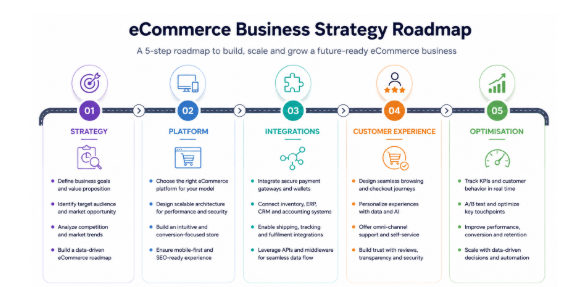
- Define the target customer and value proposition: Clarify who you are selling to, what problem you solve, and why they should buy from you instead of a competitor or marketplace.
- Choose the right commerce model: Your business may need a D2C store, B2B portal, marketplace, multi-vendor platform, subscription model, or a combination of channels.
- Choose the Right Technology and Development Partner: Your eCommerce platform should support your current needs and future growth. Consider factors such as product range, expected order volume, payment options, inventory, fulfilment, mobile experience, and third-party integrations. The right development partner can help you build a secure, scalable online store that integrates smoothly with your business systems and delivers a reliable customer experience.
- Build the operational foundation: Plan payments, taxes, inventory, fulfilment, delivery, support, returns, and fraud prevention before scaling marketing efforts.
- Design for trust and conversion: Use clear product information, transparent pricing, secure checkout, visible reviews, accurate delivery expectations, and accessible customer support.
- Invest in retention: Loyalty programmes, subscriptions, post-purchase communication, relevant offers, and efficient support can increase repeat purchases and customer lifetime value.
- Use data responsibly: Track performance, improve customer experiences, and protect customer information through clear governance and secure systems.
Final Thoughts
The impact of eCommerce on business is significant because it can transform how companies acquire customers, sell products, manage operations, and build long-term relationships. The opportunities in ecommerce are substantial for startups, established retailers, B2B companies, manufacturers, and service providers.
However, sustainable success requires more than an online storefront. Businesses need the right eCommerce technology, secure payment systems, reliable fulfilment, strong customer support, clear data practices, and a strategy for customer retention.
If you are planning to launch or scale an eCommerce platform, marketplace, B2B portal, or mobile commerce application, can help you build a secure, scalable solution aligned with your business goals.
Build Your Scalable eCommerce Platform
Build a secure, scalable eCommerce platform that delivers seamless shopping experiences and supports sustainable growth.
Talk to Our eCommerce Experts
Ahamed Sajid is a technology delivery leader focused on building scalable systems that bridge business strategy and execution. With experience across fintech, mobility, e-commerce and enterprise platforms, he specializes in designing structured approaches to complex problem-solving and product delivery. He is particularly interested in how well-defined systems, processes, and technology frameworks can drive sustainable growth and operational clarity. Through his work, Ahamed advocates for pragmatic innovation where ideas are shaped into reliable, high-impact solutions that deliver real-world value.