
Every time a customer taps a prepaid card at a retail terminal, swipes a corporate expense card, or completes an online purchase with a virtual card, a sophisticated chain of distributed systems comes to life within milliseconds.
That apparent simplicity masks a carefully orchestrated sequence of API calls, ledger updates, fraud validations, network routing decisions, and settlement workflows involving issuers, acquirers, payment networks, and backend financial systems.
As embedded finance reshapes industries, non-fintech businesses — retailers, logistics providers, healthcare organizations, travel companies, enterprise platforms — are integrating open-loop card capabilities directly into their products. Rather than becoming banks themselves, they rely on a card issuance platform that handles regulatory complexity while exposing programmable APIs for card lifecycle management and transaction processing.
This article follows a transaction from tap to authorization, ledger recording, clearing, and settlement — and along the way, walks through what it actually takes to plug into one of these platforms.
What Is an Open-Loop Card?
Open-loop cards run on globally accepted payment networks — Visa, Mastercard, RuPay, and regional schemes. Unlike closed-loop cards, which only work within a single merchant’s ecosystem, open-loop cards work anywhere the underlying network is accepted.
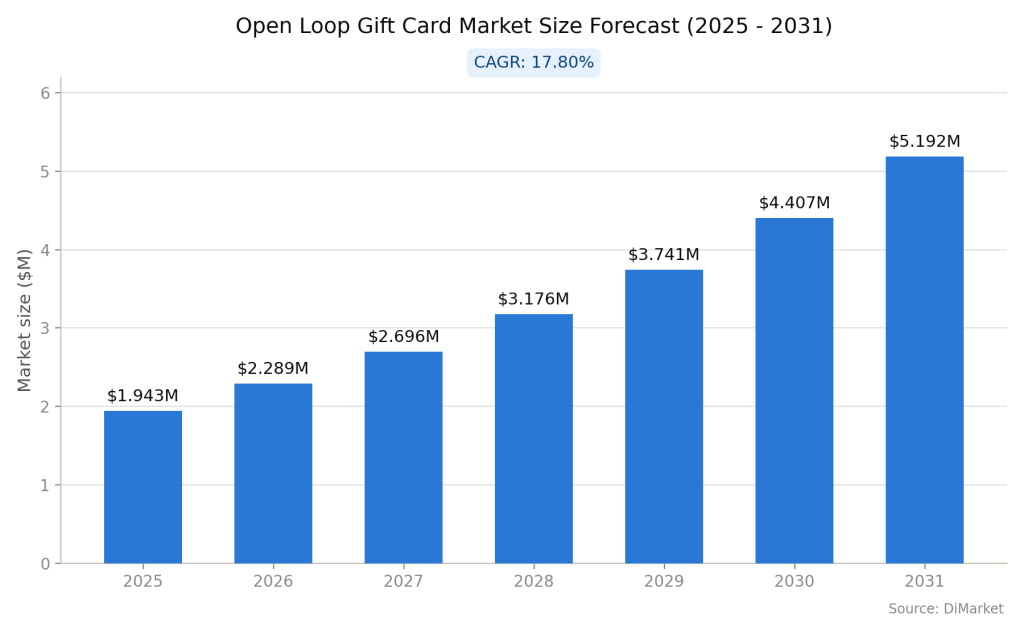
The scale of this shift isn’t theoretical. Market research firm DiMarket projects the open-loop gift card market growing from roughly $1.943M in 2025 to $5.192M by 2031 — a 17.80% CAGR. That kind of sustained growth is exactly why the underlying issuance and ledger architecture matters: platforms built on shortcuts today are the ones that end up re-architected under load a few years in.
Payroll cards, corporate expense cards, travel and forex cards, general-purpose prepaid cards, government benefit cards, and network-backed gift cards all fall into this category. Payroll cards are a good illustration of the stakes involved: C3Pay, a WPS-compliant payroll card program built for Edenred UAE, processes salaries for millions of workers on exactly this open-loop rail. Because each of these touches multiple financial institutions, payment networks, and regulatory regimes at once, the supporting technology stack is considerably more complex than a typical wallet application.
The Role of a Card Issuance Platform
At the center of every modern prepaid or debit program sits the card issuance platform — effectively the operating system for a card’s entire lifecycle, from issuance to closure.
It typically owns customer onboarding and
KYC integration — increasingly built as a hard gateway rather than a form users fill out once — card generation and BIN management, wallet creation and balance management, transaction authorization, spending controls and merchant category restrictions, card blocking and hotlisting, card replacement, and the regulatory reporting and settlement/reconciliation work that keeps a program compliant.
Modern platforms expose all of this through REST APIs, so fintechs and enterprise applications can integrate financial services without building payment infrastructure from scratch. To issue a new card, for instance, a developer calls a /cards endpoint with customer and program identifiers in the request body; the response returns either the card number or a tokenized value, along with activation controls and spending limits. A webhook subscription then delivers real-time notifications whenever a transaction is authorized or declined, so the product layer can update balances and fire alerts without polling.
Getting from sandbox to production
Because this is usually the first thing a product team actually has to do, it’s worth walking through concretely rather than leaving it as a bullet list. Integration typically moves through a fairly consistent sequence:
You start in the issuance platform’s developer portal, where you generate API credentials for a sandbox environment. From there, you map your existing customer onboarding flow to the platform’s KYC requirements — deciding what identity data you collect versus what you hand off to the platform’s own verification.
Webhook endpoints get configured next, since almost everything downstream (balance updates, fraud alerts, transaction notifications) depends on your system receiving events rather than polling for them. You then define card controls and limits at the program level — geographic restrictions, merchant category blocks, velocity limits — before running end-to-end test transactions in sandbox, ideally including deliberate failure cases (declined transactions, expired cards, insufficient balance) rather than only the happy path. Only after sandbox testing holds up do you move to a production rollout, which usually comes with its own compliance review and a support relationship with the issuer for ongoing operational issues.
The teams that get burned here are usually the ones that treat sandbox testing as a formality and skip the failure-case testing — the architecture described in the rest of this article exists precisely because failures (network timeouts, duplicate requests, ledger sync delays) are a normal part of operation, not an edge case.
Core Components of a Modern Card Issuance Platform
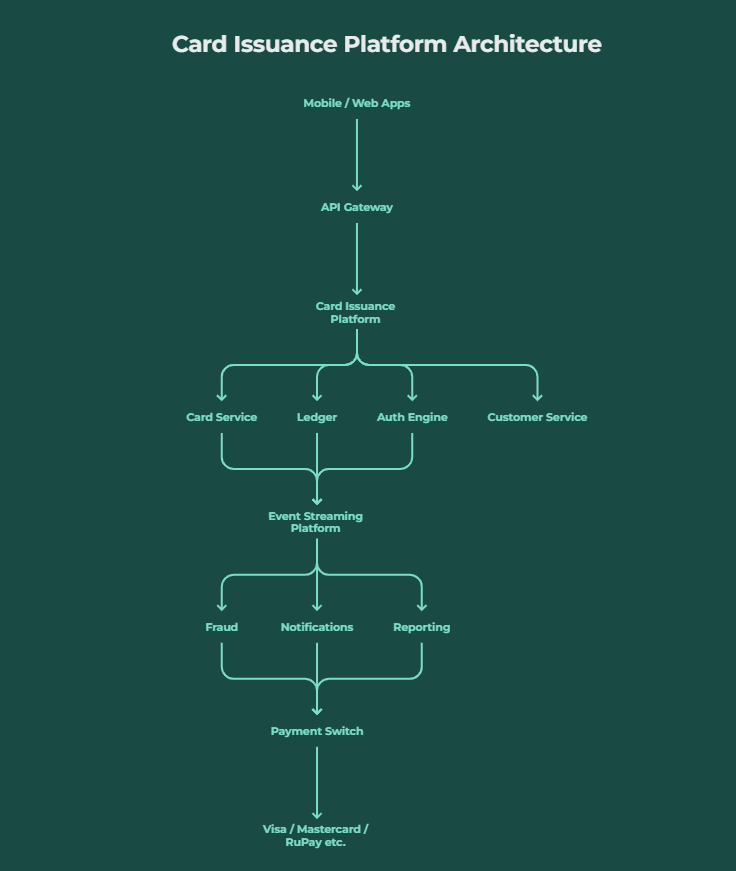
A scalable architecture uses loosely coupled services rather than one monolithic application. This mirrors the
five isolated service tiers that define a compliant payment engine more broadly: an onboarding and KYC service that handles identity verification independently of transaction processing; a card management service that owns card generation, activation, and lifecycle state; an authorization engine that makes real-time approve/decline decisions; a ledger service that is the single source of financial truth; and a notification/event layer that lets all of the above stay in sync without calling each other directly.
Each service owns one business capability and communicates with the others asynchronously through events wherever possible — a design choice that matters a lot once you get to the failure-handling discussion below.
Understanding the Transaction Lifecycle
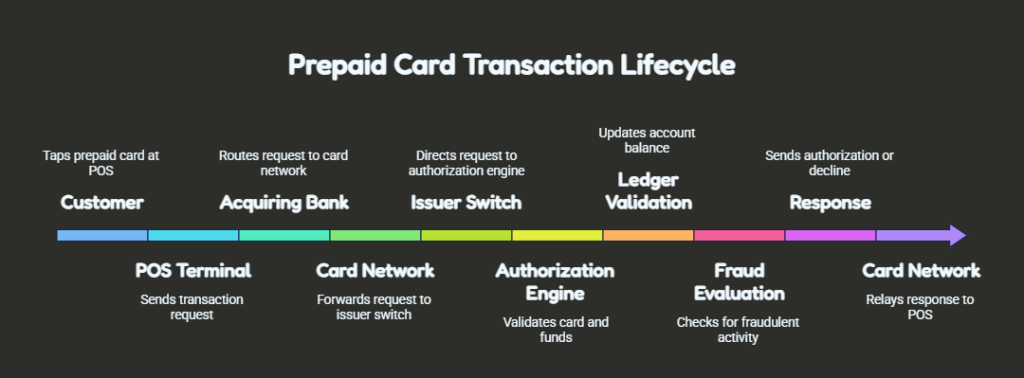
Here’s what happens, step by step, when a customer taps a prepaid card at a retail store. The complete round trip generally takes 200–500 milliseconds, which means every step in this chain has to make a fast decision without sacrificing accuracy.

Step 1: Transaction initiation.
The POS terminal reads the card and assembles a standardized authorization request — PAN or tokenized card number, merchant ID, terminal ID, amount, currency, transaction type, and timestamp. This gets forwarded to the merchant’s acquiring bank.
Step 2: Network routing.
The acquiring bank reads the card’s Bank Identification Number (BIN) to identify the payment network and forwards the request there. The network, in turn, identifies which issuing institution owns the card and routes the request accordingly. Modern issuer platforms often expose this authorization step through API gateways or dedicated switching infrastructure capable of handling thousands of requests per second — this is the layer that feeds directly into the authorization engine.
Step 3: Authorization.
Once the request reaches the issuer, the authorization engine runs through a sequence of checks: Is the card active, blocked, or expired? Does the customer have sufficient balance? Are spending limits exceeded? Is this merchant allowed? Does the transaction fall within geographic restrictions? Does fraud scoring flag elevated risk? Each of these shapes the final approve/decline decision, and they typically run in parallel rather than sequentially to stay within the latency budget.
The Ledger: The Financial Source of Truth
One of the most misunderstood pieces of a card issuance platform is the ledger. It’s not a balance table — it’s the authoritative financial record of every monetary movement in the system, implemented as an append-only, double-entry ledger with no updates or deletes on committed entries. Instead of updating a balance directly, every transaction creates paired accounting entries.
When a transaction is authorized:
- Debit: Customer Available Balance
- Credit: Authorization Hold
When settlement happens later:
- Debit: Authorization Hold
- Credit: Merchant Settlement Account
This double-entry approach is what gives the system complete auditability, regulatory compliance, financial reconciliation, and historical traceability — you can always reconstruct exactly how a balance got to where it is, rather than trusting a single mutable number.
Why ledger synchronization matters
Authorization happens in real time. Settlement often follows hours or even days later. That gap is one of the hardest engineering problems in payment systems: how do multiple independent services maintain a consistent financial view of the same account across that delay?
In practice, teams lean on a combination of techniques. Periodic reconciliation jobs compare and realign balances across services to catch drift before it compounds. Distributed locks enforce atomicity on critical financial records so two processes can’t update the same balance simultaneously. Versioned events, idempotency controls, and compensating transactions handle the cases where something does go wrong — letting the system detect and correct discrepancies rather than assuming they won’t happen.
Underneath all of this, platforms typically track several balances at once rather than a single number: an available balance (what the customer can spend right now), an actual balance (before pending holds), a hold balance (funds reserved but not yet settled), and a settlement balance (funds in transit to the merchant).
A successful transaction moves funds through this sequence — available balance → authorization hold → clearing → settlement — with each state transition published as an event so downstream systems can stay synchronized without being tightly coupled to each other.
API Routing in Modern Payment Platforms
Routing in this context is a lot more involved than standard REST request forwarding. For every incoming request, the routing layer has to decide which authorization engine should process it, which regional regulatory rules apply, which ledger instance owns the account, which fraud engine should evaluate it, which payment switch is responsible, and which external network the request ultimately needs to reach.
Each request gets enriched with this contextual information before it reaches any downstream service, which is what allows routing decisions to stay precise even as a platform scales across regions and card programs.
Real-Time Authorization vs. Settlement
A common misconception among developers new to this space is that payment completion happens the moment a transaction is approved. In reality, authorization and settlement are two distinct financial events. Authorization verifies funds are available, places a hold on them, and returns an approval — but no money has actually moved yet. Settlement is the separate, later event that transfers the money, updates financial accounts, removes the authorization hold, and completes the accounting entries.
Splitting these two phases apart is what lets a merchant capture a transaction later (common in hotel or rental scenarios, for instance) while guaranteeing the customer can’t spend the same held balance twice in the meantime.
Handling Failures Gracefully
Distributed financial systems have to assume partial failures will happen — a payment network timeout, a fraud service that’s temporarily unavailable, a ledger sync delay, a duplicate request from a merchant retry, or an outright network partition are all things a production system will encounter regularly, not hypothetically.
To stay financially consistent through all of that, systems lean on idempotency keys to make retries safe, event replay and dead-letter queues to recover from processing failures without losing transactions, distributed tracing to debug issues across services, and retry policies, circuit breakers, and saga orchestration to contain failures instead of letting them cascade. Together, these patterns are what prevent the worst-case outcome in payments engineering: a duplicate debit that silently drains a customer’s balance twice for one purchase.
Security Considerations
Security in a card issuance platform isn’t a bolted-on feature — it’s foundational to the architecture. A production-grade platform builds in PCI DSS compliance, TLS encryption, tokenization of sensitive card data via HSM-backed key management, multi-factor authentication, role-based access control, and strong API authentication as baseline requirements, layered with active fraud monitoring, velocity checks, and transaction anomaly detection. Increasingly, AI-powered fraud models are running alongside traditional rule engines to catch behavioral anomalies that static rules miss.
Why API-First Architecture Matters
Legacy card management systems typically required heavy customization for every new customer. Modern platforms flip that: card creation, activation, balance inquiry, transaction history, spending controls, wallet top-up, and card blocking are all exposed as standardized APIs from day one.
That standardization is what lets an organization build a custom mobile app, a partner-facing portal, or an embedded finance experience on top of the issuance engine without ever having to modify it — and it’s also what makes it realistic to integrate with digital onboarding platforms, core banking systems, payment gateways, loyalty engines, notification services, and analytics tools without a bespoke integration project for each one.
Where the Architecture Is Headed
The next generation of issuance platforms is moving past pure transaction processing toward something closer to intelligent financial infrastructure — AI-assisted fraud detection and real-time risk scoring that adapt continuously rather than relying on static rules, programmable spending policies and dynamic card controls that product teams can adjust without engineering involvement, and embedded compliance engines that keep regulatory logic separate from core business logic.
That last point is the one most likely to matter for teams operating across multiple markets: rather than maintaining separate platforms per country, architectures are increasingly isolating country-specific regulation into configurable compliance modules. New regional requirements can then be introduced as configuration changes rather than as changes to the platform core — a meaningful difference for any organization planning to scale a card program beyond a single country.
Final Thoughts
Open-loop payment ecosystems are among the more demanding distributed systems built in production software today, largely because they have almost no tolerance for the usual trade-offs: they need to be fast (sub-second authorization), correct (immutable, auditable ledgers), and resilient (graceful handling of the failures that will happen at scale), all at once.
For an organization embedding financial services into its product, the choice of issuance platform is really a choice about which of these trade-offs you’re willing to own yourself versus hand off. Getting that right — and getting through sandbox testing with the failure cases, not just the happy path — is what determines whether a card program is boring and reliable in production, or a source of 2 a.m. pages.
Mindster has built production card issuance and payment infrastructure across several of these scenarios, including the WPS-compliant payroll program referenced above. If you’re evaluating an issuance platform or reviewing an existing architecture for gaps,
get in touch to talk through what you’re building.
Frequently Asked Questions and Answers
1. What is open-loop card architecture, and how does it differ from closed-loop systems?
Open-loop card architecture refers to payment cards (like Visa or Mastercard) that can be used anywhere those networks are accepted. Closed-loop cards (such as store gift cards) are limited to specific merchants or ecosystems.
2.What are the key compliance requirements when issuing open-loop cards?
Key compliance requirements include KYC (Know Your Customer), AML (Anti-Money Laundering), PCI DSS for data security, and adherence to card network and local regulatory standards.
3.How do I choose the right card issuance platform for my fintech business?
Consider factors such as integration capabilities (APIs), compliance support, scalability, cost structure, available card features, and customer support.
4. What is the typical onboarding process for launching a card program?
This typically involves regulatory approval, integrating with a card issuance platform, designing card products, setting up KYC/AML processes, and launching pilot tests before full rollout.
5. How ledgers managed and synchronized in real-time for card transactions?
Modern platforms use event-driven architectures and APIs to update ledgers in real time, ensuring all transactions are accurately recorded and reconciled.
6.What is the role of KYC (Know Your Customer) and AML (Anti-Money Laundering) in card issuance?
KYC verifies the identity of customers to prevent fraud, while AML processes monitor and report suspicious transactions to prevent money laundering.
7.How do I ensure the security of customer card data?
Follow PCI DSS standards, use encryption and tokenization, and partner with reputable processors who comply with industry security certifications.
8.What is API routing, and why is it important for seamless card processing?
API routing enables secure, efficient communication between your platform and card networks/processors, ensuring real-time processing and integration.
9. How do transaction authorization and settlement work in open-loop card systems?
Authorization checks cardholder funds and approves/declines transactions instantly; settlement is the clearing of funds between banks, typically within 1-2 business days.
10.What are common pitfalls to avoid when integrating with card networks (Visa, Mastercard, etc.)?
Pitfalls include underestimating compliance needs, poor documentation, lack of test environments, and not planning for scaling or internationalization.
11.How can I monitor and prevent fraud in my card program?
Implement real-time fraud monitoring tools, set transaction limits, use machine learning for anomaly detection, and enforce robust KYC/AML procedures.
12.What are the costs and fee structures involved in operating an open-loop card program?
Costs may include card production, network fees, processor fees, compliance costs, and customer support. Fee structures can vary based on transaction volume and product features.
13.How do I handle disputes and chargebacks as a card issuer?
Establish clear dispute resolution processes, maintain thorough transaction records, and respond promptly to card network chargeback requests.
14.What reporting and reconciliation tools are essential for card program management?
Look for tools that provide real-time transaction data, automated reconciliation, exception reporting, and customizable analytics dashboards.
15.How do I scale my card program internationally, and what additional considerations are there?
Consider cross-border compliance, multi-currency support, local KYC/AML regulations, card network acceptance, and support for local languages.
Ahamed Sajid is a technology delivery leader focused on building scalable systems that bridge business strategy and execution. With experience across fintech, mobility, e-commerce and enterprise platforms, he specializes in designing structured approaches to complex problem-solving and product delivery. He is particularly interested in how well-defined systems, processes, and technology frameworks can drive sustainable growth and operational clarity. Through his work, Ahamed advocates for pragmatic innovation where ideas are shaped into reliable, high-impact solutions that deliver real-world value. Connect with Ahamed Sajid via: /