

Google Play’s July 2026 update enforces strict new requirements around third-party AI data governance, Earned Wage Access (EWA) framing, unrated apps, and store transparency. With a firm deadline of August 15, 2026, and no general grace periods, non-compliant apps face immediate removal or store rejection. To safeguard market access, enterprise value, and customer acquisition funnels, executive leadership must audit vendor dependencies and align product, legal, and engineering teams immediately to ensure continuous platform readiness.
For a fintech company, a Google Play app store suspension is the operational equivalent of having your front door padlocked by regulators overnight.
In a single instant, your primary customer acquisition channel freezes. Your live transaction volume drops to zero. Your CAC spikes as paid marketing campaigns drive prospective users to a broken download link. Worse, the board and investors start asking hard questions about operational oversight and platform risk.
Google’s July 2026 policy update isn’t a routine set of developer guidelines—it is a fundamental shift in platform accountability. By tightening enforcement on third-party AI data streams, Earned Wage Access (EWA) positioning, personal loan terms, and metadata disclosures, Google has drawn a firm line in the sand: outsourcing your software capabilities to third parties no longer outsources your legal or platform liability.
With a minimum 30-day compliance window ending on August 15, 2026, treat this moment as an executive mandate. Proactively aligning your product architecture, legal disclosures, and store metadata is not just an engineering task—it is an aggressive defense of your company’s valuation, market access, and customer trust.
Here is the strategic breakdown of what C-suite leaders must review—and execute—before the compliance clock runs out.
Key Compliance Dates & Timeline
Google’s policy update introduces tight compliance windows. Teams must track two core milestones: the 30-day general policy window and the end-of-month technical API targets.
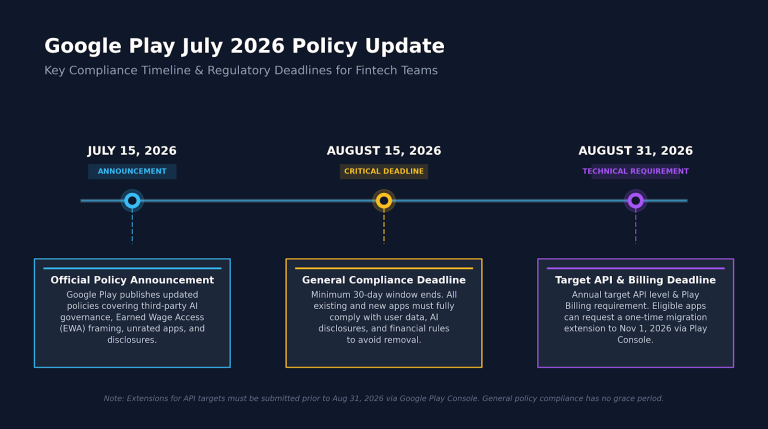
⌛Official Policy Announcement-July 15, 2026
Google Play publishes policy changes, updating requirements across third-party AI data governance, Earned Wage Access (EWA) framing, unrated app restrictions, and location disclosures.
⌛General Compliance Deadline -August 15, 2026
Minimum 30-day window ends. All existing and new apps must comply with user data, third-party AI disclosure, and financial services updates to avoid rejection or removal from Google Play.
⌛Target API & Billing Requirements-August 31, 2026
Annual deadline for apps to target the latest Android API levels and updated Play Billing Libraries. (Eligible developers can request a one-time migration extension until November 1, 2026 via Play Console).
Google’s July 15, 2026 policy announcement gives developers a minimum 30-day window, until August 15, 2026, to bring their apps into full compliance with the updated policies. All existing and new apps must meet these requirements by the deadline to avoid potential removal or rejection.
At this time, Google has not specified any phased compliance or extended grace periods for general policy adherence, so teams should plan to complete necessary updates within this initial window.
The update places particular emphasis on third-party AI integrations, financial services, personal loans, EWA apps, and unrated apps.
Google’s financial services policy also reinforces that apps must not expose users to deceptive or harmful financial products and services.
For fintech teams, that means store approvals now depend not only on product functionality, but also on how clearly the app is represented and how responsibly it handles user trust.
Why fintech apps are under greater scrutiny
Fintech apps operate in a high-trust, high-regulation environment. That makes them especially sensitive to platform policy changes because even small inconsistencies can affect approval timelines, user confidence, and market access.
This is particularly relevant for products that rely on AI-driven guidance, lending workflows, wage access models, or third-party integrations. When those features touch sensitive financial decisions, the compliance burden extends beyond the feature itself and into the entire product ecosystem
 Let's Build Together
Is Your Fintech App Exposed to Google Play's Compliance Deadline?
Audit your third-party AI data flows, SDKs, and financial disclosures before August 15.
Request a Compliance AuditExecutive Risk Matrix: Balancing Compliance & Velocity
For fintech teams, the broader lesson is clear: strong product execution now includes platform readiness as a core discipline.
The legal implications behind the policy shift
Google’s policy materials make it clear that developers remain responsible for compliance even when third-party AI or other external services are involved.That is a significant point for fintech teams, because it removes the assumption that outsourced capability means outsourced accountability.
In practice, this means legal review can no longer be limited to launch-stage approvals.
As the product evolves, disclosures, privacy language, and feature claims must evolve with it. If those layers drift apart, the risk is not only policy rejection — it is also user confusion and reputational damage.
Core UX Standards for High-Converting Fintech Apps
- Clear AI & Partner Disclosures: Contextual explanation of how financial algorithms use customer data.
- Upfront Transparency: Fee schedules and terms presented before user commitment.
- Purpose-Driven Permissions: Requesting device access only when necessary for active features.
- Simple Financial Terms: Plain-language descriptions for lending and wage access models.
For financial products, good UX is not just about polish. It is part of the trust architecture.
Pre-launch checklist
Before authorizing your team’s next major release, confirm these high-level review checkpoints are complete:
AI & Vendor Disclosures: Third-party AI dependencies and data flows are documented and disclosed.
Financial Flow Alignment: Store listing claims match in-app fee calculations and terms.
SDK & API Audits: Third-party libraries collect only authorized user data.
Cross-Functional Sign-off: Engineering, Legal, and Product teams have validated the build against Google Play’s July 2026 rules.
For teams operating across markets, this checklist should be reviewed alongside regional regulatory requirements, especially where financial product definitions differ by jurisdiction.
How Mindster Empowers Fintech Founders to Scale Safely
Navigating rapid platform updates while scaling product features requires a technical team with deep domain expertise. Mindster serves as a strategic technology partner for fintech founders, delivering robust mobile app development, code audits, and architectural updates designed for long-term platform compliance.
By proactively addressing platform policies, founders can turn compliance from a reactive scramble into a competitive moat—building resilient software that earns the confidence of investors, users, and app stores alike.
Protect your distribution and keep your product scaling.
Schedule a strategic consultation with Mindster’s fintech development experts to audit your app ahead of Google Play’s compliance deadlines.
Scale Confidently Across the Fintech Industry
Build secure, regulation-ready mobile applications engineered for continuous store access and growth.
Explore Fintech Solutions with Mindster
Akhila drives the content strategy at Mindster, combining analytical clarity with a passion for digital product innovation. With a deep focus on mobile app strategy and software solutions, she bridges the gap between engineering complexity and intuitive user experiences. She thoughtfully articulates tech concepts, transforming frameworks, case studies, and digital transformation trends into actionable insights for product teams and business leaders.