
Building a payment application in a regulated market is not the same as building one in an open environment. The rules are different. The stakes are different. And the architecture has to reflect that.
The moment your system touches salary disbursement, peer-to-peer transfers, or national clearing infrastructure, you are no longer just writing APIs. You are operating under legally mandated technical specifications—ones that have real enforcement teeth.
In the GCC specifically, two regulatory frameworks define the majority of compliant digital payment infrastructure: the UAE’s Wages Protection System (WPS) for payroll, and Oman’s Mobile Payment Central Switching System (MPCSS) for interoperable digital payments. Both sit under the authority of their respective central banks, and both require your middleware to do far more than route transactions.
This article breaks down how these frameworks shape your architecture decisions—from how you design your API gateway to how you handle KYC, reconciliation, and audit trails. Where relevant, we reference real project outcomes from production deployments.
If you are planning a fintech product for the GCC market, or reviewing an existing architecture for compliance gaps, this is a practical reference for the decisions that matter.
1.What RegulatoryFrameworks Actually Require
The UAE Wages Protection System (WPS)
WPS is a mandatory electronic salary transfer system administered by the Central Bank of the UAE (CBUAE) and enforced by the Ministry of Human Resources and Emiratisation (MOHRE). Any company in the UAE that employs workers under a fixed-term contract must pay salaries through a WPS-compliant channel.
At the technical level, WPS compliance means:
- Your system must generate and process Salary Information Files (SIF) in a format accepted by the CBUAE.
- Salary disbursements must reach workers’ accounts or cards within mandated timeframes.
- The system must maintain audit-ready records of each disbursement, linkable to the employer’s MOHRE registration.
- Worker identity must be verified through an approved KYC mechanism—in practice, Emirates ID validation.
WPS does not just apply to banks. Non-banking financial institutions, payroll service providers, and prepaid card issuers can become WPS-compliant channels, which is exactly the model used by platforms like C3Pay (issued by Edenred UAE). This matters architecturally: if you are building for a payroll provider rather than a bank, your middleware is the compliance layer.
Oman’s MPCSS Framework
MPCSS—Mobile Payment Central Switching System—is the Central Bank of Oman’s national infrastructure for interoperable mobile payments. It functions as a central switch that routes transactions between different licensed payment service providers operating in Oman.
Compliance with MPCSS means:
- Your platform must integrate directly with the MPCSS switch via a secure, certified API connection.
- Transactions must achieve real-time clearing and settlement with millisecond-accurate reconciliation.
- User onboarding must meet the Central Bank of Oman’s AML and KYC mandates, typically requiring identity validation against national databases.
- Data residency rules apply: all PII and transaction logs must remain within Oman’s borders.
- The system must support interoperability with all other MPCSS-registered providers, meaning your switch integration must be bidirectional.
Unlike WPS, which primarily governs employer-to-worker payment flows, MPCSS governs a much wider surface area: P2P transfers, merchant payments, utility settlements, and government fee collections. Your middleware architecture has to support all of these transaction types under a single compliance umbrella.
2.Where Middleware Sits in This Picture
The term “middleware” gets used loosely in software engineering. In the context of regulated payment systems, it has a specific and load-bearing meaning.
Your middleware is the layer that sits between your user-facing application and the regulated financial infrastructure—the central bank’s switch, the wallet engine, external KYC providers, banking APIs, and legacy ERP systems. It is responsible for:
- Translating user actions into compliant transaction requests
- Enforcing business rules and regulatory constraints before any funds move
- Managing the handshake sequences between multiple backend systems
- Maintaining a complete audit trail of every action and API call
- Handling failure states gracefully without leaving funds in ambiguous states
In a WPS payroll context, the middleware handles SIF generation, employer verification, salary file submission to the central bank system, and reconciliation confirmation. In an MPCSS context, the middleware manages the three-way communication between the mobile app, the wallet engine, and the national switch—ensuring that every transaction has a clear beginning, middle, and end in the ledger before the user sees a confirmation.
The middleware is not an optional optimization layer. In regulated payment systems, it is the compliance layer. Everything that makes your system legally operable lives here.
3.Key Architecture Decisions in Compliant Fintech Middleware
3.1 KYC as a Gateway, Not a Form
In most regulated GCC markets, a user cannot access payment features until their identity has been formally verified. This is not just a policy preference—it is a legal mandate under AML frameworks.
The architectural implication is that KYC must be built as a hard gateway in your middleware, not as a form that users fill out and that you review later. Specifically:
- Users are provisioned in a restricted state by default.
- Full wallet features are gated behind successful KYC verification.
- Failed or pending verifications trigger a fallback flow—either a manual review queue or a field agent verification path.
- The KYC result is cryptographically tied to the user account so it cannot be bypassed.
In a WPS environment, this means Emirates ID validation happens at registration and the system confirms the match before the card is activated. In an MPCSS environment, integration with a government-validated KYC provider (such as Uqudo in Oman, which validates against national databases in real time) ensures that every account creation meets the Central Bank of Oman’s AML standards before the user can transact.
The practical effect of getting this right is significant. An 80% reduction in manual processing overhead is achievable when automated KYC replaces manual document review—a figure borne out in production deployments at national scale.
3.2 The Audit Trail Architecture
Regulators do not just want to know that transactions happened—they want to know who authorized them, what system state existed at the time, and what the outcome was. This requires a different approach to logging than you would use in a standard web application.
In a compliant fintech middleware, your audit log must capture:
- User intent (the action they initiated in the app)
- The API handshake sequence between your middleware and each downstream system
- The exact timestamp and response code at each step
- The final transaction state confirmed by the wallet engine or central bank switch
- Any failure or retry events
This is not the same as application logging. Your standard error logs are not an audit trail. The audit trail must be immutable—append-only, not modifiable after the fact—and stored in a way that regulators can access during an inspection without needing your engineering team to run a query.
A standard wallet engine (like FSS, used in production MPCSS deployments) tracks balance changes, but it does not capture the full picture of what happened at the middleware level. Your orchestration layer needs to log actions that happen between the app request and the wallet engine call—because that is where the user intent and the API handshake occur.
3.3 Transaction Finality and Reconciliation
In a national payment switch context, funds should never be “in-flight” without a recorded state. If your middleware sends a transfer request to MPCSS and the response is delayed or lost, you need a deterministic recovery path.
The standard pattern is a three-way handshake: your middleware sends the request, waits for switch acknowledgment, and only confirms to the user once the wallet engine has recorded the debit and the switch has confirmed routing. If any step fails, the middleware must roll back or retry in a way that prevents double-debiting.
This is harder to implement than it sounds, particularly under high concurrency. During peak billing periods—utility payment days, for example—the reconciliation logic must handle hundreds of concurrent transactions without introducing race conditions into the ledger. Testing for this specifically (audit integrity testing under high-concurrency load) is a mandatory pre-launch step for MPCSS integration.
3.4 Security Layers That Regulators Expect
Across both WPS and MPCSS frameworks, there is a baseline set of security controls that regulators expect to see. Some are explicit requirements; others are implied by the audit and liability framework.
| Security Control | Purpose | Regulatory Relevance |
| Device binding | Ties the wallet cryptographically to a registered device | Prevents SIM-swap and account takeover attacks |
| Dynamic OTP on transfers | Requires a one-time password for each outgoing transaction | Non-repudiation for financial transactions |
| Biometric authorization | FaceID/TouchID for high-value actions | Second factor without friction |
| 24-hour cooling-off period | Restricts high-value capabilities for new accounts | AML risk mitigation for synthetic identities |
| PCI-DSS compliant wallet engine | Governs how card and account data is stored and transmitted | Explicit requirement for licensed PSPs |
| Encrypted API channels | TLS + payload-level encryption on all central bank integrations | Central bank certification requirement |
Table 1: Security Controls Required in WPS and MPCSS-Compliant Payment Middleware
The 24-hour cooling-off period deserves specific mention because it is often overlooked in initial designs. It is a simple but effective fraud control: when a user creates a new account or adds new payment credentials, certain high-value transaction types are restricted for the first 24 hours. This prevents fraud scenarios where a synthetic identity is created specifically to perform a single large transfer.
4.The Multi-Corridor Remittance Problem (WPS-Specific)
One of the more technically demanding requirements in WPS-compliant payroll platforms is international remittance. A large percentage of the UAE’s migrant workforce sends money home regularly—to India, Pakistan, Bangladesh, the Philippines, and Nepal, among other destinations.
Building remittance into a WPS-compliant app means:
- Integrating with banking APIs that provide real-time currency exchange rates and cross-border transfer corridors
- Ensuring that only fully KYC-verified users can access remittance features
- Handling status updates from the banking partner asynchronously—the bank verifies, then returns a result; your middleware needs to manage this state correctly
- Maintaining compliance with both UAE outbound remittance rules and the destination country’s inbound regulations
In a production deployment, this creates a three-party integration: your middleware, the banking API partner (such as RAKBANK for UAE-based transfers), and the destination-country correspondent bank. Your middleware cannot assume synchronous responses. It must hold the transaction in a “pending” state, monitor for the bank’s status update, and surface the result to the user only when confirmed.
The failure modes here are non-trivial. A user who initiates a transfer and sees an error—but whose funds have actually been debited—is both a customer service problem and a regulatory problem. Your middleware must be able to definitively resolve ambiguous transaction states, which requires both good state machine design and reliable retry logic.
5.Virtual Identifiers and P2P in MPCSS
One of the practical challenges in building P2P payment features for a general population is that most people cannot accurately recall a bank account number or IBAN under time pressure. MPCSS-integrated systems address this through virtual identifier systems—where users can send money to another user using a simple alias (a phone number, a username, or a memorable code) rather than a full account number.
At the middleware level, this requires:
- A virtual identifier registry that maps aliases to verified wallet accounts
- A lookup service that resolves identifiers before initiating the transfer request to MPCSS
- Validation that the destination identifier belongs to a KYC-verified account before funds are routed
- Graceful handling of stale or deregistered identifiers
The benefit of getting this right is measurable in adoption metrics. Virtual identifiers lower the barrier to small-value transfers significantly, turning the wallet into a daily-use tool rather than a one-time utility payment channel. This is a financial inclusion outcome as much as it is a technical feature.
6.Real-World Reference: Two Production Deployments
C3Pay – WPS Compliance at Scale (UAE)
C3Pay, built for Edenred UAE, is the UAE’s largest WPS-compliant payroll platform, processing salaries for over 2 million workers monthly across 7,000 businesses. The product targets a specific market reality: 88% of UAE workers are migrants, and approximately 60% earn below AED 5,000 per month—a salary level that disqualifies them from opening traditional bank accounts.
The middleware architecture for C3Pay handles:
- Automated Salary Information File (SIF) generation and submission to the CBUAE
- Emirates ID-based e-KYC for self-service worker onboarding
- RAKBANK API integration for real-time international remittances to India, Pakistan, Bangladesh, the Philippines, and Nepal
- Card management operations (activation, blocking, PIN management) with biometric authorization
- Utility payments and mobile top-ups via the TransferTo (DT One) integration
A notable architectural constraint in this deployment was device performance. The platform had to run on entry-level smartphones with limited RAM and low-bandwidth networks—common among the migrant worker demographic. This pushed the architecture toward a thin client model, where the app does minimal processing and the middleware handles all business logic and compliance enforcement.
The result: 1.6 million active users, salary processing at scale with full WPS auditability, and an employer-to-worker onboarding flow that requires no physical branch visit.
ONEIC Pay – MPCSS Integration at National Scale (Oman)
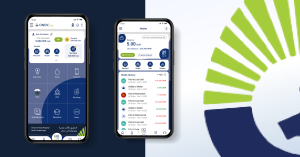
Caption: Screens of home screen and digital wallet of oneic pay
ONEIC (Oman National Engineering and Investment Company) is the largest licensed Non-Banking Financial Institution and Payment Service Provider in Oman. The project involved transitioning ONEIC from a traditional payment collection service to a licensed digital wallet provider under the Central Bank of Oman’s MPCSS framework.
The middleware stack (PHP Laravel) acts as the orchestration layer between:
- The Flutter-based mobile application (ONEIC Pay) serving 500,000+ active users
- The FSS India wallet engine, which manages the core ledger and balance reconciliation
- The MPCSS national switch, which routes interoperable P2P transfers and utility settlements
- Uqudo, for real-time biometric KYC validated against Oman’s national identity database
The middleware manages the three-way reconciliation handshake in real time—ensuring no transaction is confirmed to the user until the wallet engine and the MPCSS switch have both recorded it. It also enforces the 24-hour cooling-off period, device binding, and the complete audit trail that meets Central Bank of Oman inspection requirements.
Business outcomes: 80% reduction in manual processing overhead through automated KYC and reconciliation, a 100% success rate in preventing unauthorized account takeovers since launch, and full compliance with CBO regulatory mandates across the platform’s operational lifetime.
A production-ready rollout of this scope—from core development through MPCSS integration and regulatory sandbox testing—follows a structured timeline: six months for core development and wallet engine integration, followed by three months for regulatory sandbox testing and a controlled pilot launch.
Explore the Oneic pay case study
7.Fintech Compliance Gaps That Cause the Most Problems
Based on the architecture patterns required by WPS and MPCSS, these are the gaps that appear most frequently in systems that fail compliance review or face operational issues post-launch.
Treating KYC as a one-time check rather than a persistent gate
KYC is not a checkbox at registration. If a user’s verification expires, is flagged for review, or a new regulatory requirement increases the verification threshold, your system must be able to downgrade their access level without manual intervention. This requires KYC status to be a live attribute in your middleware, not a historical record.
Incomplete audit trails
Logging the final transaction state is not enough. Regulators need to see the full sequence: what the user requested, what the middleware sent to each downstream system, what each system responded, and what the final confirmed state was. If your audit trail only logs successes, it will fail inspection the first time a dispute is raised.
No graceful handling of central bank switch timeouts
A timeout from MPCSS or a WPS gateway is not the same as a failed transaction—but your system must treat it correctly. If the switch timed out but the transaction may have processed, your middleware must query for the actual state before presenting any result to the user. Assuming failure and refunding without checking creates double-credit scenarios; assuming success without confirming creates fund loss scenarios. Neither is acceptable.
Weak data residency enforcement
GCC data residency rules require PII and financial records to remain within the country’s borders. If your infrastructure uses cloud providers with multi-region data replication by default, you may be violating this without realizing it. Data residency must be explicitly enforced at the infrastructure level, not assumed.
Skipping VAPT before launch
Vulnerability Assessment and Penetration Testing is not optional for licensed PSPs in GCC markets. Central bank certification processes typically require evidence of VAPT conducted by an approved third party. Building this into your development timeline rather than treating it as a final-stage gate prevents the most common launch delays.
Explore Fintech Application Engineering: The Architecture of Regulated Payment Systems and Compliance
8.Practical Recommendations for Teams Building in This Space
If you are building or reviewing a fintech payment system targeting WPS or MPCSS compliance, these are the design principles that tend to separate systems that pass regulatory review from those that do not:
- Design KYC as a state machine, not a form. Users have states (unverified, pending, verified, suspended), and every feature is gated on state. State transitions are logged.
- Build your audit trail at the middleware level, not the application level. Log every API call, every response code, and every state change in an append-only store.
- Treat central bank switch responses as authoritative. The ledger is what the switch says it is, confirmed by your wallet engine—not what your app thinks happened.
- Implement idempotency keys on every transaction request. This prevents duplicate processing when retries are required after timeout failures.
- Test reconciliation under load before launch, not after. Audit integrity testing under high-concurrency conditions is a mandatory pre-launch step for MPCSS integration.
- For multi-corridor remittance, design for async responses from day one. Do not build for synchronous confirmation and retrofit async handling later.
- Data residency is an infrastructure decision, not an application decision. Involve your cloud and infrastructure team in the compliance architecture review, not just the application engineers.
- Budget nine to twelve months for a production-ready national-scale payment system. Six months for core development and integration, three months for regulatory sandbox and controlled pilot.
Final words
WPS and MPCSS are not the most complex regulatory frameworks that exist in global payments, but they are rigorous, and they are enforced. The central banks that administer them have certification processes, sandbox environments, and inspection rights—and systems that are not built with compliance as a first-class concern tend to surface their gaps at the worst possible moment.
The good news is that the architecture patterns required for compliance—proper KYC gating, immutable audit trails, deterministic transaction finality, layered security controls—are also the patterns that produce more reliable and maintainable systems in general. Designing for compliance does not mean designing for bureaucracy; it means designing for correctness.
For teams building in this space, the highest-leverage investment is getting the middleware architecture right early. The middleware is where compliance lives. The app is what users see; the wallet engine is where money sits; but the middleware is what makes the system legally operable—and getting that layer wrong is expensive to fix after launch.
Frequently Asked Questions (FAQs)
Q1: What is the main difference between integrating with UAE’s WPS and Oman’s MPCSS?
- The structural flow differs significantly: The UAE’s Wages Protection System (WPS) is primarily an asynchronous, batch-oriented system designed for payroll processing. It relies on generating and validating Salary Information Files (SIF) submitted to the Central Bank.
- Real-time clearing vs. Batch clearing: Oman’s Mobile Payment Central Switching System (MPCSS) is a real-time, bidirectional clearing network built for instant operations like peer-to-peer (P2P) transfers, merchant payments, and utility settlements. MPCSS requires millisecond-accurate reconciliation handshakes.
Q2: Why can’t I just use standard application error logs as a regulatory audit trail?
- Lack of complete state representation: Standard application logs capture system exceptions and errors but usually fail to trace the entire chronological sequence of a user’s financial intent.
- Regulatory immutability requirements: Financial regulators require an immutable, append-only ledger that preserves the full execution sequence. This means your middleware must systematically log the user intent, the multi-party API handshake sequence, corresponding timestamps, and final transaction states from the central switch or wallet engine.
Q3: What happens if a central bank switch times out during a live transaction?
- Do not assume success or failure blindly: A network or switch timeout from MPCSS or a WPS gateway is ambiguous; it does not explicitly mean the payment failed. Assuming failure can lead to double-debit/double-credit issues, while assuming success blindly causes fund losses.
- The deterministic resolution path: Your middleware must leverage strict idempotency keys on every transaction request. If a timeout happens, the platform should safely query the central switch for the true recorded state before returning any final result or executing a rollback.
Q4: How should Know Your Customer (KYC) be designed to pass a central bank review?
- Move away from static forms: Regulators reject systems where KYC is treated as a simple, historical checkbox filled out at registration.
- Design KYC as a live state machine: KYC must be an active orchestration gateway in your middleware. Users should be provisioned in a restricted state by default, with full payment features gated behind live state validations. If a user’s verification expires or is flagged for review under Anti-Money Laundering (AML) changes, the middleware must automatically downgrade their access level without engineering intervention.
Q5: What are the primary infrastructure requirements regarding data residency in the GCC region?
- Explicit localized boundaries: Regulatory frameworks enforced by central banks in countries like Oman mandate that all Personally Identifiable Information (PII) and financial transaction logs must strictly reside inside the country’s national borders.
- Avoid implicit cloud replication: You cannot rely on default multi-region public cloud setups that seamlessly replicate data across global data centers. Compliance must be actively enforced at the containerization or local cloud provider level.
Q6: What is a typical timeline for developing and launching a production-ready fintech middleware?
- The 9 to 12-month framework: Building national-scale payment infrastructure requires a structured roadmap to pass audit testing.
- Core development phase: Allocate approximately six months for core service development, API gateway mapping, and downstream wallet engine integrations.
- Testing and certification phase: Allocate the remaining three to six months for rigorous third-party Vulnerability Assessment and Penetration Testing (VAPT), central bank regulatory sandbox testing, and a controlled pilot launch.

Akhila drives the content strategy at Mindster, combining analytical clarity with a passion for digital product innovation. With a deep focus on mobile app strategy and software solutions, she bridges the gap between engineering complexity and intuitive user experiences. She thoughtfully articulates tech concepts, transforming frameworks, case studies, and digital transformation trends into actionable insights for product teams and business leaders.