

The future belongs to applications that anticipate user needs, not just respond to them. Artificial intelligence is no longer an optional feature, it’s the fundamental difference between market leaders and forgotten apps.
The Invisible Challenge: Why Most Mobile Apps Fail
he role of artificial intelligence in mobile software has fundamentally shifted. Mobile AI is no longer limited to basic cloud-hosted chatbots or server-dependent classification models. Modern mobile architectures rely on hybrid, on-device inference engines—such as Apple CoreML, Google ML Kit, and Apple Intelligence—running localized Neural Processing Units (NPUs).
Building a competitive mobile product today requires navigating emerging patterns like zero-click shopping, predictive UI/UX design trends, and robust backend infrastructure. This guide outlines how engineering teams, product managers, and enterprise decision-makers structure, build, and deploy secure, AI-native mobile applications.
From Static Interfaces to Predictive & Agentic UX
Traditional mobile UX relies on deterministic navigation: users open an application, manually search, fill out form fields, and trigger database queries. Modern mobile applications leverage predictive, contextual, and agentic workflows to run tasks proactively.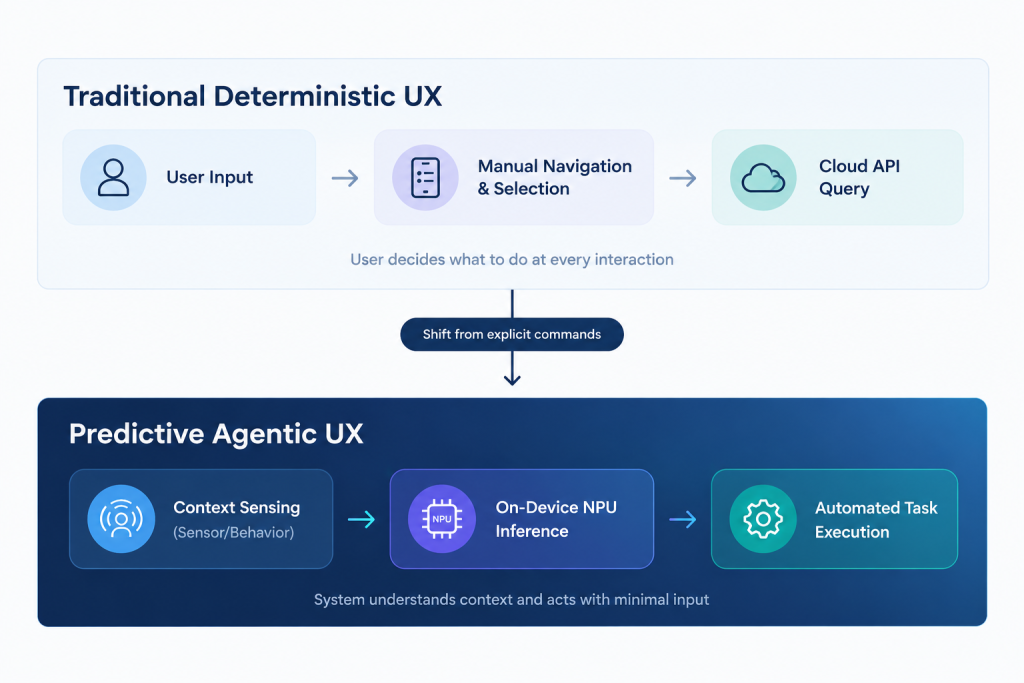
-
Predictive UX: Apps analyze on-device sensor data (location, time of day, usage frequency) to adapt user interfaces, prioritize dashboard widgets, and predict intended actions before a tap occurs.
-
Agentic Execution: Instead of simply responding to single prompt inputs, in-app agentic frameworks execute multi-step routines—such as cross-referencing calendar availability, parsing receipts, and filing expense reports automatically.
Core Pillars of the Mobile AI Ecosystem
To avoid monolithic codebases and maintain scalable application performance, AI functionality is organized into specialized architectural layers:
1. Dynamic UI & Generative Personalization
Generative engines adapt mobile application views dynamically based on user context. Instead of hardcoded dashboard layouts, generative UI models adjust component hierarchy, real-time messaging, and visual assets on the fly without requiring continuous app store releases.
Deep-dive guide: Learn how to build real-time personalized interfaces in our post on Generative AI for Dynamic Content in Mobile Apps.
2. In-App LLMs & Conversational Workflows
Modern mobile apps integrate Large Language Models (LLMs) to support natural language query processing, voice-driven interfaces, and automated customer support. Modern implementations balance cloud LLMs (such as OpenAI GPT-4o or Anthropic Claude APIs) with small, quantized on-device models to preserve battery life and minimize API token costs.
Deep-dive guide: Explore API architectures and developer tools in our complete guide to ChatGPT & LLM Mobile App Integration.
3. In-App AI Copilots & Task Automation
AI Copilots function as persistent, context-aware assistants embedded within mobile applications. Operating alongside user workflows, copilots streamline complex tasks—such as auto-filling long financial applications, suggesting smart inline edits, or executing multi-step e-commerce checkouts.
Deep-dive guide: Review UX design patterns and state management in our breakdown of AI Copilots for Mobile Apps.
4. Sector-Specific Industry Applications
AI implementation patterns vary depending on regulatory requirements and domain workflows:
-
Fintech: Real-time fraud detection running locally on biometric authentication layers, paired with automated spending analysis.
-
Healthcare: On-device medical imaging processing, offline diagnostic support, and HIPAA-compliant health telemetry tracking.
-
E-Commerce & Retail: Computer-vision search, dynamic pricing models, and personalized product visualizers.
Deep-dive guide: See real-world business metrics and ROI in Beyond the AI Buzz: What AI Can Actually Do in Mobile Apps.
Why AI Matters for Modern Apps
The competitive intensity in app markets demands differentiation. Users have access to thousands of applications in every category. Those that survive and thrive are typically the ones offering superior experiences through intelligent features that solve real problems.
Artificial intelligence provides multiple strategic advantages that directly impact business outcomes:
Enhanced User Personalization
Rather than offering identical experiences to all users, AI-powered applications deliver customized content, recommendations, and interfaces tailored to individual preferences. This personalization significantly increases user satisfaction, reduces churn, and drives revenue through targeted upselling and cross-selling.
Operational Efficiency
AI automates traditionally manual processes, from customer support to quality assurance. Chatbots handle routine inquiries without human intervention, while machine learning algorithms identify bugs and performance issues automatically. This efficiency translates directly to reduced costs and faster time-to-market for updates.
Data-Driven Insights
Applications generate vast amounts of user interaction data. AI transforms this raw data into meaningful insights—which features drive engagement, which user segments are most valuable, what price points optimize revenue. These insights guide strategic product decisions and resource allocation.
Competitive Differentiation
In crowded markets, intelligent features create defensible competitive advantages. Applications with sophisticated recommendation systems, natural language understanding, or predictive capabilities attract users seeking premium experiences.
Key Business Metrics Impacted by AI:
-
- User acquisition costs (reduced through better targeting)
-
- Customer lifetime value (increased through retention improvements)
-
- Conversion rates (optimized through personalization)
-
- Revenue per user (enhanced through intelligent upselling)
-
- Development costs (reduced through automation)
Global AI Market Expansion
The financial opportunity in AI-powered mobile applications is substantial and growing rapidly. Market analysis reveals accelerating adoption across industries, geographies, and user demographics. This expansion signals both significant opportunity and increasing competitive pressure for businesses.
Market Growth Trajectory
-
- 2025 Market Size: The global AI-enabled mobile app market is valued at approximately $28.1 billion, representing substantial growth from previous years
-
- Growth Rate: The market is expanding at a compound annual growth rate of 32.5%, indicating accelerating adoption
-
- 2034 Projection: Industry analysts project the market will reach $354.1 billion within a decade, representing more than a tenfold increase
Geographic Distribution
AI adoption is not uniform globally. Understanding regional market dynamics helps identify opportunities and understand competitive landscapes:
-
- Asia-Pacific Dominance: This region leads globally with 55.3% market share and $11.7 billion in current revenue. Dense populations, high smartphone penetration, and tech-savvy consumers drive rapid AI adoption
-
- North American Market: While smaller in percentage share, North America represents significant value through enterprise AI adoption and premium consumer applications
-
- European Growth: Stricter data privacy regulations (GDPR) shape AI development approaches, creating differentiation opportunities for privacy-conscious solutions
Industry-Specific Opportunities
-
- Entertainment leads with 53.6% market share, driven by streaming platforms and social media apps
-
- AI-enabled social media applications capture 65.1% of their respective market segments
-
- Gaming applications utilizing AI show 79.7% market engagement levels
-
- Emerging opportunities in healthcare, fintech, and e-commerce demonstrate expanding use cases
AI Implementation Strategies
Successful AI integration requires understanding how artificial intelligence transforms application architecture, development processes, and user experiences. Strategic implementation goes beyond simply adding AI features—it involves reimagining applications around intelligent capabilities.
Strategic Architecture Decisions
Effective AI implementation begins with strategic architectural choices that influence scalability, performance, and maintainability:
-
- On-Device vs. Cloud Processing: Determine whether AI models run locally on user devices or remotely on servers, balancing latency, privacy, and computational requirements
-
- Model Selection: Choose between pre-trained models that work out-of-the-box and custom-trained models optimized for specific use cases
-
- Data Infrastructure: Design systems to collect, process, and store the high-volume data required for machine learning
-
- Integration Points: Identify where AI should enhance user experiences versus where it adds unnecessary complexity
Development Process Optimization
AI-powered development processes themselves leverage artificial intelligence to improve efficiency:
-
- Code generation and completion tools accelerate development velocity
-
- Automated testing systems identify bugs and performance issues early
-
- Predictive analytics reveal potential failure points before users encounter them
-
- Machine learning-driven resource allocation optimizes infrastructure spending
Key Applications and Use Cases
Artificial intelligence creates value across diverse mobile applications. Understanding specific use cases helps identify opportunities for your organization and anticipates future capabilities users will expect.
Intelligent Recommendation Systems
Perhaps the most widespread AI application in mobile apps, recommendation systems analyze user behavior, content preferences, and social connections to suggest products, content, and experiences. Platforms like Netflix, Spotify, and Amazon attribute significant revenue growth to sophisticated recommendation algorithms.
Voice and Natural Language Interfaces
Virtual assistants powered by natural language processing enable hands-free interaction with applications. Users can perform tasks through conversation rather than navigating complex menus, improving accessibility and user experience.
Computer Vision and Image Analysis
Applications leveraging computer vision can recognize objects in photos, verify user identities through facial recognition, apply real-time filters, and enable augmented reality experiences. These capabilities enhance both consumer and enterprise applications.
Health and Wellness Monitoring
AI-powered health applications track vital signs through wearable devices, detect anomalies that might indicate health issues, and provide personalized wellness recommendations. Early detection capabilities can be life-saving for serious conditions.
Intelligent Input and Communication
Predictive text systems that learn individual typing patterns, auto-correct misspellings, and understand context significantly improve communication speed and accuracy on mobile devices. These systems adapt to user behavior over time, becoming increasingly personalized.
Fraud Prevention and Security
Machine learning algorithms monitor transaction patterns and user behavior to identify fraudulent activities with minimal false positives. Financial applications especially benefit from AI’s ability to detect sophisticated fraud schemes.
Contextual Search and Discovery
Beyond keyword matching, intelligent search systems understand user intent and context. Visual search capabilities allow users to photograph objects and find similar items, enabling discovery that wasn’t previously possible.
Smart Image Capture and Enhancement
Smartphone cameras with AI optimization automatically adjust settings for optimal image quality across diverse lighting conditions, recognize scenes and subjects, apply professional-quality filters, and enhance images after capture.
Technical Stack Architecture: On-Device vs. Cloud AI
Selecting the right runtime environment directly affects latency, offline accessibility, user privacy, and operational expenditures. When building across platform architectures, leveraging dedicated AI Development Services ensures optimal integration between local hardware acceleration and cloud intelligence.

| Architectural Layer | On-Device Inference (Edge) | Cloud-Based AI APIs |
| Frameworks / SDKs | Apple CoreML, Google ML Kit, PyTorch Mobile, ONNX Runtime | OpenAI API, Anthropic Claude API, Google Vertex AI |
| Latency | Extremely low (<10ms) | Variable (100ms–2000ms+ depending on network) |
| Offline Reliability | Fully operational offline | Fails without active internet connection |
| Data Privacy | Zero-data-leakage; data remains on silicon | Data transmitted via TLS to external servers |
| Cost Model | One-time development cost (utilizes local NPU) | Recurring per-token / per-API call operational cost |
| Primary Use Cases | Biometrics, object detection, voice recognition, real-time filters | Complex multi-modal reasoning, large document analysis |
Data Privacy, Security, and Compliance
Deploying AI models inside mobile applications introduces unique security considerations:
-
Zero-Trust & Local Enclaves: Sensitive user data processed locally must utilize secure hardware enclaves (such as Apple Secure Enclave or Android KeyStore).
-
Data Minimization & Differential Privacy: Telemetry pipelines should scrub personally identifiable information (PII) before sending data out to external cloud AI models.
-
Regulatory Compliance: AI-enabled pipelines must comply with regional standards including GDPR, CCPA, HIPAA for health data, and PCI DSS 4.0 for payment processing.
Structured Integration Process & Risk Mitigation
Successful AI integration follows a structured approach that minimizes risk while maximizing business value: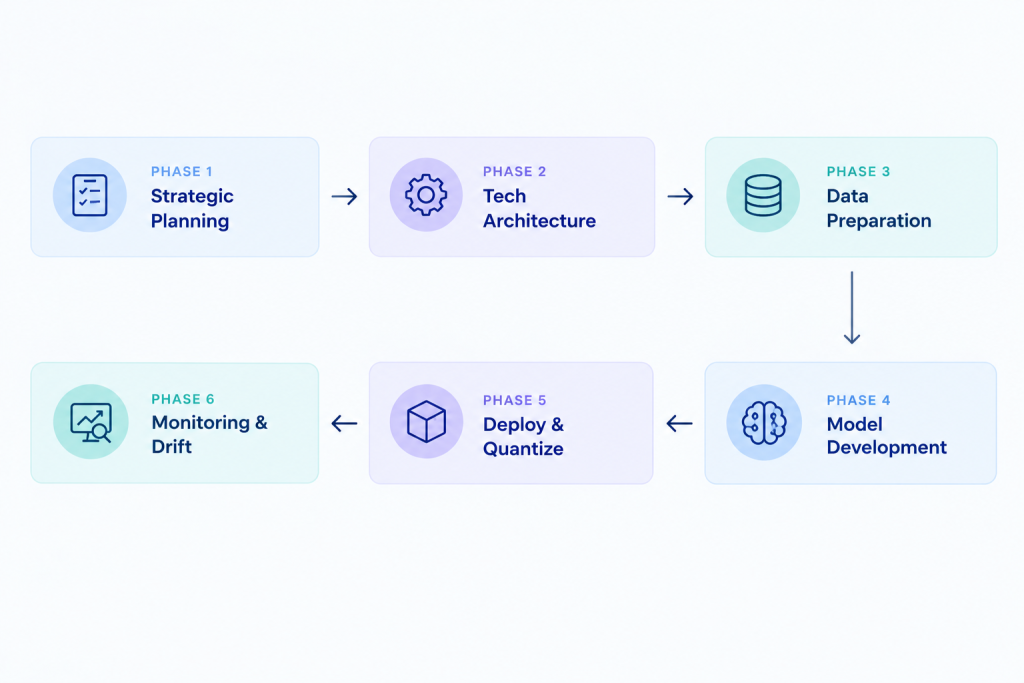
-
Phase 1: Strategic Planning: Define specific, measurable business KPIs for each AI feature before development begins.
-
Phase 2: Tech & Architecture Selection: Evaluate available AI frameworks and service providers; balance on-device inference vs. cloud APIs.
-
Phase 3: Data Collection & Preparation: Establish pipelines for clean, representative telemetry data, ensuring compliance with differential privacy rules.
-
Phase 4: Model Development & Fine-Tuning: Build, fine-tune, or prompt-engineer models against diverse test sets.
-
Phase 5: Testing, Quantization, & Deployment: Optimize models for mobile hardware via quantization and edge pruning before gradual rollout.
-
Phase 6: Continuous Monitoring: Track model performance metrics continuously to detect hallucination drift and maintain response accuracy.
Cost Factors & TCO Breakdown
Total cost of ownership (TCO) for AI mobile applications spans initial development through recurring infrastructure:
Estimated Development Ranges
-
Basic AI Features ($8,000–$15,000): Simple recommendation engines, basic chatbots, or elementary image filters. Ideal for MVPs.
-
Moderate AI Integration ($15,000–$25,000): Context-aware chatbots, object recognition, and personalized user flows.
-
Advanced AI Systems ($25,000–$50,000+): Real-time computer vision, on-device model quantization, and multi-modal agentic workflows.
Ongoing Operational Costs
Annual maintenance and operations typically consume 15–20% of original development costs:
-
API Token Consumption: Recurring operational expenses for third-party cloud LLM calls.
-
Vector Database Hosting: Infrastructure for retrieval-augmented generation (RAG) using datastores like Pinecone or SQLite vector extensions.
-
Continuous Monitoring: Retraining models with fresh data and maintaining zero-trust security compliance.
Cost Optimization Strategies
- Leverage pre-trained models rather than training from scratch (saves 60-70% of time)
- Use cloud-based AI services reducing infrastructure overhead
- Implement phased development, starting with core features then expanding
- Partner with experienced development teams in cost-effective regions
- Utilize open-source tools and frameworks reducing licensing costs
For the majority of companies in these industries, the AI app concepts we looked at in the previous part represent the future. Therefore, it becomes crucial to get in touch with a trustworthy and knowledgeable partner in order to execute the concepts for contemporary AI mobile apps at reasonable costs.

Akhila drives the content strategy at Mindster, combining analytical clarity with a passion for digital product innovation. With a deep focus on mobile app strategy and software solutions, she bridges the gap between engineering complexity and intuitive user experiences. She thoughtfully articulates tech concepts, transforming frameworks, case studies, and digital transformation trends into actionable insights for product teams and business leaders.