
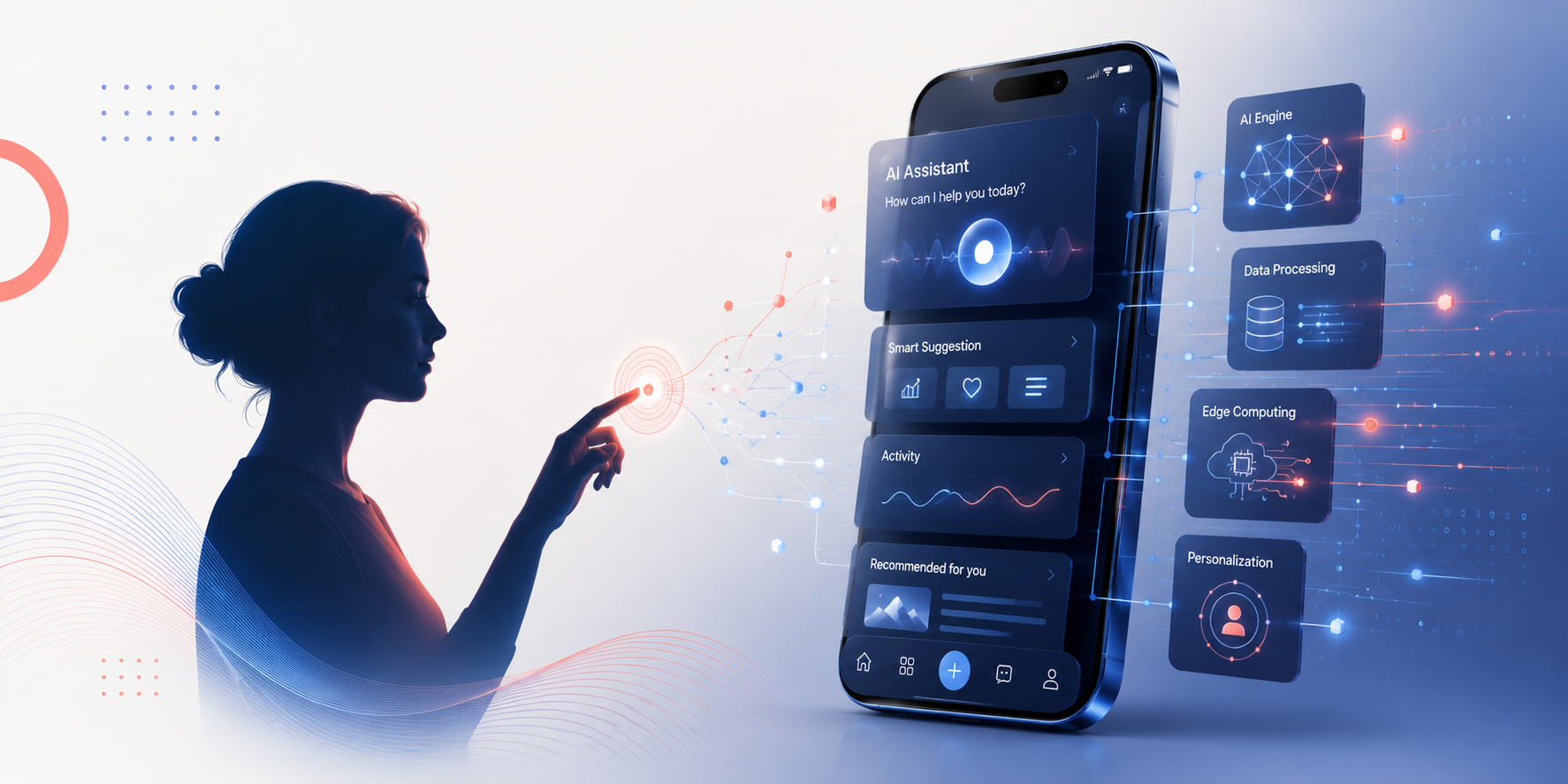
Ask a business owner what “AI in their app” means, and most will describe a chatbot tucked into the corner of a screen. Meanwhile, the phone in their pocket is already running neural networks on-device, chaining multi-step tasks without a round trip to a server, and matching intent instead of keywords. That gap, between what people picture and what AI can actually do inside a mobile product, has never been wider.
And that gap is exactly where the confusion starts. As AI’s real capability has grown, so has the myth that it can now design and build a mobile product on its own. It can’t. Whether you’re scaling an enterprise platform or evaluating custom AI app development, here’s an honest look at how far AI has come, what it can actually do, where it still stops short, and why human engineering remains the part no model replaces.
1.How Far Has AI Really Come? The Unseen Evolution
Most people only see a fraction of what’s actually happening inside a modern mobile app. Under the hood, capability has moved through three distinct waves.
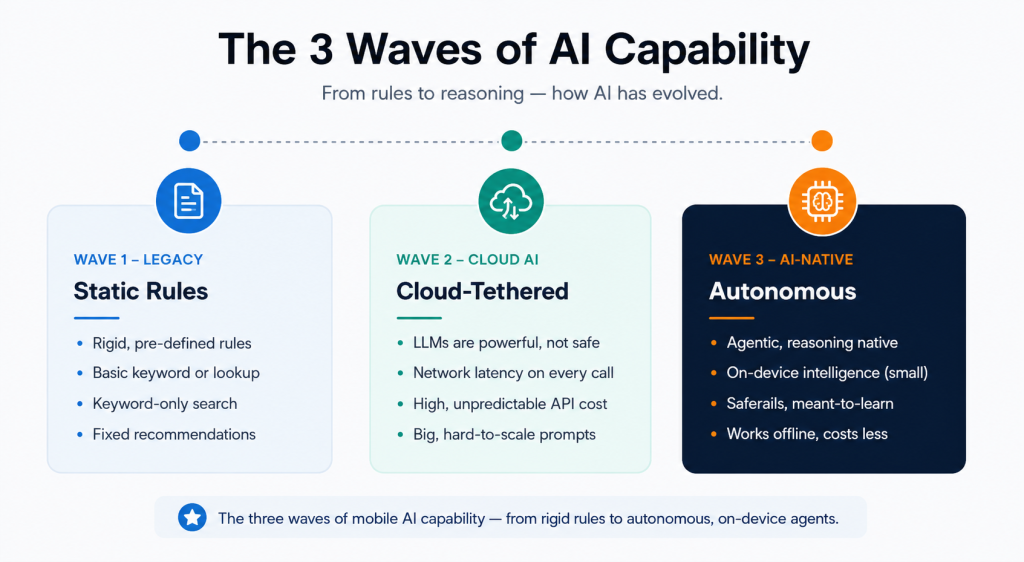
- Era 1 — Rule-Based (Legacy): Apps relied on rigid decision trees for automated replies, simple biometric verification, and basic statistical recommendation engines.
- Era 2 — Cloud-Tethered Generative AI: Apps wrapped cloud-hosted large language models into chat tabs. Flexible, but constrained by network latency, unpredictable API costs, and rigid prompt setups.
- Era 3 — Autonomous & AI-Native (Current State): Today’s mobile AI development leans on agentic AI, autonomous, task-driven agents that execute multi-step workflows across apps, paired with retrieval-augmented generation (RAG) and local, on-device processing.
2.What Modern AI Can Actually Do Behind the Screen
Building this into a real product involves three technical capabilities that go well past surface-level UI tricks.
On-Device Inference (Edge AI)
Frameworks like Apple CoreML, Google TensorFlow Lite, and ONNX Runtime let compressed neural networks run locally on a phone’s own processor (its NPU) — no server call required.
- Fast, local processing: voice parsing, image recognition, and intent matching run on-device, often completing in tens of milliseconds instead of waiting on a network round trip.
- Data privacy by default: sensitive health data, biometrics, and documents never have to leave the device to be processed.
- Offline functionality: core features keep working even with no active connection.
Intent-Driven Interfaces
Instead of forcing users through nested menus, this generation of apps introduces task-oriented conversational surfaces. Pairing a cloud LLM with a RAG pipeline lets the app interpret real intent — “scan my last three invoices, pull the totals, and draft an expense report” — and coordinate the underlying API calls on its own.
Vector Search & Hyper-Personalization
Legacy apps rely on exact keyword matches, which is how you end up at “No Results Found.” Modern architectures convert queries into vector embeddings stored in a vector database, such as Pinecone or Milvus.
- Semantic search: understands meaning even when the exact words are missing — “lightweight running jackets for rainy weather” still returns the right results.
- Predictive UX: layouts and product feeds adapt in real time based on behavior, not a static ranking.
3.What AI Still Cannot Do (And Why Humans Still Lead App Engineering)
Despite how capable these models have become, there’s a hard line where AI stops and human product engineering has to take over. Leaning on AI tools without experienced engineers behind them is how you end up with security gaps, broken logic, and features nobody adopts.
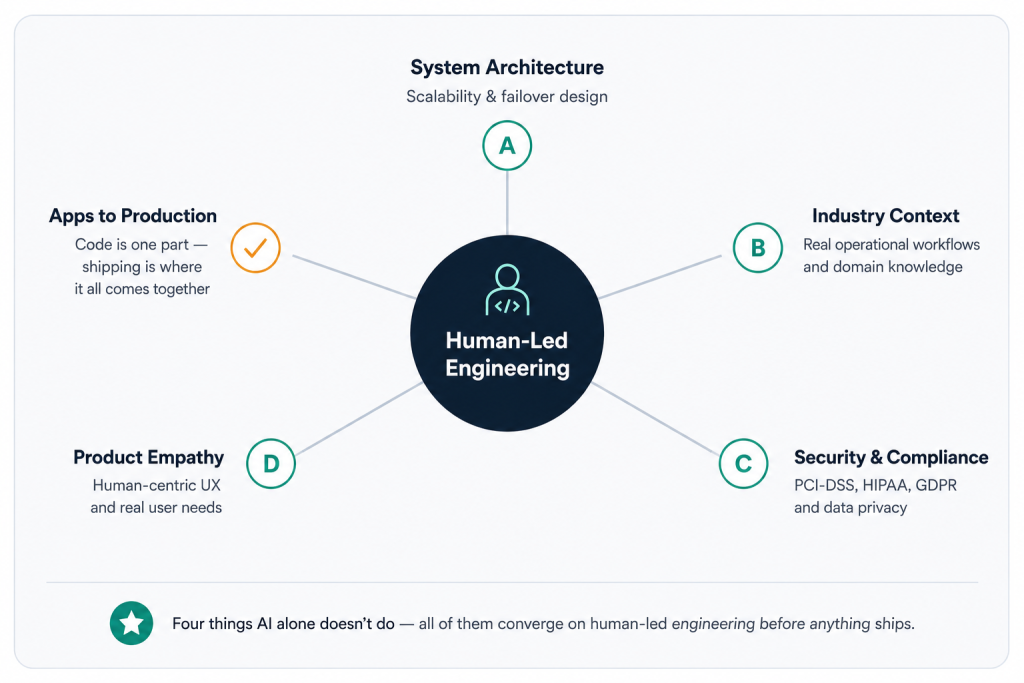
1. System Architecture & Scalability
AI can output code snippets, but it doesn’t architect complex, cloud-native systems. Human engineers design the database schemas, API orchestration layers, microservices, and failover mechanisms that let an app hold up under millions of concurrent requests.
2. Industry-Specific Domain Knowledge & Context
A model doesn’t understand the operational nuance of a fintech wallet, a healthcare telemetry system, or a jewelry supply chain app. Domain experts know how those businesses actually run, which is what keeps a product solving a real bottleneck instead of a hypothetical one.
3. Security, Regulatory Compliance & Data Ethics
Models don’t carry an understanding of legal or ethical risk. Meeting PCI-DSS, HIPAA, or GDPR, closing data leaks, and hardening endpoints against prompt injection or model exploitation all require human security auditing.
4. Human-Centric UX & Product Empathy
AI can follow a design token spec, but it doesn’t have empathy. An interface that feels natural, accessible, and genuinely easy to use still needs UX researchers who understand human psychology, edge-case frustration, and real user behavior.
4.Legacy vs. AI-Driven vs. Human Engineering
Put side by side, the pattern is consistent: AI extends what’s possible, and human engineering is what makes it reliable.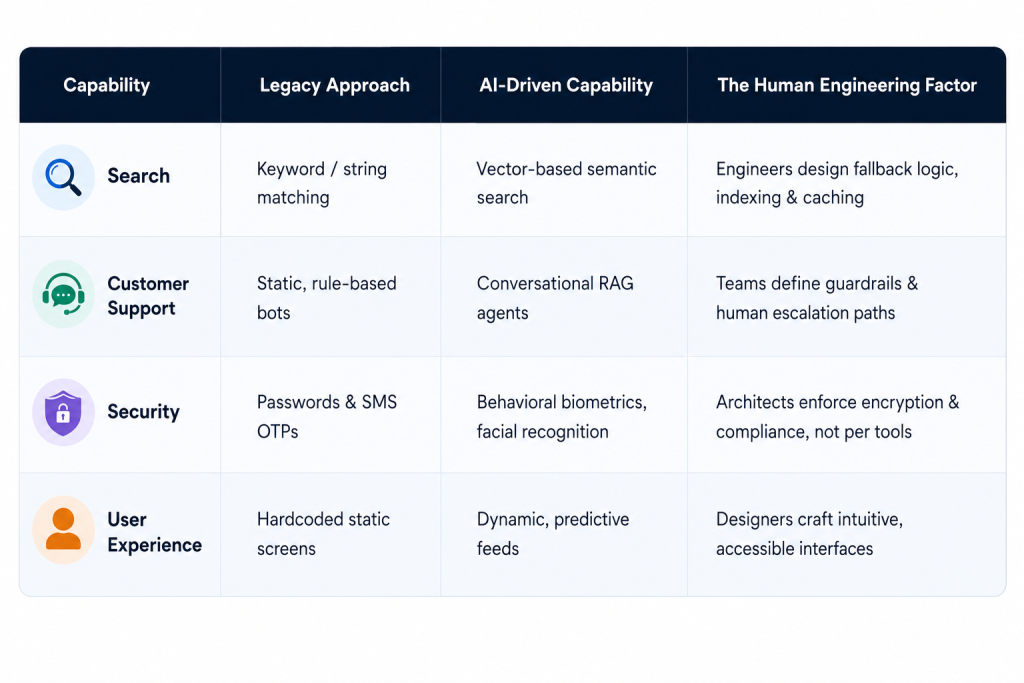
5.What Responsible AI Engineering Looks Like in Practice
None of this is theoretical. When AI is treated as an accelerant rather than a shortcut, the same five checkpoints tend to show up before anything ships:
- Discovery before architecture: the business goal gets defined first, and the cloud and mobile architecture is designed around it, not the other way round.
- AI where it earns its place: RAG pipelines and on-device deployment (CoreML, TensorFlow Lite) go in where they move a real metric, not by default because the technology exists.
- Compliance from day one: encryption, fraud detection, and regulatory requirements (GDPR, HIPAA, PCI-DSS) are part of the architecture, not a review that happens after launch.
- Design that carries the load: the interface makes AI functionality feel obvious to use, not just technically possible.
- Ownership through the lifecycle: proof-of-concept, deployment, and maintenance stay connected, so the system holds up as usage grows.
It’s the standard we hold our own AI builds to at Mindster, and a reasonable one to expect from anyone building this for you.
Ready to Move Beyond the AI Hype?
AI has genuinely changed what’s possible inside a mobile app: offline inference, semantic search, agents that act on intent instead of taps. None of that is hype. What hasn’t changed is who’s accountable for the architecture, the compliance, and the experience once real users show up — that part still needs engineers who’ve done it before.
Whether you are modernizing a legacy application or evaluating custom AI app development with an experienced AI app development company, Mindster delivers the end-to-end engineering expertise needed to turn your vision into impact.

Akhila drives the content strategy at Mindster, combining analytical clarity with a passion for digital product innovation. With a deep focus on mobile app strategy and software solutions, she bridges the gap between engineering complexity and intuitive user experiences. She thoughtfully articulates tech concepts, transforming frameworks, case studies, and digital transformation trends into actionable insights for product teams and business leaders.