


A practical plan for businesses that already sell online and want to add independent sellers, without starting from zero or losing their customers.
Turning an established store into a multi-vendor marketplace is a different project from building a marketplace on day one. You already have customers, products, orders, search rankings, and working habits. The job is to add independent sellers without breaking any of that.
This guide lays out a 60-day plan for a first release, using an established grocery business with 20 to 25 vendors as the working example. It explains what makes 60 days possible, what that first release deliberately leaves out, how to protect your existing traffic and customers during cutover, and where the plan can slip.
Note: This is a planning scenario, not a case study of a delivered project. For features, costs, and the typical 4 to 6 month timeline of a marketplace built from scratch, read our complete guide to building a multi-vendor marketplace app.
Key takeaways
- 60 days buys a first release, not a finished marketplace. It covers one storefront, core seller tools, and central administration. Automated payout runs, complex promotions, and deep ERP integrations come later.
- An API-first commerce base shortens the build. Moving onto a pre-built composable commerce foundation (such as Medusa) removes months of standard e-commerce engineering. The marketplace logic itself—vendors, order splitting, and commissions—is still custom.
- Approvals and data migration control the schedule. Payment-provider approval, seller verification, and data mapping must start in week 1 and run alongside development.
Why is converting a store different from building a marketplace?
A new marketplace starts with nothing. A conversion starts with a working business, which helps and hurts at the same time.
- It helps because your product catalogue, customer base, order history, and operational workflows already exist.
- It hurts because that data must be moved without breaking live sales, existing URLs must keep their search rankings, and the new seller model has to fit around your current operations.
Think of it like adding stalls to a shop that is already trading. You are not designing a market from scratch. You are making room for new traders while the till keeps ringing.
The scenario we will use
| Item | Assumption |
|---|---|
Business | Established grocery commerce business moving to a marketplace |
Architecture | Composable, API-first commerce base (Medusa) with custom marketplace modules |
Model | One central marketplace (your own inventory plus third-party sellers) |
Vendors | 20 to 25 |
Products per vendor | About 15,000 |
Vendor product records | 300,000 to 375,000 |
Customer experience | One storefront for all vendors |
Delivery rule (Day 1) | Per-vendor flat shipping fee or zone-based delivery via one third-party fleet |
Vendor tools | Separate dashboard for each vendor |
Operations | Central administration for the marketplace owner |
Target | About 60 days to a first production release |
Two structural decisions shape the entire build:
- Separating products from offers: The same grocery item can be sold by several vendors at different prices. The catalogue has to separate the base product from each vendor’s offer of it, which defines the data model from week 1.
- Keeping Day 1 delivery simple: Multi-vendor grocery logistics can easily derail a 60-day timeline. For the first release, orders split by vendor at checkout with a clear per-vendor delivery fee or a single local delivery fleet. Unified multi-vendor time slots and cold-chain routing wait for phase two.
What is reused vs. what is custom-built?
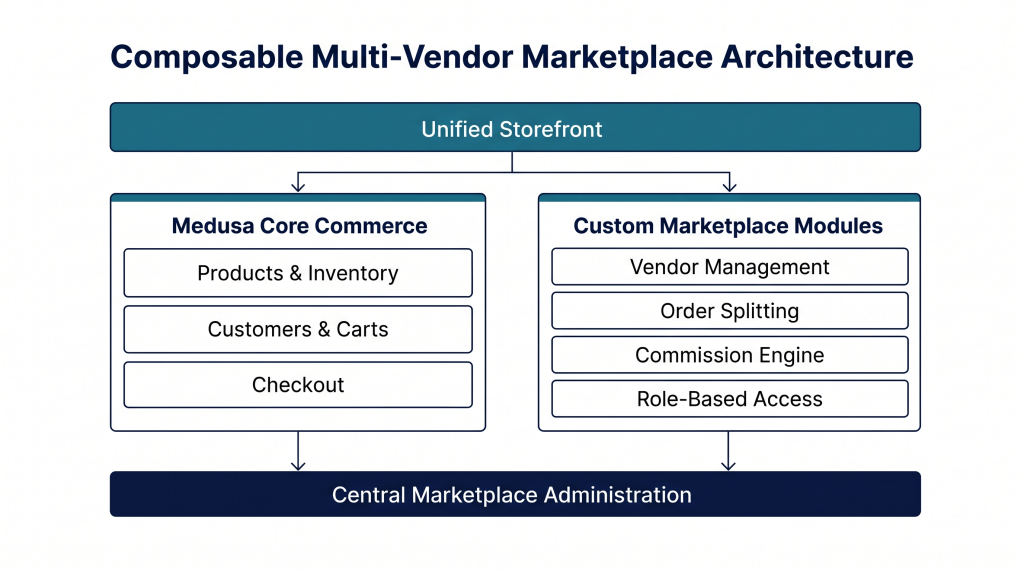
Instead of hacking marketplace plugins onto a monolithic store—or coding carts, checkouts, and user authentication from scratch—this plan uses Medusa’s modular commerce engine for core e-commerce and focuses engineering time on custom marketplace logic.
| Capability | Implementation approach |
|---|---|
Products and inventory | Medusa core commerce capabilities |
Customers and carts | Medusa core commerce capabilities |
Vendors | Custom marketplace module |
Vendor-product association | Custom marketplace logic |
Vendor authentication | Role-based vendor access controls |
Order splitting | Custom marketplace workflow |
Commission calculation | Custom commission module |
Vendor settlements | Custom financial workflows |
Marketplace administration | Custom admin extensions |
Storefront | Customised storefront experience |
Medusa provides the commerce foundation and a marketplace recipe, but the actual multi-vendor rules still have to be designed and built. For an established business, that is an advantage: you are not forced into a rigid, off-the-shelf vendor workflow or commission structure.
Is 60 days realistic?
Not for every marketplace, and not by AI-assisted development alone. It becomes realistic when six conditions hold:
- A tight first scope. Essential marketplace functions only, with everything else parked in later phases.
- A pre-built commerce foundation. Reusing Medusa’s core modules avoids rebuilding standard e-commerce plumbing.
- A migration plan from week 1. Data mapping, 301 URL redirects, and validation start immediately, not at the end.
- Parallel work. Marketplace modules, storefront, data migration, and integrations progress together where dependencies allow.
- Experienced oversight. Architecture, security, money calculations, and data reconciliation still need senior engineering judgement.
- Approvals on time. Payment-provider and seller-verification processes start in week 1.
It is not realistic if you need multiple countries and currencies, complex tax rules, auctions or rentals, deep ERP integration, or native mobile apps for every user type in the first release. In those cases, plan on the longer timeline in our general marketplace guide.
Where does AI help, and where does it not?
Generic AI coding tools often produce code that ignores a framework’s intended architecture. What makes AI useful in a 60-day Medusa build is framework-specific context:
- Medusa Agent Skills: Provide coding agents with framework-specific guidance for implementing modules, workflows, and API routes using established Medusa patterns.
- Medusa Docs MCP: Connects AI coding tools directly to Medusa’s live documentation so developers spend less time searching docs and writing boilerplate.
Even with those tools, AI speeds up repetitive engineering—it does not replace human judgement on money, security, or live data.
| AI helps with | People must own |
|---|---|
First drafts of modules, API routes, and dashboard screens | Architecture decisions |
Data transformation and migration scripts | Commission and payout calculations |
Test cases and debugging | Security and vendor access control |
Technical documentation | Data reconciliation and production cutover |
The real benefit is not simply faster code. It is that senior engineers spend their time on vendor rules, financial accuracy, and cutover safety rather than boilerplate.
What do you get on day 60, and what waits?
| In the first release | In later phases |
|---|---|
One storefront with unified search, cart, and checkout | Automated payout runs and advanced settlements |
Vendor registration and manual approval workflow | Complex promotions and cross-vendor loyalty rules |
A dashboard for each vendor: products, stock, and orders | Deep ERP and warehouse management integration |
Checkout split into separate orders per vendor | Multi-vendor delivery slot coordination and cold-chain routing
|
Commission calculated on every order | Native mobile apps (if not in initial scope) |
Central admin for vendors, orders, and reports | Multiple countries and currencies
|
Migration of existing customers, products, orders, and 301 URL redirects | Advanced analytics and vendor performance scoring |
One payment gateway and one shipping setup (per-vendor fee or single fleet) | Additional marketplaces or regional storefronts |
The eight-week plan
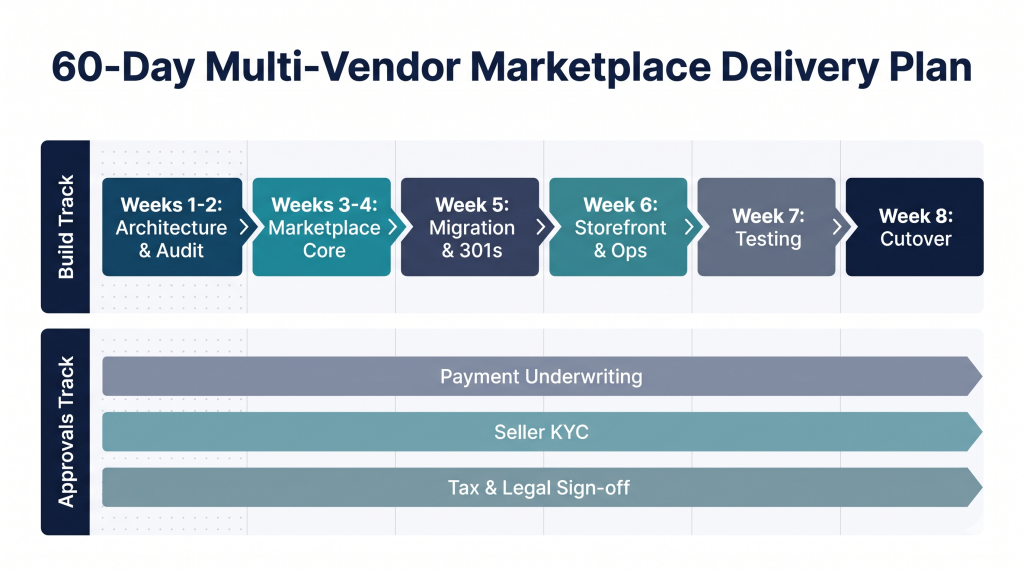
The project runs on two tracks. The build follows the weeks below. The approvals track starts in week 1 and runs throughout: payment-provider approval, seller identity verification, and tax rules.
| Weeks | Focus | What you decide or provide |
|---|---|---|
1 to 2 | Architecture and foundation: Audit current platform, data, and URL structure; set up the Medusa environment; define vendor roles; agree on the migration plan | Scope sign-off, commission rules, vendor list, access to current data
|
3 to 4 | Marketplace core: Vendor onboarding, product ownership, vendor dashboards, per-vendor order splitting, commission calculation | Weekly reviews, onboarding fields, and approval rules |
5 | Migration and integrations: Product, customer, and order migration; 301 redirect mapping; payment and shipping connections | Answers on data clean-up, payment and shipping credentials |
6 | Storefront and operations: Complete the storefront, vendor order handling, admin tools, and customer/vendor notifications | Approval of customer and vendor journeys |
7 | Testing: Vendor data isolation, order splitting, commissions, payments and refunds, migration accuracy, performance, and security
| User acceptance testing with a small group of real vendors |
8 | Cutover: Final data sync, handling in-flight orders, DNS switch, production deployment, monitoring, and stabilisation | Go or no-go decision |
Not sure if your scope fits 60 days?
Share your vendor count, catalogue size, and current platform, and we will map out what a realistic first release looks like.
Talk to the Mindster teamWhat do you need to provide?
A fast build depends on fast decisions from your side. Before week 1 starts, have these six items ready:
- A named decision-maker who can approve scope and trade-offs within 24 to 48 hours.
- Commission rules: A flat rate, or clear rates by category or vendor.
- Your vendor list with business registration and identity documents.
- Access to your current store data and someone who understands its quirks.
- A payment provider that supports split payouts, with the merchant application already started.
- Tax and legal advice for your market, especially if the platform will hold seller funds before paying them out.
How are vendors kept apart?
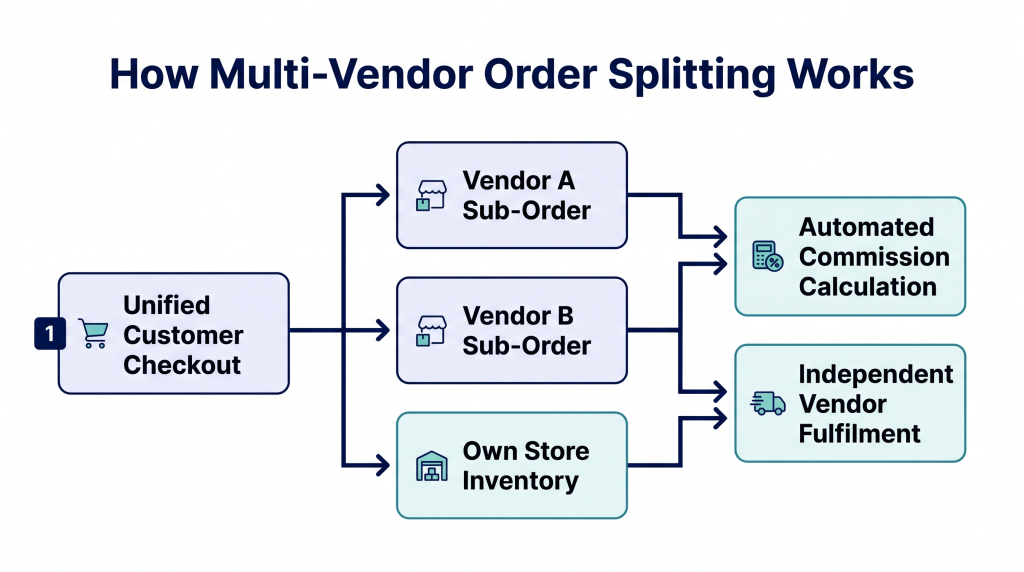
With 20 to 25 vendors, you do not need a separate database or deployment for each one. One shared marketplace works, governed by strict role-based access rules:
- Each product offer belongs to one vendor.
- Vendors see and edit only their own products, stock, and orders.
- Vendor reports show only that vendor’s sales and commissions.
- Marketplace administrators see everything.
This is simpler to maintain and scale than separate deployments. If you later expand into multiple independent regional marketplaces, multi-tenancy can be introduced at the marketplace level.
How do you move 300,000 product records without losing customers or SEO?
Migration is usually the part that takes longest and breaks most easily. Treating it purely as a database transfer is a mistake—you are moving a live business. The safe approach is staged and repeatable:
- Map the data and URLs first. Your current products, variants, customers, and order statuses rarely match the new structure one to one. At the same time, map every live product and category URL to its new destination using 301 redirects so you do not lose organic search rankings on launch day.
- Migrate a sample batch first, then verify it against the source system.
- Use bulk imports, not one record at a time, with automated retries for failed rows.
- Handle images and live stock as separate steps so media transfers do not bottleneck database writes.
- Plan for customer login continuity. Because password hashes rarely transfer cleanly between different commerce platforms, plan a clear, friction-free password reset prompt or magic-link login for returning customers.
- Reconcile everything: Record counts, financial totals, customer details, and historical orders.
- Run a final delta sync just before cutover and establish a clear rule for in-flight orders and open returns so nothing falls between the old and new systems.
Financial records, customer data, and inventory deserve the strictest checks. Anyone who says a live store migration needs no validation has never done one.
What can go wrong?
| Risk | Why it happens | How to reduce it |
|---|---|---|
Payment approval is late | Split-payout underwriting takes longer than standard merchant accounts
| Apply in week 1 and keep a backup provider ready |
Messy source data | Duplicate SKUs, missing attributes, and outdated stock records | Audit and clean source data in weeks 1 to 2
|
Scope creep | New seller features or custom workflows added mid-build
| Maintain a written phase-two backlog and enforce it
|
Slow vendor onboarding | Collecting KYC documents and training sellers takes longer than expected
| Onboard a pilot group of 5 vendors first
|
Tax and legal surprises | Marketplace facilitator and escrow rules vary by market | Get local legal and tax sign-off before locking the payment setup |
Ready-made base or custom build?
If you want a ready-made base, our Enterprise Multi-Vendor Marketplace Platform splits one checkout into separate seller orders, cleans seller product data before it goes live, and connects with existing ERP and warehouse systems.
The 60-day plan in this article assumes custom marketplace modules built on Medusa. Which approach suits you depends on how specific your seller workflows are. We compare the underlying options in Monolithic vs Headless vs Composable Commerce.
Next steps
Moving from a single store to a multi-vendor marketplace is not a choice between speed and flexibility. It comes down to a tight first scope, a modular foundation, a disciplined migration that protects your customers and SEO, and starting payment approvals in week 1. With those in place, you can launch a working marketplace in 60 days and expand it in phases.
Ready to turn your store into a multi-vendor marketplace?
You don't need to rebuild from scratch or risk your existing SEO and customer data. Share your current platform, vendor count, and catalogue size, and we'll map out a phased migration and 60-day launch plan tailored to your operations.
[Book a Marketplace Scoping Call
Akhila drives the content strategy at Mindster, combining analytical clarity with a passion for digital product innovation. With a deep focus on mobile app strategy and software solutions, she bridges the gap between engineering complexity and intuitive user experiences. She thoughtfully articulates tech concepts, transforming frameworks, case studies, and digital transformation trends into actionable insights for product teams and business leaders.