

August 28, 2026 Fintech-Apps

Why Mobile Apps & Fintech Wallets Are Ditching Subscriptions for Pay-Per-Action Credits and Biometric ID

mobile wallet infographic
Overview

Flat $20/month SaaS subscriptions are failing feature-heavy mobile apps as high-compute AI actions erode profit margins on power users. This guide explains why legacy pricing models break, how shifting to pay-per-action credit meters, embedded digital wallets, and biometric verification protects unit economics, and how business leaders can modernize their mobile apps to capture lost revenue.

For nearly a decade, the $19.99/month SaaS subscription was software’s undisputed money-maker. Today, AI-driven mobile apps have officially broken that playbook.

Unlike legacy software, every dynamic workflow, automated report, or media file generated inside a modern app triggers an immediate backend computing bill. Under a flat $20 monthly fee, your power users aren’t driving growth—they are quietly eating your profit margins.

To survive, leading founders are executing a massive pivot: ditching flat monthly subscriptions for pay-per-action credit meters, embedded digital wallets, and biometric identity verification.

Here is why the $20 flat rate fails for feature-rich apps, and how moving to usage-based micro-transactions protects your unit economics.

1. The Subscription Profit Trap: Why $20/Month SaaS Is Failing

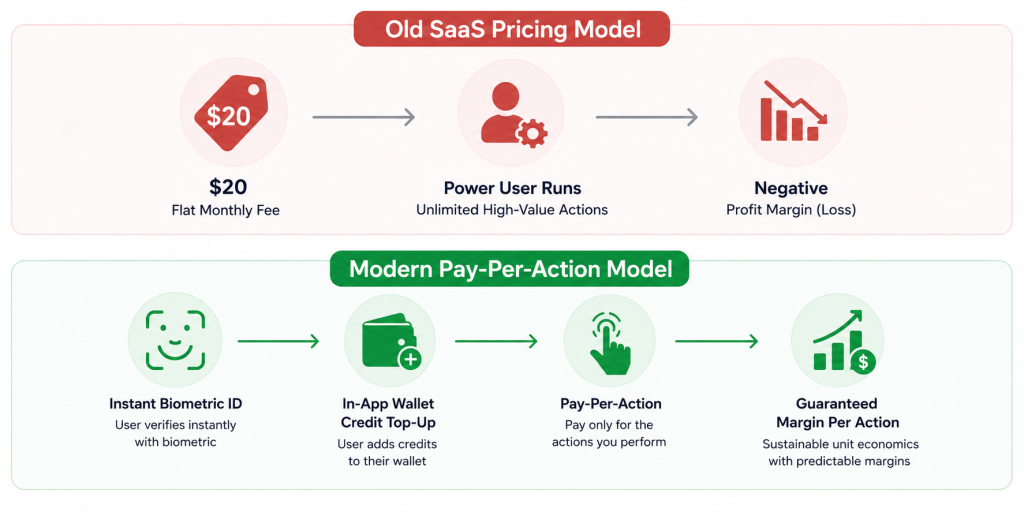
To understand why flat-rate pricing is collapsing for feature-rich mobile products, business owners must look at the structural flaws inherent in legacy software pricing:
pricing model

The Heavy User Deficit

Under traditional flat pricing, a light user who opens your app once a week pays $20. A heavy business user who relies on your app six hours a day also pays $20. In legacy software, that disparity was fine because server costs were negligible.

In modern, feature-heavy mobile apps, server computing costs scale directly with usage. The heavy power user who consumes 80% of your operational computing budget pays the exact same monthly fee as the casual user. Instead of power users driving your growth, they actively erode your net profit margins.

Subscription Fatigue & High Churn

On the customer side, buyer behavior has shifted dramatically. Consumers and enterprise buyers alike are actively auditing their recurring bank statements. They are tired of committing to $200+ annual subscriptions for tools they only use sporadically.

When forced to choose between committing to yet another monthly recurring bill or walking away, a growing majority of mobile users choose to walk away before ever experiencing the core value of your product.

The $5 to $20 “Dead Zone”

The middle tier of consumer and small-business software pricing is fast becoming unsustainable. Apps must either be completely free entry points monetized through secondary services, or they must transition to transparent, usage-based consumption where pricing strictly reflects the business value delivered.

2. The Pay-Per-Action Blueprint: The 3 Core Pillars

Transitioning your product from a flat monthly fee to a flexible, consumption-based model does not mean confusing your customers with complex bills. Instead, modern mobile software relies on three non-technical business pillars to create a seamless buying experience:

Pillar A: In-App Digital Credit Meters

Instead of charging a customer’s credit card 10 cents every time they tap a button—which is financially impossible due to fixed credit card processing fees—apps issue internal credit meters.

Customers purchase simple, one-tap credit top-up packs (e.g., $10 for 100 credits, or $50 for 600 credits). The app deducts credits transparently based on the value of the action:

  • Basic Task (e.g., fetching a simple summary): Deducts 1 Credit
  • Advanced Task (e.g., generating a full business report): Deducts 10 Credits
  • Complex Automated Task (e.g., running a multi-step workflow): Deducts 25 Credits

Customers feel they are paying fairly for what they actually use, and your business guarantees a healthy profit margin on every single button tap.

Pillar B: Biometric Fraud Protection


When in-app credits carry real financial value, protecting your product from trial abuse becomes a core business strategy.

If your app offers 20 free starter credits to attract new sign-ups, malicious users or automated scripts will attempt to create thousands of fake accounts to harvest free compute power.

Modern mobile platforms solve this by integrating quick biometric identity checks (such as a 1-second facial scan or device fingerprint login) during onboarding. This ensures that your promotional budget goes strictly to real human prospects who can convert into paying customers, rather than bot networks draining your operational budget.

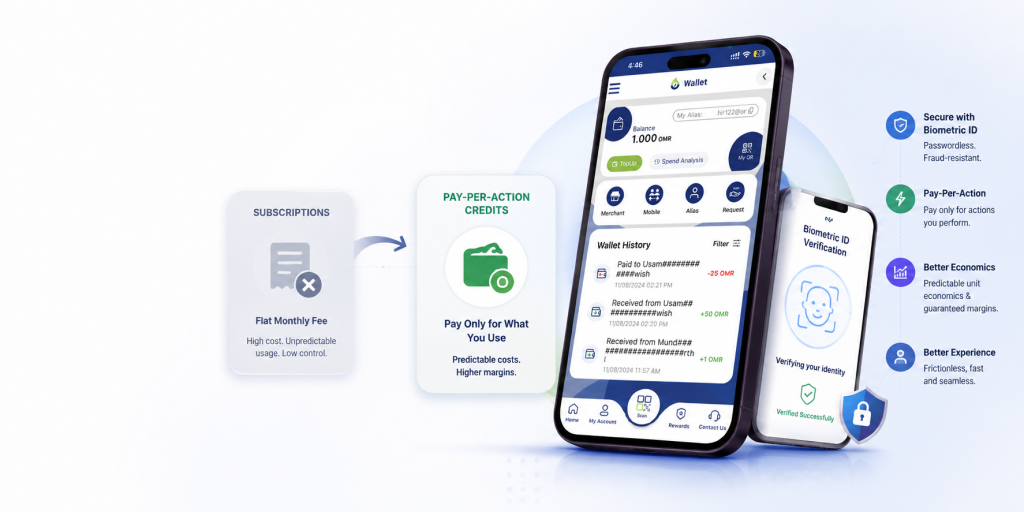
Pillar C: Embedded Micro-Wallets

To make spending money inside your app feel effortless, the payment flow must be friction-free.
digital wallet

Leading apps embed lightweight digital wallets directly into the mobile interface. Users can top up their wallet balance instantly using one-tap payment options like Apple Pay or Google Pay. Once loaded, micro-deductions happen quietly in the background, eliminating the friction of filling out credit card details every time a user needs more credits.

3. Financial Comparison: Flat Subscriptions vs. Pay-Per-Action

To evaluate how this pricing shift impacts your bottom line, consider how traditional subscriptions compare directly against metered digital wallets across key business metrics:

Business Metric Traditional Flat Subscription ($20/mo) Pay-Per-Action Micro-Wallet Model

Profit Margins

Unpredictable & Vulnerable. Power users eat away your profit margins as usage grows.


Protected & Guaranteed. Every feature call is priced to guarantee a baseline gross margin.

Customer Acquisition Friction

High. Buyers hesitate to sign up for another long-term monthly credit card charge.

Low. Customers start with small, low-risk credit top-ups ($2 to $10) with no recurring commitment.

Revenue Ceiling per Customer

Hard Capped at $20/mo. You cannot capture more revenue even if you deliver massive enterprise value.

Uncapped. Heavy business users who extract high value willingly spend $150–$500+ monthly.

Account Abuse & Trial Leakage

High Risk. Bot networks and fake emails drain promotional resources without penalty.

Blocked. 1-second biometric identity verification locks free trial credits to single verified humans.

Customer Retention & Loyalty
Vulnerable to Churn.

Customers cancel when they feel they didn't use the app enough in a given month.

High Retention. Unused credit balances remain available, keeping customers tied to your ecosystem without penalty.

Let's Build Together

Is Your Mobile App Model Eating Your Profit Margins?

Protect your unit economics by upgrading to high-converting pay-per-action micro-wallets and biometrics today.

Audit Your App Model

4. Strategic Advantages for Founders & Business Owners

Shifting to an intent-driven, pay-per-action monetization strategy transforms your core business performance in three vital ways:

1. Removing Revenue Ceilings

Under a flat $20 monthly plan, your revenue per user stops at $240 a year, regardless of whether that user generates thousands of dollars in business value using your tool.

Under a pay-per-action credit system, enterprise clients or high-volume power users naturally consume more credits as your app becomes central to their operations. Your revenue scales automatically alongside the real business value you provide, unlocking enterprise-level revenues from your most active users without negotiating complex custom contracts.

2. Dramatically Lowering Onboarding Friction

The hardest part of growing a digital product is getting a user to hand over their credit card for a recurring monthly bill.

By offering a low-cost $2 top-up or a small starter credit pack, you remove the psychological barrier of recurring financial commitments. Prospects try your product with zero fear of hidden monthly charges, driving significantly higher sign-up conversions and reducing your customer acquisition cost (CAC).

3. Creating Predictable Cash Flow & Unit Economics

When every feature inside your mobile application is mapped to an internal credit cost that exceeds its baseline delivery cost, your business achieves true unit-economic predictability. You no longer have to worry about unexpected spikes in server costs during high-traffic months, because increased usage directly correlates with increased credit purchases and higher net revenue.

5. Implementation Roadmap: How Business Leaders Can Transition

If your current software product or upcoming digital roadmap involves feature-heavy processing, automated workflows, or advanced digital services, updating your business model should be an immediate strategic priority.

Follow this 4-step execution framework:

Step 1: Conduct a Feature Cost & Margin Audit

Identify your app’s top 5 most popular features. Calculate the exact backend operational cost required to execute each feature once. Compare that operational cost against what your average user currently pays under your subscription plan to identify whether heavy users are running at a net loss.

Step 2: Establish Your Credit Value & Pricing Tiers

Create a simple credit exchange rate (e.g., 100 Credits = $10). Assign clear credit prices to your app’s features based on the business value delivered and the margin you want to protect. Keep the pricing structure transparent so customers always know what a task costs before tapping.

Step 3: Implement One-Tap Wallet Top-Ups

Eliminate all friction from the purchasing process. Integrate one-tap digital payment flows (such as native Apple Pay and Google Pay integration) directly into your app’s wallet screen, allowing users to replenish their balance in under three seconds.

Step 4: Secure Free Trials with Biometric Verification

If you offer free starter credits to new sign-ups, implement lightweight biometric identity checks during onboarding. Ensuring one verified person receives one free credit allocation protects your operating budget from bot networks and trial abuse.

Explore digital wallet case study

Partnering with Mindster to Modernize Your Revenue Engine

Transitioning from rigid monthly subscriptions to a flexible, high-margin micro-wallet model requires a strategic combination of smooth user experience design, secure payment architecture, and reliable account management systems.

At Mindster, we specialize in helping business owners, product founders, and scaling enterprise teams transform legacy digital applications into high-converting, profitable mobile platforms.

Our core business and engineering solutions include:

  • Custom Digital Wallet Integration: Building seamless, in-app credit meters and balance management systems that make spending effortless for your customers.
  • Frictionless Payment Gateways: Integrating secure, high-conversion payment flows designed for instant, one-tap credit purchases.
  • Biometric Identity Protection: Implementing fast, user-friendly biometric identity verification to protect your trial budgets from account fraud and automated bot abuse.
  • Software Product Modernization: Upgrading outdated app architectures into responsive, modern mobile products designed for measurable financial growth.

Protect Your Profits and Scale Your Mobile Revenue

If your app’s subscription model is struggling to deliver sustainable profit margins, or if you are planning to launch a new feature-rich mobile product, our team is ready to help you build a modern monetization roadmap.

Let's Build Together

Transform Your App into a High-Margin Platform

Eliminate subscription friction and capture lost revenue with custom, usage-based mobile payment solutions.

Build Your Revenue Roadmap
Akhila Mathai
THE AUTHOR

Akhila Mathai

senior content strategist

LinkedIn

Akhila drives the content strategy at Mindster, combining analytical clarity with a passion for digital product innovation. With a deep focus on mobile app strategy and software solutions, she bridges the gap between engineering complexity and intuitive user experiences. She thoughtfully articulates tech concepts, transforming frameworks, case studies, and digital transformation trends into actionable insights for product teams and business leaders.


FAQ'S

Strategic FAQ for Industry 4.0 & Custom MES

Flat subscriptions assumed server costs per user were close to zero. Modern, feature-rich apps trigger high-compute infrastructure calls for every complex action, meaning heavy users consume more computing budget than their monthly fee covers, directly eroding your profit margins.
It removes subscription friction. Instead of forcing users into a high-risk $200+ annual commitment up front, customers can start with small, low-cost credit top-ups ($2 to $10) and only pay when they derive actual value from the application.
When apps issue free promotional starter credits to acquire users, bot networks and multi-account farming attempt to harvest those credits for free compute. One-second biometric identity checks during sign-up ensure free credits go strictly to verified human prospects.
Conduct a feature-level cost audit to calculate the exact infrastructure cost of executing each feature once. Then, establish a credit exchange rate (e.g., 100 Credits = $10) and set credit prices above your base delivery costs to guarantee positive margins on every user action.
LATEST BLOG

Latest tech tips, news, and repair insights