
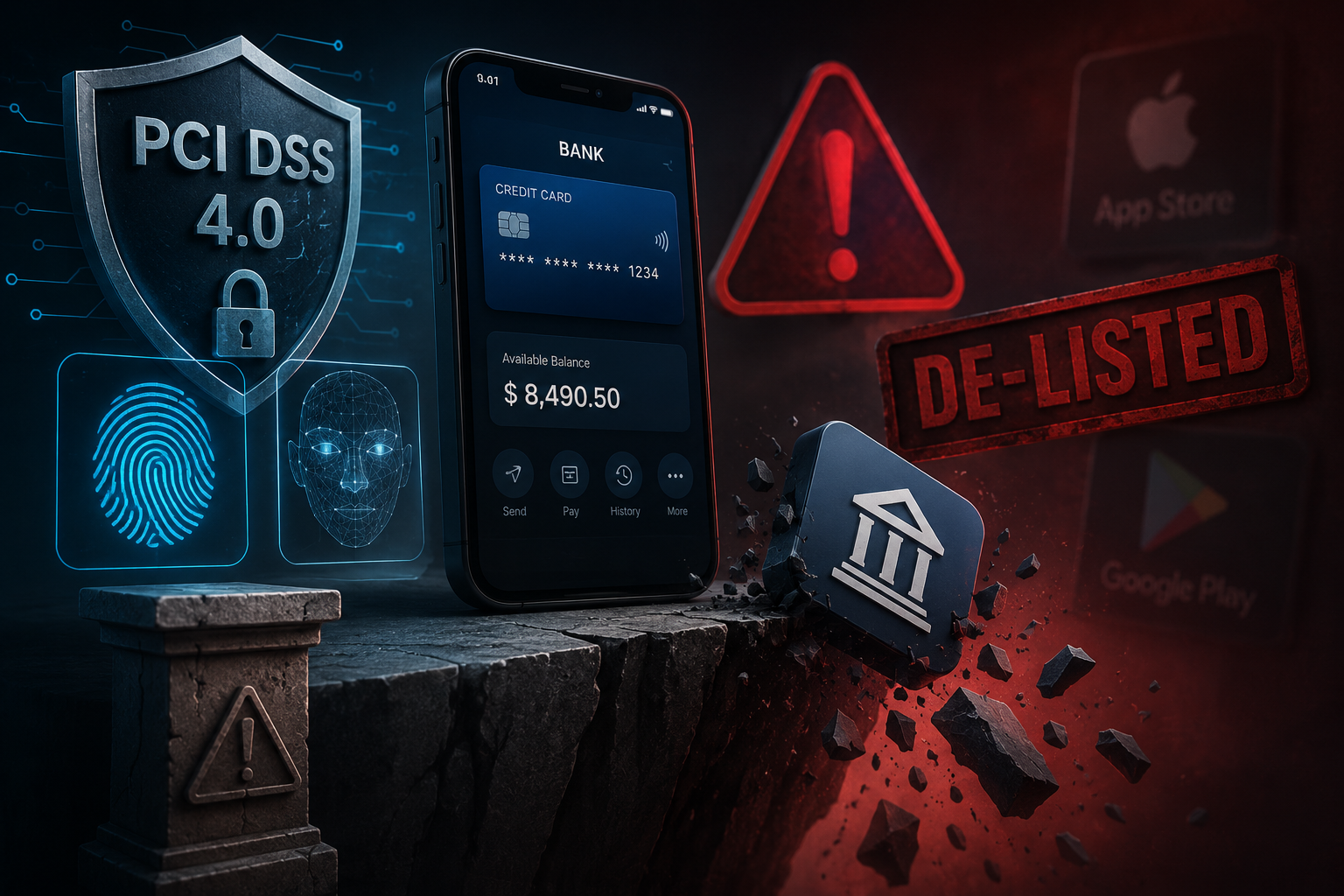
Let’s be honest: nobody built a fintech startup because they were passionate about PCI compliance.
You built it to move money faster, kill friction, and take market share from slow, dusty banks. Compliance has always felt like that annoying tax you pay to stay in business—something you kick down the road until a partner bank or auditor forces your hand.
But the game just changed, and most founders are building on borrowed time.
Regulators are no longer just sending polite warning letters; they’re quietly de-listing apps and pulling payment processing rails. Central banks have declared war on SMS passcodes, and app stores are enforcing strict behavioral biometric rules.
The real kicker?
The outdated security tools your team is using right now aren’t just putting you in regulatory crosshairs—they’re actively killing your checkout conversion rates.
You don’t need a 200-page PDF of legal jargon. You need to know what breaks, why it breaks, and how to keep your app live and making money. Let’s talk about what’s actually happening under the hood.
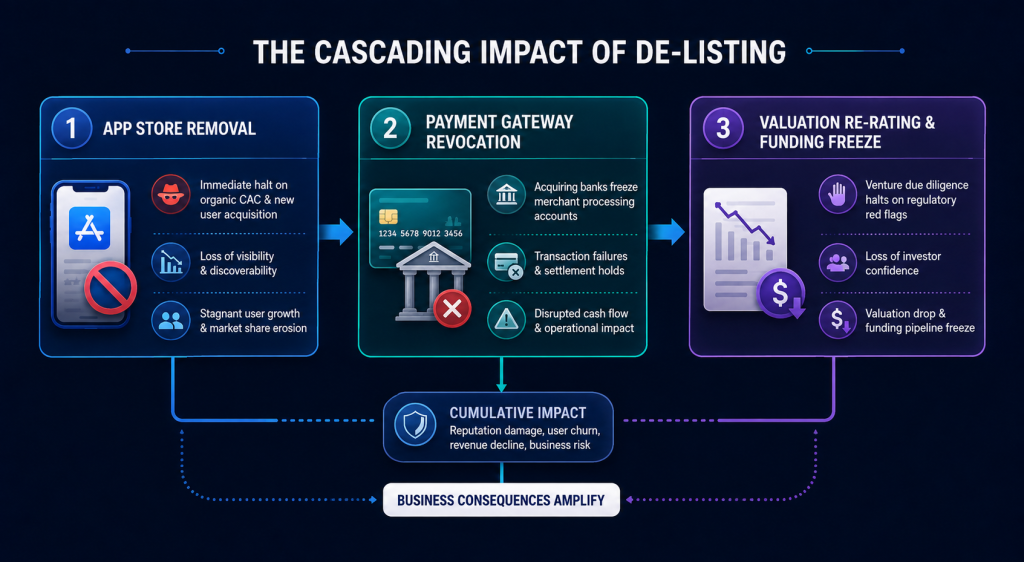
The Hidden Costs of Non-Compliance: Beyond Fines to Existential Threats
When non-technical executives think about regulatory non-compliance, they usually worry about direct financial penalties. While PCI DSS 4.0 non-compliance fines can range from $5,000 to $100,000+ per month depending on transaction volume, the secondary consequences are far more destructive to a scaling startup:
The Strategic Problem: Moving Beyond “Password → OTP → Transaction”
The traditional fintech authentication sequence is familiar:
Username → Password →OTP →Transaction
It works. It is also increasingly showing its age.
PCI DSS 4.0 has raised the bar around authentication and access control into the Cardholder Data Environment (CDE). Apple and Google continue to tighten expectations around financial apps, security, and user protection. At the same time, fraudsters are getting better at exploiting stolen credentials, SIM swaps, phishing, and compromised devices.
This leaves founders with a fundamental strategic question: How do you make authentication stronger without making the product harder to use?
The answer is rarely “another OTP.” It lies in an authentication architecture that operates invisibly in the background—combining device trust, native biometrics, behavioral signals, and continuous risk assessment.
Password →OTP →Transaction
It works. It is also increasingly showing its age.
PCI DSS 4.0 has raised the bar around authentication and access control into the Cardholder Data Environment (CDE). Apple and Google continue to tighten expectations around financial apps, security, and user protection. At the same time, fraudsters are getting better at exploiting stolen credentials, SIM swaps, phishing, and compromised devices.
This leaves founders with a fundamental strategic question: How do you make authentication stronger without making the product harder to use?
The answer is rarely “another OTP.” It lies in an authentication architecture that operates invisibly in the background—combining device trust, native biometrics, behavioral signals, and continuous risk assessment.
Myth Busting: What PCI DSS 4.0 Actually Requires
A point often missed in fintech product discussions: PCI DSS 4.0 does not state that every fintech application must implement fingerprint or facial recognition.
The PCI Security Standards Council (SSC) defines three distinct authentication factors:
- Something you know — Password, PIN, or passphrase.
- Something you have — Physical token, smart card, OTP device, or phone/SIM.
- Something you are — Biometric characteristics (fingerprint, facial, or voice recognition).
Multi-Factor Authentication (MFA) requires using at least two independent factors from these distinct categories. For founders, the core question is not whether the app includes biometrics, but whether the authentication design can demonstrate the right level of assurance for the systems and transactions in scope.
Furthermore, PCI DSS 4.0 expands the scope of MFA requirements for access to the CDE. Requirement 8.4.2 explicitly covers MFA for access into the CDE, while other requirements apply depending on the system and access path.
 Let's Build Together
Is Your Fintech Security Architecture Ready for 2026?
Identify authentication gaps, PCI DSS 4.0 risks, and opportunities to strengthen security without adding unnecessary friction to your users.
Assess Your Security Architecture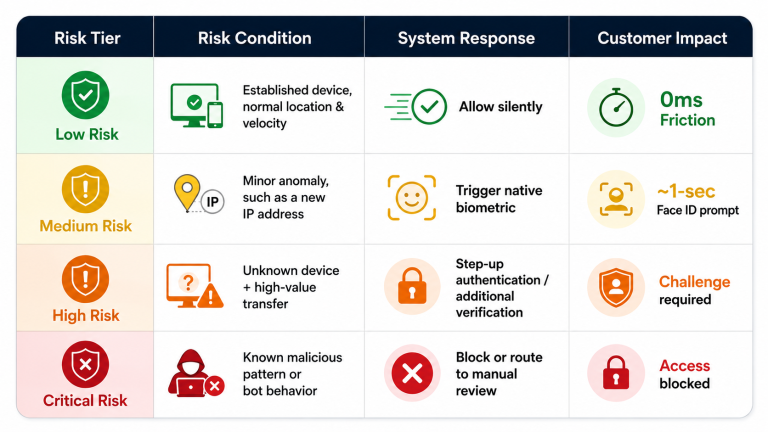
When 95% of your transactions are verified as low-risk in the background, you reserve authentication friction only for the moments that genuinely warrant it. Compliance and conversion begin to reinforce each other.
Biometrics Introduce Their Own Compliance Traps
It is tempting to treat biometric storage as a quick fix, but storing raw biometric data on your backend creates severe privacy, security, and compliance liabilities.
The PCI MFA guidance explicitly states that biometric data must be protected against unauthorized replication or misuse. It also highlights the heightened risks when authentication elements rely on multipurpose consumer devices like smartphones.
❌ HIGH RISK PATTERN:
Camera / Fingerprint ──► Raw Biometric Data ──► Fintech Backend Database
✅ SAFER ARCHITECTURAL PATTERN:
Device Biometric ──► OS Security Layer (Enclave) ──► Cryptographic Assertion ──► Auth Service
Where possible, mobile applications should leverage platform-native mechanisms (such as Apple’s Local Authentication framework or Android’s Biometric Prompt) rather than building custom biometric capture engines. Apple’s App Store guidelines specifically require financial apps to utilize native OS-level authentication layers.
Biometric authentication does not mean your backend needs to possess your customer’s biometric data.
The Hidden PCI DSS 4.0 Pitfall: Payment Page Scripts
Authentication isn’t the only area where fintechs get caught off guard. PCI DSS 4.0 Requirement 6.4.3 introduces strict new controls around all scripts running on payment pages.
Payment-page scripts must be:
- Authorized and inventoried.
- Integrity-controlled to prevent unauthorized modification.
- Written with documented justification for why each script is necessary.
This applies directly to third-party and fourth-party scripts. If your checkout flow loads analytics, chat widgets, marketing tags, and fraud SDKs simultaneously, every single script expands your compliance attack surface. You must know exactly what code is executing around your payment experience—and why.
The Founder Strategy: The Compliance Firewall Architecture
Founders should avoid tightly coupling regulatory requirements with core product logic. Instead, deploy a Compliance & Risk Middleware Layer:
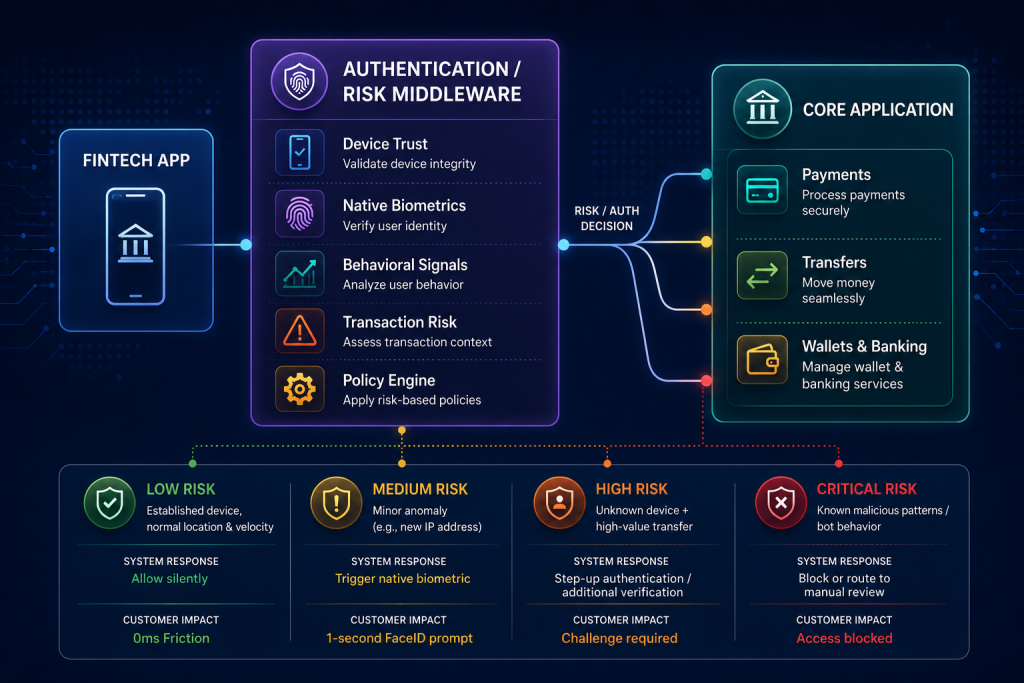
This creates a compliance firewall. Your product engineering team can continue shipping new payment flows, onboarding journeys, and loyalty features without embedding complex, fast-changing regulatory logic throughout the primary application codebase.
The 90-Day Execution Roadmap
You don’t need to freeze your roadmap for six months to address this. A focused 90-day program establishes a resilient foundation:
Days 1–30: Discover & Audit
- Map the Cardholder Data Environment (CDE): Trace all systems, API paths, and databases in scope for PCI DSS 4.0.
- Inventory Third-Party Scripts: Audit all scripts and SDKs running on payment pages (Requirement 6.4.3 compliance).
- Review App Store Posture: Confirm developer accounts and financial feature declarations match Apple and Google regulatory guidelines.
Days 31–60: Architect & Decouple
- Design the Risk Engine: Define fallback mechanisms, device-trust models, and step-up rules.
- Deprecate Bare SMS OTPs: Transition primary secondary factors toward device-bound passkeys or native biometric assertions.
- Establish Policy Rules: Map low-risk vs. high-risk transaction thresholds.
Days 61–90: Implement & Isolate
- Deploy Security Middleware: Implement an isolated auth/risk service layer between frontend UIs and backend core services.
- Integrate Native OS Biometrics: Hook into platform-native LocalAuthentication frameworks.
- Verify Audit Logging: Ensure immutable, time-synchronized logging (Requirement 10.4) across all CDE access points.
The Bottom Line
PCI DSS 4.0 isn’t just an IT security ticket—it’s a fundamental product architecture decision.
Founders who win won’t be the ones who stack the most authentication steps in front of their customers. They will be the ones who build intelligent, risk-adaptive architectures that make bank-grade security feel entirely invisible.
Don’t wait for an urgent notification from an acquiring bank or an app store rejection letter to audit your security stack.
At Mindster, we specialize in building high-scale digital products, fintech wallets, and mobile apps that pass complex regulatory audits without sacrificing conversion rates. Whether you need a PCI DSS 4.0 readiness audit or a risk-based authentication architecture, our product engineering team is ready to help.
Contact Mindster Today to Schedule Your Security & Architecture Consultation

Ahamed Sajid is a technology delivery leader focused on building scalable systems that bridge business strategy and execution. With experience across fintech, mobility, e-commerce and enterprise platforms, he specializes in designing structured approaches to complex problem-solving and product delivery. He is particularly interested in how well-defined systems, processes, and technology frameworks can drive sustainable growth and operational clarity. Through his work, Ahamed advocates for pragmatic innovation where ideas are shaped into reliable, high-impact solutions that deliver real-world value.