
Building a successful digital product requires balancing engineering efficiency with flawless end-user performance.
For years, cross-platform frameworks forced businesses to compromise—accepting minor UI lags, ballooning codebase sizes, or fragmented platform behaviors in exchange for faster time-to-market. In this blog, we explore how modern Flutter has evolved beyond a simple mobile UI toolkit into a robust, enterprise-grade engine. By leveraging the Impeller rendering engine, Dart 3’s type safety, and a unified multi-platform compilation strategy, we demonstrate how businesses can eliminate platform-specific fragmentation, slash engineering overhead, and deliver native-performance experiences across Android, iOS, Web, and Desktop from a single codebase.
The modern Flutter ecosystem changes this equation entirely. No longer just a mobile UI toolkit, Flutter has evolved into a robust, multi-platform runtime engine capable of powering production-grade applications across Android, iOS, Web, Desktop, and embedded devices from a single, unified codebase.
1. High-Performance Graphics via the Impeller Engine
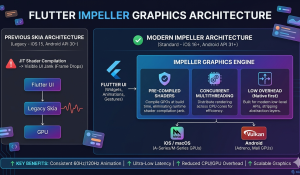
Historically, cross-platform frameworks relied on runtime UI interpretation or just-in-time shaders, occasionally causing noticeable frame drops (jank) during initial page transitions or complex animations. Flutter’s transition away from the legacy Skia engine to Impeller solves this bottleneck fundamentally.
Impeller optimizes the rendering pipeline through three distinct engineering choices:
-
Pre-compiled Shaders: Impeller compiles its complete set of Graphics Pipeline Objects (GPOs) during the initial build phase rather than at runtime. This completely eliminates compilation-induced frame drops, ensuring consistent 60Hz or 120Hz scrolling from the very first launch
-
Concurrent Multithreading: The engine distributes single-frame workloads across multiple CPU cores, preventing the UI thread from bottlenecking during high-density rasterization tasks.
-
Modern API First: Built explicitly to target modern low-level graphics APIs like Metal on iOS/macOS and Vulkan on Android, Impeller strips out legacy abstraction layers to talk directly to device hardware.
You may also like Flutter Vs React Native: which one is best for your next project?
2. Structural Integrity with Dart 3 and Sound Null Safety
A framework is only as reliable as its underlying programming language. The modern Flutter ecosystem runs on Dart 3, a language optimized for client-side compilation and rigorous type safety.
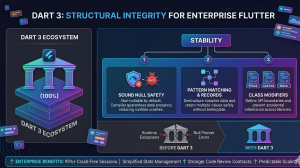
For enterprise software architectures, Dart 3 introduces structural safeguards that drastically reduce runtime errors and regression risks:
-
100% Sound Null Safety: Dart’s compiler strictly enforces that variables cannot contain null unless explicitly declared. By catching null reference vulnerabilities during compilation rather than in production, teams experience a major drop in application crashes.
-
Pattern Matching and Records: Developers can destructure complex data shapes and safely return multiple structured values from a single function without inventing throwaway wrapper classes. This clean syntax reduces boilerplate code in state management layers.
-
Class Modifiers: Control whether classes can be extended, implemented, or mixed in outside of their defining library. This allows platform developers to build immutable, highly predictable domain models that external teams cannot accidentally break.
3. True Multi-Platform Compilation from One Codebase
While the initial promise of cross-platform was limited to sharing business logic between Android and iOS, modern Flutter treats Desktop, Web, and Foldables as native peers.
Desktop Maturity (macOS, Windows, Linux)
Flutter compiles directly to native x64 or ARM64 machine code for desktop environments. Rather than running inside a heavy, resource-intensive browser wrapper, desktop targets execute as native binaries with direct access to local file systems, native menus, and hardware peripherals.
Web Optimization via WebAssembly (Wasm)
For web deployment, modern Flutter leverages WebAssembly (Wasm). Instead of compiling Dart code down to complex JavaScript abstractions, Wasm allows the application logic to execute at near-native speeds directly in the browser. Combined with CanvasKit rendering, Flutter web applications achieve smooth UI interactions that mirror native desktop application profiles.
Responsive Form Factors & Foldables
With native display APIs built directly into the window property layer, Flutter dynamically reads physical display hinges and screen posture changes. Layout parameters adjust fluidly as a user unfolds a device, splitting views or expanding canvases without requiring app restarts or state loss.
4. Default Enterprise Design with Material 3
User experience expectations have evolved beyond simple flat layouts. Flutter embeds Material Design 3 directly into its core design tokens by default.
This deep integration offers design and development teams immediate access to modern layout components, dynamic color generation based on user settings, expressive typography configurations, and enhanced accessibility support out of the box. Teams spend less time styling primitive interface elements and more time engineering bespoke brand animations and intuitive workflows.
Strategic Value: Why Modern Flutter Dominates Product Roadmaps
When evaluating technical debt and long-term project viability, engineering leaders choose the modern Flutter ecosystem for its concrete operational advantages:
- Accelerated Feature Velocity: Teams maintain a single, cohesive source of truth. A single code modification updates business logic, security patches, and UI presentations across mobile, web, and desktop instantly.
- Reduced Engineering Overhead: Instead of siloing development teams into distinct Swift, Kotlin, and JavaScript groups, organizations run lean, cross-functional engineering teams using a unified toolchain.
- Predictable UX Across Platforms: Because Flutter owns its pixel-rendering pipeline via Impeller, your application looks, behaves, and performs identically across diverse hardware ecosystems, mitigating device-specific interface bugs.
The modern Flutter ecosystem has transitioned from a promising multi-platform alternative into a dominant framework for high-scale, cross-platform product engineering. By isolating performance bottlenecks at the compiler and rendering levels, Flutter enables software teams to build faster, scale further, and deliver exceptional digital experiences on any screen.
Enterprise Governance: A CTO’s Guide to Adoption
When moving toward a unified Flutter strategy, decision-makers often face questions regarding integration and long-term stability.
The Migration Path
You do not need to commit to a “big bang” rewrite. Flutter supports Add-to-App integration, allowing you to embed Flutter modules directly into existing native codebases. Using the Strangler Fig Pattern, you can replace legacy views with modern Flutter screens incrementally, minimizing risk and spreading costs over multiple development cycles.
Proven Scale and Adoption
Flutter is not a theoretical tool; it is battle-tested by global giants managing massive, transaction-dense user bases:
- Google (Wallet & Pay): Standardized their global security and payments architecture on Flutter.
- Automotive Leaders (BMW & Toyota): Utilize Flutter for high-performance in-vehicle infotainment systems.
- Alibaba: Powers retail experiences for hundreds of millions of users, proving stability at absolute scale.
Integration and Security
Flutter integrates seamlessly into existing enterprise environments:
- DevOps: Fully compatible with standard CI/CD pipelines (GitHub Actions, GitLab CI, Jenkins, Codemagic).
- Security: Because Flutter compiles to native binaries, it supports robust security protocols including SSL pinning, standard encryption at rest, and advanced code obfuscation.
- Backend Agnostic: It connects natively to any REST, gRPC, or GraphQL backend, making it a drop-in replacement for existing frontend architectures.
Long-Term Support and Stability
Google maintains a highly predictable, quarterly release cadence for Flutter. As an open-source framework backed by a massive global community and a diverse steering committee, your stack is protected from vendor lock-in and single-point-of-failure risks.
Strategic Conclusion
Modern Flutter has transitioned from an alternative framework to the industry standard for high-scale, cross-platform engineering. By unifying the toolchain, eliminating rendering bottlenecks, and providing a robust, type-safe development environment, organizations can reduce engineering overhead while simultaneously elevating the quality of their digital products.
Looking to modernize your application architecture?
At Mindster, we engineer high-performance cross-platform digital solutions tailored for enterprise scale. Connect with our engineering curators today to plan your transition to a unified, modern Flutter ecosystem.
Also read: Flutter vs Java: What’s Best for Your Next Android App
Explore Top Flutter Tools and Plugins Developers Must Use in 2025

Akhila drives the content strategy at Mindster, combining analytical clarity with a passion for digital product innovation. With a deep focus on mobile app strategy and software solutions, she bridges the gap between engineering complexity and intuitive user experiences. She thoughtfully articulates tech concepts, transforming frameworks, case studies, and digital transformation trends into actionable insights for product teams and business leaders.