


Picture a flash-sale weekend where your marketing campaign hits every target—only for your storefront to crash at checkout because three WooCommerce plugins fought over the same database table. Or imagine waiting four months and spending lakhs just to launch a basic B2B pricing tier on Magento because every update threatens to break your core checkout flow.
If you run a growing e-commerce brand, this isn’t hypothetical—it’s the daily cost of running on a monolithic platform. Medusa, an open-source, TypeScript-first headless commerce engine, eliminates this bottleneck by separating your customer-facing storefront from a fast, modular backend built for scale.
Key Takeaways
- Monoliths tax your speed: Magento and WooCommerce tie your storefront and backend together, meaning heavy traffic or plugin updates routinely stall checkouts and delay new feature launches.
- Real brands see measurable gains: Global merchants like Tekla and Mitsubishi Electric Europe replaced rigid legacy setups with Medusa, cutting page load times by over 50% and launching multi-region stores in weeks rather than quarters.
- You don’t need a risky “big bang” launch: Using API-based delta syncs, you can migrate catalogs, inventory, and customers in stages with near-zero downtime.
- Total cost of ownership drops: Eliminating enterprise licensing fees and constant PHP maintenance lets your engineering budget go toward conversion-driving features instead of keeping the lights on.
Why Legacy Platforms Break When You Scale
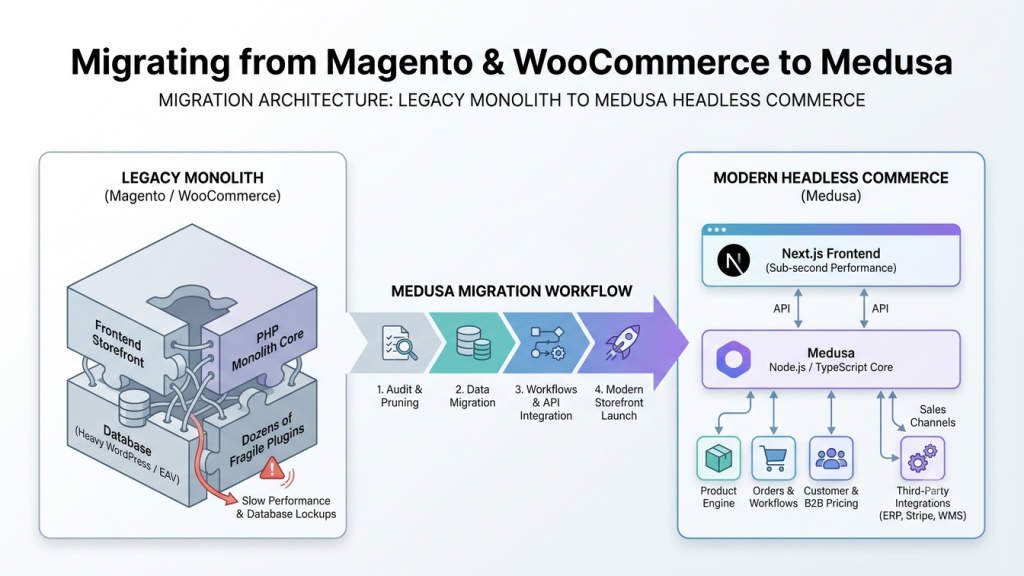
Magento (Adobe Commerce) and WooCommerce were built for an era when online stores were simple digital catalogs. Today, your customers expect sub-second mobile page loads, localized currencies, custom bundling, and seamless ERP syncs.
When you force a monolithic platform to handle modern demands, two real-world failure patterns emerge:
- The WooCommerce Plugin Trap: Because WooCommerce stores orders, products, and subscriptions inside WordPress’s wp_posts and wp_postmeta tables, high order volumes create severe database bottlenecks. During peak sales, background tasks like inventory syncs or abandoned-cart emails lock the database—leaving paying customers staring at a spinning checkout wheel.
- The Magento Maintenance Wall: Magento’s complex Entity-Attribute-Value (EAV) architecture requires specialized PHP developers for even minor changes. A routine security patch or third-party extension upgrade frequently triggers cascading regressions across shipping calculators, tax rules, and payment gateways.
Medusa solves both problems by decoupling your architecture. Your storefront (typically built in Next.js) communicates with Medusa’s Node.js commerce engine via clean APIs, while custom business logic—like ERP integrations or loyalty rules—runs in isolated workflows that never threaten checkout stability.
Proven in Production: Real-World Case Studies
Moving off an established platform is a major business decision, yet leading enterprise and direct-to-consumer brands have already leaped to Medusa with clear commercial results:
Tekla: Slashing Load Times and Unlocking Global Expansion
Danish homeware brand Tekla outgrew its legacy monolithic setup as international demand surged. Slow page speeds and rigid multi-currency constraints were hurting mobile conversion rates across European and global markets.
- The Shift: Tekla migrated to a headless architecture powered by Medusa and a modern React storefront.
- The Outcome: Site performance jumped dramatically, mobile bounce rates dropped, and their team gained the agility to roll out localized storefronts, custom tax rules, and regional payment methods without rebuilding core infrastructure.
Mitsubishi Electric Europe: Unifying Complex Multi-Country Commerce
Managing distributor networks, spare-parts catalogs, and varying regional compliance rules across Europe created heavy operational friction on Mitsubishi Electric Europe’s legacy architecture.
- The Shift: They adopted Medusa to unify multi-region catalog management, custom pricing tiers, and localized fulfillment workflows under one modular engine.
- The Outcome: Instead of maintaining fragmented regional installations, their engineering team now manages multiple European markets from a single codebase—cutting feature deployment cycles from months to days.
Visionare: Escaping Agency Bottlenecks for B2B & DTC
Fast-growing commerce brands like Visionare faced ballooning retainer fees and multi-week turnaround times whenever marketing wanted to test new bundles or checkout flows on their legacy stack.
- The Shift: Moving to Medusa allowed their lean internal team to own their commerce workflows directly in TypeScript.
- The Outcome: Checkout customization became a matter of hours, hosting costs stabilized, and third-party logistics (3PL) integrations stopped breaking during high-volume drops.
Wondering what a migration looks like for your exact catalog size and tech stack?
Don’t guess your timeline or budget. Get a tailored technical audit of your current Magento or WooCommerce plugins, custom integrations, and a clear roadmap for moving to Medusa without disrupting daily sales.
Book Your Free Commerce Architecture AuditHow the Migration Works: A Low-Risk Playbook for Business Owners
A well-executed migration protects your revenue, your customer data, and your hard-earned Google rankings. Here is how technical teams move you from Magento or WooCommerce to Medusa safely:
1. Audit Plugins and Cut Dead Weight
Most mature stores carry 30 to 50 extensions—many of them abandoned or redundant. Your team audits every active plugin and sorts it into Keep, Replace, or Drop. Medusa includes multi-currency, regional pricing, and discount engines out of the box, so you only rebuild workflows that actually differentiate your business.
2. Map Your Catalog and Store Rules cleanly
Your legacy data translates cleanly into Medusa’s modular schema without losing product relationships:
| Business Element | Magento / WooCommerce | Medusa Equivalent |
|---|---|---|
Product Variants | Configurable or Variable products | Products with structured options & variants |
Multi-Region Stores | Store Views or Multisite plugins | Native Sales Channels & Regions |
B2B / Wholesale Pricing | Customer groups & tier-price plugins | Built-in Customer Groups & Price Lists |
ERP & Logistics Syncs | Fragile PHP hooks & cron jobs | Event-driven Workflows & Subscribers |
3. Run Staged API Migrations (No Big-Bang Risk)
Rather than relying on error-prone CSV exports, engineers build an API-based importer that pulls products, stock levels, customers, and order history directly from Magento or WooCommerce. Because it tracks source IDs, you can test the entire new store on staging while your old store keeps taking orders—then run a quick final sync right before launch.
4. Protect Your SEO Equity and Customer Accounts
- 301 Redirects: Every legacy URL (such as Magento’s .html product links or WooCommerce’s /product/ slugs) is mapped with server-side 301 redirects so you don’t lose organic search traffic.
- Frictionless Logins: Because legacy password hashes cannot be exported directly for security reasons, customer profiles and shipping addresses migrate intact, and returning buyers get a seamless one-click password reset on their first login.
How Customizable Is Medusa for Unique Business Workflows and Integrations?
Medusa is built as an extensible Node.js/TypeScript commerce framework rather than a rigid SaaS template. When a standard commerce platform cannot model your pricing, fulfillment, or backend stack, Medusa lets your engineering team build custom behavior using decoupled primitives that never break core updates:
- Custom Modules & Data Models: You can introduce brand-new database entities and business domains—such as subscription schedules, rental periods, multi-vendor seller payouts, or license-key pools—without altering Medusa’s core product or order tables.
- Durable Workflows with Rollback: Complex processes (like splitting a single cart across multiple warehouses, reserving ERP stock, and capturing payment) run as multi-step Workflows. If step 3 fails—say an ERP API times out—Medusa automatically runs compensation logic to roll back earlier steps so inventory and payments stay in sync.
- Event Subscribers & Scheduled Jobs: Subscribers react asynchronously to commerce events (such as order. placed or customer.created) to trigger webhooks, CRM updates, or WhatsApp notifications, while scheduled jobs handle recurring tasks like nightly price or catalog syncs.
- Custom ERP, WMS & Payment Connectors: Even if a regional payment gateway or legacy ERP (like SAP Business One, NetSuite, Microsoft Dynamics 365, or a custom warehouse system) lacks an off-the-shelf plugin, engineers can wrap its REST, GraphQL, or OData API inside a dedicated Medusa module.
- Tailored Admin Extensions: Teams can inject custom widgets, approval screens, or order-management views directly into the Medusa Admin dashboard so operations staff manage everything in one place.
Main Migration Risks & How They Are Proactively Managed
Moving an active store carries operational and commercial risks, particularly around revenue continuity, data accuracy, and organic search visibility. Experienced teams neutralize each risk before launch:
| Risk Area | What Can Go Wrong | Proactive Mitigation Strategy |
|---|---|---|
SEO & Organic Traffic Drops | Changed URL structures (e.g., dropping Magento’s .html or WooCommerce’s /product/ paths) cause 404 errors and lost rankings. | Crawl every legacy URL pre-launch, deploy a complete server-side 301 redirect map, preserve meta tags and JSON-LD schema, and monitor Google Search Console daily post-cutover. |
Data Corruption or Duplicate Records | Re-running CSV imports or poorly mapped scripts creates duplicate SKUs, broken variant links, or mismatched stock counts. | Build idempotent API-based importers that track source platform IDs, run full staging rehearsals, and validate row counts and tax calculations before go-live. |
Checkout Downtime During Cutover | Switching DNS mid-day causes lost orders or inventory discrepancies between the old and new databases. | Schedule cutover during low-traffic hours, place the legacy store in a brief catalog freeze, run a final delta sync for recent orders, and keep a tested rollback plan ready. |
Customer Login & Payment Friction | Legacy password hashes (bcrypt/phpass) cannot be imported into Medusa’s scrypt auth, risking abandoned checkouts from returning buyers. | Migrate customer profiles and addresses intact, trigger a seamless one-click password reset flow on first login, and coordinate payment token transfers with your payment gateway. |
ERP & Third-Party Integration Failures | Webhook mismatches or rate limits cause orders to get stuck between the storefront and fulfillment warehouse. | Stress-test all ERP, 3PL, and payment webhooks in sandbox staging, and wrap external calls in Medusa Workflows with automatic retries and dead-letter alerting. |
Final Thoughts
Holding onto a slow, fragile e-commerce platform isn’t playing it safe—it’s quietly capping your conversion rate and burning engineering hours on maintenance instead of growth. Migrating from Magento or WooCommerce to Medusa gives you the speed of a custom-built platform with the reliability of proven open-source commerce modules. When your tech stack stops getting in the way, your team can finally focus on selling.
Ready to Future-Proof Your Storefront?
Whether you are planning a phased headless rollout or a full platform migration, our commerce engineers can help you transition smoothly with zero lost orders.
Schedule a Consultation with Our Medusa Migration Team
Akhila drives the content strategy at Mindster, combining analytical clarity with a passion for digital product innovation. With a deep focus on mobile app strategy and software solutions, she bridges the gap between engineering complexity and intuitive user experiences. She thoughtfully articulates tech concepts, transforming frameworks, case studies, and digital transformation trends into actionable insights for product teams and business leaders.