
A doctor appointment booking app connects patients with healthcare professionals for in-clinic visits and virtual consultations. Building an on-demand medical booking app requires three primary modules (Patient, Doctor, Admin), regulatory compliance (such as HIPAA, GDPR, and HL7/FHIR), and seamless EHR/EMR integration. On average, developing a doctor appointment app costs between $25,000 and $100,000+, depending on feature complexity, platform selection (iOS, Android, or Cross-platform), and telemedicine capabilities.
The healthcare industry has shifted rapidly toward digital-first patient experiences. Long waiting lines, missed appointments, and manual scheduling errors are driving clinics, hospitals, and health-tech startups to adopt automated scheduling platforms.
Whether you are a healthcare enterprise optimizing your clinical workflow or a startup launching an on-demand medical platform, this guide outlines the end-to-end process of doctor appointment app development, including core features, compliance mandates, tech stack options, and complete cost estimates.
Why Invest in Doctor Appointment App Development?
Developing an automated scheduling platform delivers distinct business and operational advantages for both patients and healthcare providers.
Key Benefits for Patients
- 24/7 Self-Scheduling: Patients can browse doctor profiles, check real-time availability, and book appointments outside regular office hours without calling the front desk.
- Reduced Waiting Times: Automated time-slot allocations minimize clinic waiting room congestion.
- Automated Reminders: Push notifications, SMS, and calendar integrations significantly lower forgotten consultations.
- Centralized Medical History: Patients can store digital prescriptions, diagnostic lab reports, and appointment receipts in one secure hub.
Key Benefits for Clinics and Doctors
- Drastic Reduction in No-Shows: Automated booking confirmations, prepayments, and automated SMS alerts decrease no-show rates by up to 30–40%.
- Optimized Clinical Workflow: Administrative staff save hours each day by eliminating manual phone bookings, rescheduling, and manual calendar management.
- Integrated Telemedicine: Providers can conduct high-quality video consultations directly through the app, expanding their geographic reach.
- EHR/EMR Synchronization: Direct integration reduces duplicate data entry and updates patient charts automatically.
Essential Features of a Doctor Appointment Booking App
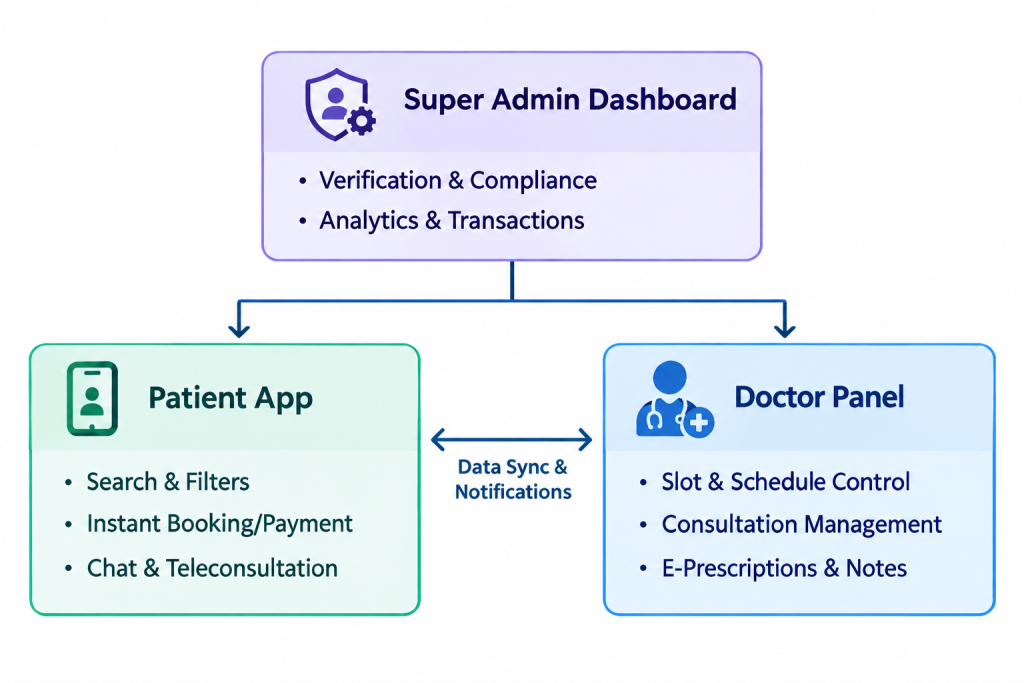
A scalable healthcare scheduling app consists of three interconnected panels: the Patient App, the Doctor/Provider Panel, and the Super Admin Dashboard.
1. Patient Panel
- Smart Search & Advanced Filters: Filter doctors by medical specialty, location, accepted insurance network, ratings, consultation fee, and next available slot.
- Profile Management: Medical history, ongoing medications, emergency contacts, and insurance card upload.
- Real-Time Calendar Booking: View open consultation slots, choose between in-clinic visit or video consultation, and receive instant booking confirmation.
- In-App Teleconsultation: Encrypted WebRTC-based high-definition video calling and in-app chat for follow-up questions.
- Multi-Gateway Payment Integration: Secure payments via credit/debit cards, digital wallets (Apple Pay, Google Pay), and health insurance claim workflows.
- Ratings & Verified Reviews: Post feedback and view verified patient ratings to help other users make informed decisions.
2. Doctor / Clinic Panel
- Professional Profile & Credential Verification: Upload medical licenses, degrees, clinic affiliations, and consultation pricing.
- Dynamic Calendar & Slot Management: Open, block, or adjust consultation hours, lunch breaks, and holiday schedules in real-time.
- Appointment Acceptance & Queue Management: Accept, reschedule, or cancel appointments with custom reason notes sent directly to the patient.
- Digital Prescription (e-Rx) Builder: Generate, digitally sign, and dispatch electronic prescriptions directly to patients and partner pharmacies.
- Access to Patient Records: Review past visit notes, diagnostic imaging, and lab test results prior to the consultation.
3. Super Admin Dashboard
- Doctor Credential Verification & Onboarding: Manual and automated verification of medical licenses, NPI numbers, and hospital affiliations.
- User Management: Centralized control over patient profiles, provider accounts, and platform permissions.
- Financial & Revenue Tracking: Monitor booking fees, platform commission cuts, doctor payouts, and refund processing.
- Compliance & Security Audit Logs: Track data access events to maintain strict adherence to healthcare privacy regulations.
- Platform Analytics & Reporting: Track peak booking hours, high-demand specialties, user retention, and platform performance.
Recommended Technology Stack & Architecture
To guarantee speed, data security, and scalability, select battle-tested tools across your front-end, back-end, and cloud layers:
| Layer | Technology Options | Purpose |
|---|---|---|
Mobile Front-End | Flutter, React Native, Swift (iOS), Kotlin (Android) | Cross-platform code efficiency or native high-performance mobile apps |
Web Admin Panel | React.js, Next.js, Vue.js, Tailwind CSS | High-speed responsive administrative dashboards |
Back-End API | Node.js (NestJS), Python (FastAPI / Django), Go | Secure, asynchronous microservices and API orchestration |
Database | PostgreSQL, MongoDB, Redis (caching) | Relational data integrity, fast caching, and session storage |
Telemedicine Engine | WebRTC, Twilio Video, Agora.io | Encrypted, low-latency audio/video consultations |
Cloud Hosting | AWS (HIPAA-eligible architecture), Google Cloud Healthcare API | Secure, compliant cloud hosting and storage |
Protocols & Standards | HL7, FHIR (Fast Healthcare Interoperability Resources) | Seamless integration with external hospital EHR/EMR platforms |
Ready to Build Your Custom Healthcare App?
Work with our experts to build a secure, custom doctor booking app. Let's plan your project today.
Get a Free Project Estimate6-Step Doctor Appointment App Development Process
Building a medical application requires disciplined engineering, stringent data security, and rigorous testing.
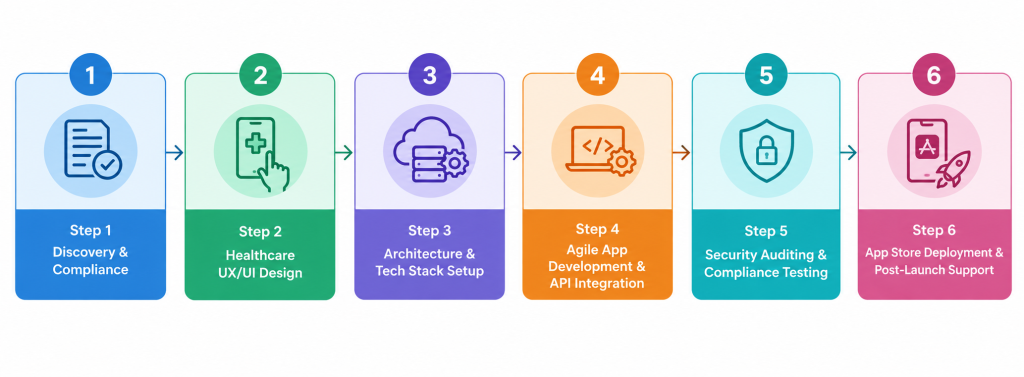
Step 1: Discovery, Business Analysis & Compliance Strategy
Define your business model (marketplace vs. single-clinic tool) and outline regulatory requirements based on your target geographic markets:
- United States: HIPAA (Health Insurance Portability and Accountability Act) and HITECH.
- European Union: GDPR (General Data Protection Regulation).
- United Kingdom: NHS Digital Service Standards & Data Protection Act.
- India: DISHA and the Digital Personal Data Protection (DPDP) Act.
Step 2: Human-Centered UX/UI Design
Healthcare apps require an accessible, clean, and intuitive user experience. Patients may be stressed or elderly, requiring high-contrast typography, minimal cognitive load, simple tap-targets, and an appointment booking flow that takes fewer than 4 clicks from search to confirmation.
Step 3: Architecture & Security Planning
Design a decoupled, microservices-based backend with end-to-end data encryption (AES-256 for data at rest, TLS 1.3 for data in transit). Implement role-based access control (RBAC) and strict multi-factor authentication (MFA).
Step 4: Agile Development & Systems Integration
- Build core appointment scheduling logic, calendar sync, and real-time push engines.
- Integrate payment processors (Stripe, Braintree) with PCI-DSS compliance.
- Integrate with legacy hospital systems via FHIR/HL7 APIs to sync Electronic Health Records (Epic, Cerner, Athenahealth).
Step 5: Quality Assurance & Penetration Testing
Execute end-to-end testing across devices and operating systems:
- Functional Testing: Booking edge cases, overlapping slot prevention, time zone synchronizations.
- Vulnerability & Penetration Testing (VAPT): Identifying backend vulnerabilities, unauthorized data leaks, and API endpoints.
- Performance Testing: Load testing to ensure server stability during sudden traffic surges.
Step 6: App Store Deployment & Continuous Monitoring
Publish the apps to the Apple App Store and Google Play Store following strict healthcare app submission guidelines. Post-launch, track crash analytics, gather patient feedback, and deploy regular security patches.
How Much Does It Cost to Develop a Doctor Appointment App?
The cost of developing a doctor appointment app typically ranges from $25,000 to $120,000+. Final costs depend on your feature scope, platform strategy, and development partner location.
Cost Breakdown by Complexity
| Complexity Level | Key Features Included | Timeline | Estimated Cost (USD) |
|---|---|---|---|
Basic MVP | Patient & Doctor profiles, standard booking calendar, basic search, push notifications, single payment gateway. | 2 – 3 Months | $25,000 – $40,000 |
Medium Complexity | All MVP features + in-app chat, video calling (WebRTC), multi-language support, ratings/reviews, e-prescriptions. | 4 – 6 Months | $45,000 – $80,000
|
Advanced / Enterprise | All medium features + full EHR/EMR FHIR integration, AI symptom checker, insurance claims engine, multi-clinic admin panel. | 6 – 9+ Months | $85,000 – $130,000+ |
Factors That Influence Development Cost
- Platform Selection: Launching natively on both iOS and Android costs ~30–40% more than cross-platform frameworks like Flutter or React Native.
- Third-Party APIs & Subscriptions: SMS gateways (Twilio), video streaming servers (Agora), and identity verification services incur recurring usage costs.
- Regulatory Audits: Independent third-party security audits and HIPAA compliance certification add to upfront development expenses.
- Development Team Model: Hiring an established healthcare app development company provides specialized compliance and domain experience compared to coordinating independent freelancers.
How AI is Transforming Healthcare Scheduling
AI Voice Assistants
AI receptionists answer calls 24/7, booking appointments, handling reschedules, and verifying insurance automatically. This eliminates patient hold times and frees up front-desk staff.
Smart Waitlist Automation
When a last-minute cancellation happens, the AI instantly texts patients on the waitlist who need that specific appointment type. The first patient to reply claims the slot, keeping the clinic’s schedule full without manual phone calls.
Predictive No-Show Alerts
The system analyzes patient history to identify who is most likely to miss an appointment. It automatically sends targeted, extra reminders to these high-risk patients, reducing overall no-show rates.
Smart Triage & Chatbots
Patients can type simple sentences like, “I need an eye exam next Monday.” The AI understands the intent, checks the correct doctor’s calendar, and instantly replies with available time slots.
Automated Clinical Notes
For in-app virtual visits, AI tools can listen to the consultation, summarize the patient’s chart, and auto-generate draft clinical notes and e-prescriptions for the doctor to review and approve.
Build Your Healthcare Booking Platform Today
Building a successful doctor appointment booking app requires finding the right balance between clean patient UX, dependable doctor workflows, and uncompromising data security. With the right features, scalable architecture, and full regulatory compliance, your app can streamline operations for providers while delivering modern healthcare access to patients.
Looking to build a custom, HIPAA-compliant doctor appointment app?
Partner with our experienced mobile app engineering team to turn your product vision into a secure, scalable healthcare platform. Contact us today for a free consultation and project estimate.
Automate Your Clinic's Scheduling Today
Cut down on no-shows and save time. Launch an easy-to-use booking app for your clinic and patients.
Schedule a Free Consultation
Akhila drives the content strategy at Mindster, combining analytical clarity with a passion for digital product innovation. With a deep focus on mobile app strategy and software solutions, she bridges the gap between engineering complexity and intuitive user experiences. She thoughtfully articulates tech concepts, transforming frameworks, case studies, and digital transformation trends into actionable insights for product teams and business leaders.