
If you run a jewellery business, your biggest cost often doesn’t show up on any single bill. It builds up slowly — a wrong price here, a tax mistake caught late there, a stock count that never quite matches your books. This happens when a business built around a price that changes every hour is still run on jewellery billing software and habits built for a price that never moves.
Manual jewellery billing software cannot keep up with live gold rates, GST rules, and stock changes happening at the same time. This costs retailers and manufacturers money through wrong prices, tax mistakes, and stock gaps that are hard to trace back. GST-compliant, ERP-linked jewellery billing software that connects billing, live gold rate, and stock in real time closes these gaps — and you do not need to throw out the system you already use to run your business.
What Manual Billing Actually Costs Your Business
A jewellery bill is really several numbers added together — gold rate, weight, purity, making charges, and GST. When staff work all of this out by hand, across one counter or many stores, your business carries the cost of every small mistake, even when no single mistake looks big on its own.
Here is where that cost builds up:
A late rate eats into your margin.
Gold and silver prices can move two or three times in one day. A counter working off a rate fixed that morning is either selling below the live market or overcharging and starting a dispute. This is why more retailers are moving to software that prices jewellery off a live, changing rate instead of a fixed one updated by hand.
Typing the same number four times adds up to mistakes.
The rate gets written on a board, read by a salesperson, typed into billing software, then typed again into your jewellery accounting software for stock and ledger records. Every one of those four steps is a place where a wrong digit can enter your books.
GST mistakes are a compliance risk, not just a bookkeeping slip.
Gold is taxed at 3% GST on the metal value, and jewellery making charges are taxed separately at 5% GST. Old gold exchange adds a third layer, the value of old gold taken in against a new purchase has its own tax treatment, separate from the new item’s GST. If a ₹1,00,000 gold item has ₹10,000 in making charges, that’s ₹3,000 GST on the gold plus ₹500 GST on the making charges, before old gold exchange is even factored in. When this depends on staff judgment at each counter, small errors turn into filing mismatches at return time. This is exactly what GST-compliant billing software is built to prevent.
Billing and stock quietly drift apart.
If your billing software and your stock system are not the same system, what leaves your shelf and what your ledger records as sold can be two different numbers. This is the real reason behind most “unexplained” stock shortages, not theft, just two systems that were never connected.
You have nothing to show when it matters.
A rate written on a whiteboard and wiped off at closing gives you no record to show a tax officer, an auditor, or a bank if they ask months later how a bill’s price was worked out. This is the gap e-invoicing software is meant to close — a record that’s created automatically, not reconstructed after the fact.
None of this is a staff problem. It’s the direct cost of running a business where your core product’s price changes constantly, while your billing tools assume it doesn’t.
What Real-Time, ERP-Linked Jewellery Billing Software Gives You
- One live gold rate, shown everywhere at once.
The live rate updates your jewellery ERP software once and appears on every connected counter at the same time — a single, changing number instead of a fixed one, applied consistently across a multi-branch jewellery software setup with several stores.
- Price and GST worked out automatically, not typed by hand.
Weight, purity, making charges, and both GST components — 3% on gold, 5% on making charges are calculated straight from the live rate and your item records. Old gold exchange value is worked out the same way, instead of being calculated separately by hand. This removes the single biggest cause of billing mistakes in your business.
- Billing and stock update together, in one step.
The item comes off your stock list and the bill is created from the same data at the same moment, not as two steps matched up later.
- Every price decision is saved without anyone having to remember to save it.
The exact rate, time, and tax calculation is recorded automatically as part of an e-invoicing software trail, a record you can show during a GST audit or bank review without digging through paper.
- It runs on the phone or tablet your staff already carry.
As jewellery POS software, it works on the shop floor, at a trade counter, or during a home visit, and keeps working if the internet drops, syncing once the connection returns.
How it connects to what you already use: This kind of system doesn’t replace your ERP or your existing jewellery accounting software — it sits alongside them as a syncing layer. It talks to your existing ERP through a standard connection method (a REST API, in technical terms), pulls in your item and rate data, and pushes billing and stock updates back through the cloud. Most setups like this run as a plug-in module, so your core system, your existing records, and your staff’s day-to-day screens barely change the connection happens in the background.
Not sure if your current ERP can support this kind of connection?
Get a free audit of your current billing setup and we’ll tell you exactly what’s possible.
Get a free audit
How This Actually Works, in Practice
This isn’t just a concept, it’s running inside Malabar Gold & Diamonds, a business with over 350 stores across 13 countries. Before moving to a connected system, they relied on a printed bill being carried by hand from the billing counter to the packing counter. On a normal day, that short walk cost a few minutes. Multiplied across every sale during a busy season, it added up to hours of lost staff time every day.
The fix was built around one idea: the moment a bill is created, it should already exist everywhere it needs to be, not get carried there by hand. A backend system pulls the bill straight from the core ERP the instant it’s confirmed at the counter, so the next department already has it on screen instead of waiting for a printed copy. What used to take five to ten minutes of walking and sorting now happens the moment the sale is locked in.
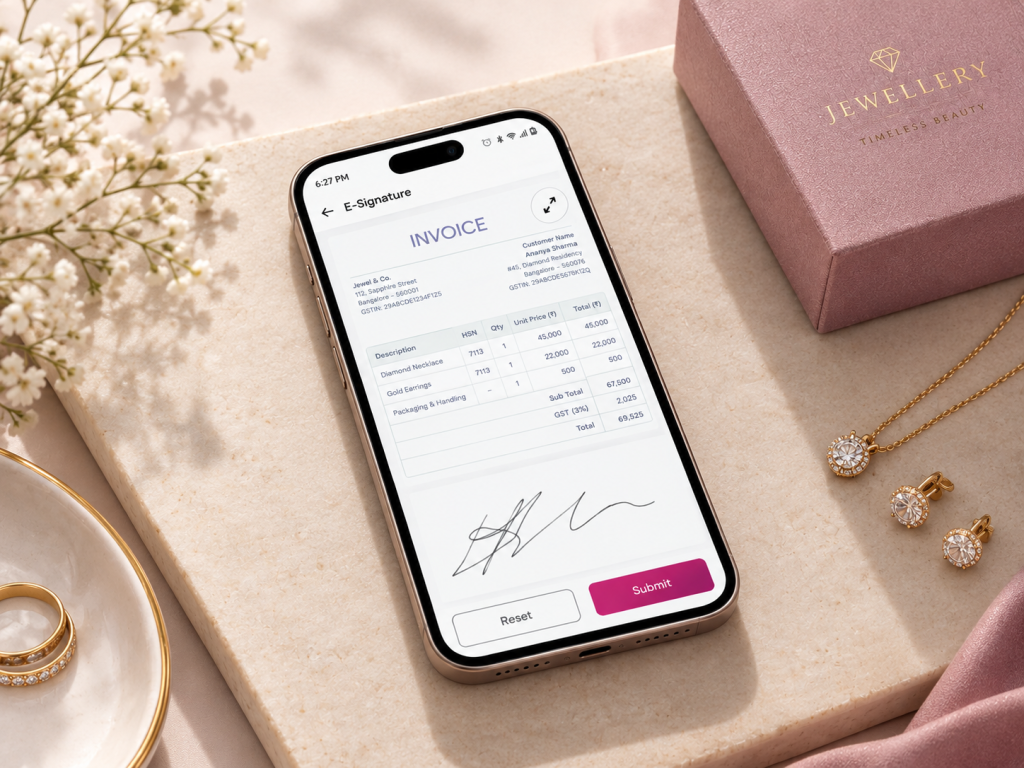
The same system solved the record-keeping problem too. Instead of paper signatures that could go missing, every transaction is signed on a tablet on the spot, and that signed record is stored automatically, a complete trail from the moment a bill was created to the final signature, ready to check anytime.
The measured result: Malabar Gold & Diamonds saw 80% less time spent on manual paperwork, and a fully paperless billing process with a complete digital record for every sale. For an owner running a single store or a multi-branch jewellery software setup across several locations, that’s not just faster billing, it’s fewer disputes, easier audits, and staff time going back into selling.
For more on how the same connected approach protects stock during internal transfers, not just at the billing counter, see [How to Protect High-Value Gold Inventory: Off-CMS Logistics Solutions for Jewellers].
If a 350-store business could fix this without replacing their core ERP, a single-store or regional business can do the same, usually faster, since there’s less already in place to work around.
Manual Jewellery Billing vs. Real-Time ERP-Linked Invoicing Software
| Business Function | Manual Billing | Real-Time, ERP-Linked Jewellery Billing Software |
|---|---|---|
Gold rate source | Fixed rate, updated now and then by staff | Live gold rate, same on every counter and branch |
Price working out | Typed by hand, depends on staff care | Worked out automatically from live rate and item data |
GST (3% gold + 5% making) | Applied based on staff judgment
| Applied correctly, every time, automatically |
Old gold exchange | Calculated separately by hand | Calculated as part of the same bill |
Stock update
| A separate step, often delayed
| Happens at the same moment as the bill |
Proof for audits | Paper, easy to lose or damage | Saved automatically as e-invoicing software records |
Where it works
| Fixed computer, back office only | Jewellery POS software on phone or tablet, works offline |
Multi-store visibility | Store by store, with a delay | Multi-branch jewellery software, real-time across all stores |
Connects to your ERP via | Manual export/import | REST API, cloud sync, plug-in module |
The Bottom Line for Owners and Manufacturers
The cost of manual jewellery billing rarely shows up as one big loss. It shows up slowly — small pricing mistakes across thousands of bills, a GST record your auditor doesn’t fully trust, and a stock count that never quite matches your ledger.
Connecting your billing to a live gold rate and your existing ERP isn’t about adding technology for its own sake. It’s about protecting your margin on every bill, keeping your GST records ready for review, and knowing your stock count is right — without adding more work to your staff’s day, or replacing the system you already run your business on.
See where your system setup is losing money.
Book a free 20-minute audit of your billing process — we’ll show you exactly where manual steps are costing you, and what connecting your ERP would actually involve for your setup.
Stop Losing Margin to Manual Billing
Get a free audit of your billing setup and see exactly where manual pricing is costing you money.
Book Your Free Audit
Akhila drives the content strategy at Mindster, combining analytical clarity with a passion for digital product innovation. With a deep focus on mobile app strategy and software solutions, she bridges the gap between engineering complexity and intuitive user experiences. She thoughtfully articulates tech concepts, transforming frameworks, case studies, and digital transformation trends into actionable insights for product teams and business leaders.