
One of the most important efforts that many organizations have started or are starting is digital transformation (DX). The Digital Transformation (DX) of businesses is being greatly aided by a perfect combination of several innovations, including SaaS architecture, the Internet of Things (IoT), mobile app development, virtual reality (VR), robotics, etc.
Nevertheless, we think that Machine Learning (ML) and Artificial Intelligence (AI) will emerge as the leading technologies driving organizations through AI in Digital Transformation. Artificial intelligence is among the key innovations in the digital age that are helping organizations grow. The most recent estimate from Research and Markets projects that AI will increase at a compound annual growth rate of 52% by 2022.
Artificial intelligence (AI) and digital transformation (DX) are related as of 2023. Even if organizations or experts mention only one, they will almost certainly talk about both simultaneously. In short, AI now powers the next stage of DX activities and software and will continue to do so, opening up novel possibilities and enabling advancements that were before impractical.
What is Artificial Intelligence (AI)?
Accenture Research defines artificial intelligence (AI) as “a set of diverse techniques that enable systems to recognize, comprehend, behave, and learn independently or to supplement human tasks.” Some human traits will be present in them, such as the capacity to understand and differentiate between objects. They additionally possess an essential advantage over people because they do not require sleep.
According to the same Accenture report, AI might change how we work and establish a new interaction between humans and machines by 2035, improving worker efficiency by up to 40%.The distinctions between the real and the virtual have become more unclear, even though musing about Artificial Intelligence (AI) may make you envision a future society like those in science fiction films.
AI is transforming society and individual lives and is increasingly acting as an economic and organizational growth catalyst. You could already deal with AI/ML-driven technologies and bots in many everyday activities. Whether it be a simple Google search, a dialogue with Amazon Alexa, Google Home, Apple’s Siri, or a simple AI tool like ChatGPT on whatever website you visited. Undoubtedly, this is altering how we go about everyday life, how we organize our careers, how we run our businesses, and how we make choices.
How Helps AI in Digital Transformation
1. Customer-focused Business Strategy
Your consumers may quickly fix their issues with chatbots, virtual assistants, and robotic self-service solutions that satisfy them. Enterprise CEOs consider increased consumer happiness as their top motivation for investing in AI, according to a 2020 study by Forbes. Big Data and algorithms built on AI assist businesses in creating thorough client profiles to comprehend their unique demands, issues, and interests.
With this information, you can customize user marketing initiatives and interfaces, which will likely increase consumer happiness. Nevertheless, considering all these advantages, many businesses need to be more concerned about the initial expenditures of AI. You should consider which organizational company operations may benefit from an AI enhancement.
2. Increased efficiency
Companies may automate complicated processes, lower human error, and release staff from duplicate jobs using AI solutions like RPA and NLP. The US, Sweden, and Japan stand to gain the most from an increase in labour output of 40% in advanced economies by 2035, according to Statista 2020 research. Utilizing cutting-edge analytics techniques, you can assess an employee’s skills and potential for growth. According to the 2020 Enabling Change study, AI technologies may provide suggestions to boost individual and team efficiency.
According to the same survey, 76% of staff members with impairments need to disclose them adequately. Fortunately, improvements in accessibility software (such as speech-to-text, predictive typing, visual recognition, and others) could make it possible for them to remove some of these obstacles so they can concentrate on their work.
3. Intelligent Choice-making
Predictive analytics software will make Your company’s decisions more effective, creative, and high quality. Artificial intelligence (AI) applications analyze vast amounts of unorganized information from many sources and produce insights. This enables you to provide services your consumers desire and identify gaps between supply and demand.
For practical remedial actions, the capacity for live data analysis is essential. Think of automotive IoT, where self-driving cars must react to exterior devices and secure concerns in milliseconds, or cybersecurity, in which you have to respond to attacks instantly.
4. Cost-effective methods
Organizations could save costs while boosting income by adopting AI projects. According to McKinsey’s State of AI in 2021 poll, over 33% of organizations have reduced their expenditures by over 20% (28% have done so by cutting between 10% and 19% of their total spending, and 18% have done so by less than 10%). Furthermore, 13% of businesses saw a 13% profit gain (21% saw 6–10% revenue growth, and 33% saw an income rise of less than 5%).
AI also lowers the cost of digital transformation by enabling connections that are wireless-first and cloud-enabled. According to IDC, 65% of businesses want to implement wireless-first approaches to cut costs and allow more prosperous user encounters. What role does AI play in all of this, then?
Benefits of AI in Digital Transformation
The digital transformation is fundamentally driven by artificial intelligence. For instance, businesses may respond to sudden developments or novel patterns more swiftly and successfully by utilizing AI-powered procedures. As a result, AI algorithms can analyze probable outcomes and potentially reduce potential dangers since they can gain insight from prior events and information.
Other advantages of utilizing AI to support digital transformation projects include:
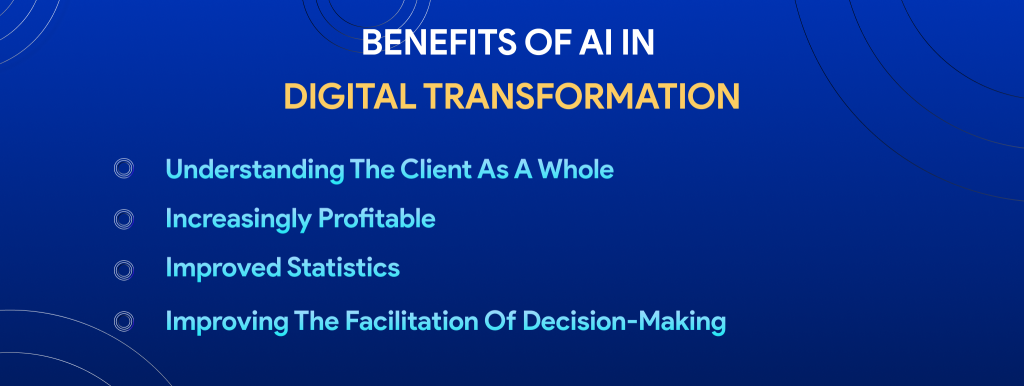
1. Understanding the Client as a Whole
It gives you a holistic view of your clients, one of the advantages of employing AI to support DX activities. To identify new patterns and shifts in customer behavior, AI can take in a lot of data and analyze it. AI may help you design customized initiatives, develop hyper-targeted messages or advertisements, and provide more seamless user experiences across many channels by providing you with valuable data.
2. Increasingly Profitable
You may reduce threats and improve performance more successfully by integrating AI technologies into your company’s operations and routines. This, in turn, can hasten the expansion of your business. An AI solution may assist you in optimizing different advertising methods, conducting testing, and scaling advertising initiatives concerning revenue.
3. Improved Statistics
Any digital transformation plan must include data; AI technologies may help you get that data and make the most of it. AI can quickly identify insights and patterns by analyzing hundreds, if not millions, of data points. You can use this to make data-driven choices and improve your ability to predict your clients’ demands.
Businesses can become more creative, adaptable, and nimble when they employ AI to drive DX projects. AI enables them to leverage data to improve existing offers, optimize corporate processes to increase efficiency, and create better business plans.
4. Improving the Facilitation of Decision-making
While minimizing any possible dangers, AI helps optimize business operations. Leaders are given access to essential data. As a result, it enables them to make quicker, more informed choices. An AI solution, for instance, can handle and analyze massive amounts of data when it is included in processes. Your AI system may “learn” from such relationships and instances with enough training, which enables it to generate recommendations or forecasts that are more precise.
AI-Powered Digital Transformation
Every day, we are being progressively impacted by AI. This is streamlining commercial operations, analyzing vast quantities of data, and assisting people in creating information. There’s no doubt that artificial intelligence still needs to be fully developed, even if it’s currently simply science fiction.
Currently, AI is being utilized to propel digital transformation. AI allows companies to develop more effective digital transformation plans, improve efficiency and accuracy at work, and minimize human error and duplication. That’s why AI enables them to gain a 360-degree picture of their consumers, enabling firms to comprehend their target market more thoroughly and quickly unearth customer data.
As a result, firms can develop tactics designed to foster customer loyalty, provide more excellent value, and produce more successful marketing campaigns. Additionally, AI assists companies in reducing risks, allowing them to expand more quickly and improve their capacity for thinking outside the box.
There are several advantages that AI will bring to organizations. It’s important to remember that it continues to possess certain shortcomings. For instance, even if AI tools and systems are widely available, there may be a learning curve associated with using them. Additionally, if you intend to create your own AI system or application, you must hire experienced personnel with the required technical expertise.
Wrapping Up
Across sectors, artificial intelligence accelerates digital transformation. AI may significantly impact your organization by enabling you to automate operations, personalize services, increase customer happiness, and reduce risks. These technologies are more readily available than before. Therefore, the issue isn’t whether to implement AI but how to accomplish it with the least disruption.
Happily, Mindster is capable of doing that. We are one of the most prominent mobile app development companies recognized globally, with an expert UI/UX Design team to create visually appealing mobile app solutions for our clients.
We have the expertise and experience to apply AI technologies in digital transformation and reinvent your operations to increase your company’s profitability, consumer focus, and cost-effectiveness. One of our projects integrating AI is the Truck Booking App. Contact us to find out how we can hasten your digital transformation.

Ankitha is a professional content writer with more than four years of experience. She writes blogs relevant to the services that we provide and also about the various mobile app solutions that we provide. With strong research skills and critical thinking skills, she can develop high-quality content that is valid and authentic. She also has good communication skills to interact with the team members to build up-to-date content related to the latest technologies.