
Most fitness apps lose 80% of their users within two weeks — not because the product is bad, but because it’s built to collect data rather than drive behaviour. This blog explores why that happens, and what product managers can actually do about it. We’ll cover the psychology behind why users return or quit, the gamification mechanics that move retention numbers (and the ones that don’t), how to measure the right things, when to fix your tracking infrastructure versus launch new features, how to segment challenges and leaderboards so they motivate rather than discourage.
The Post-Download Slump: Unde rstanding the 14-Day Churn Window
The Novelty Effect and Why It Betrays You
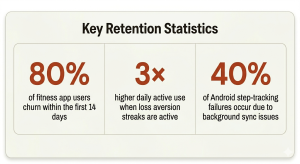
When someone installs a new fitness app, there’s a brief window — usually 3 to 7 days — where they open it consistently. Not because they’ve built a habit, but because the app is new. Once that novelty wears off, most users simply stop. If your app hasn’t given them a concrete reason to return by day 10, it won’t get one.
This is why Day-1 and Day-3 retention numbers look encouraging while Day-14 tells the real story. If you’re not tracking the two-week cohort separately, you’re making product decisions based on inflated early numbers.
The number to watch: Day-14 retention is your honest baseline. Day-1 measures curiosity. Day-14 measures whether your app has earned a place in someone’s routine. In practice, set up a dedicated Day-14 cohort in your analytics tool — group users by install week, filter to those still active on day 14, and track that number separately from your overall DAU. Tools like Mixpanel and Amplitude let you build this as a retention chart with a 14-day interval. Once you have it, segment further by acquisition source and onboarding path — you’ll quickly see which entry points produce users who actually stay.
Passive Tracking vs. Active Engagement: The Core Difference
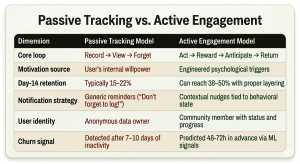
Most fitness apps are built around passive tracking — they collect data (steps, calories, heart rate) and show it back to the user. The problem is that passive tracking puts all the motivational work on the user. There’s no moment that pulls them back in.
Active engagement flips this. Instead of waiting for users to open the app, the product creates events that make returning feel worthwhile — a streak at risk, a challenge expiring, a friend who just overtook them on a leaderboard. The table below shows what this difference looks like across key product dimensions.
Behavioral Psychology: The “Why” Behind the Return
The Progress Principle and Visual Milestones
People stay motivated when they can see they’re moving forward — even in small steps. In fitness apps, this means progress rings, completion percentages, and goal proximity indicators need to be front and center, not buried in a profile screen.
One detail most apps miss: users accelerate their behavior as they get close to a goal. Someone who needs 3 more workouts to hit a milestone logs in more frequently than someone who needs 10. Your app should surface goal proximity dynamically — “You’re 2 workouts away from your monthly badge” is a more effective prompt than a generic reminder notification.
Loss Aversion: The Streak Mechanic That Outperforms All Others
People feel the pain of losing something about twice as strongly as the pleasure of gaining something equivalent. Streaks are the most direct way to use this in a fitness app — once a user has built a 20-day streak, the fear of losing it becomes a stronger motivator than any reward you could offer them.
Duolingo’s streak system is the clearest example in consumer apps: streak-holders show roughly 3× higher daily active use than non-streak users. The mechanism isn’t celebration — it’s the manufactured cost of quitting. A fitness app that shows a user their 23-day streak in red at 9 PM isn’t being aggressive. It’s being effective.
PM tip: Pair streaks with a one-time “streak shield” that users can earn through consistent engagement — not buy. This prevents anxiety-driven churn from users who fear losing everything on one bad day, while keeping the streak’s motivational power intact. It also solves a real product edge case: users who travel, fall ill, or have an unavoidable off-day shouldn’t feel punished by a system designed to help them. A shield they earned feels fair. A streak that resets to zero because of a work trip feels hostile — and those users rarely come back.
Social Proof: Turning Solo Workouts into Community Wins
The most underused retention lever in fitness apps isn’t a feature — it’s context. Showing a user that 847 people in their city completed the same run this week is more motivating than a global leaderboard where they rank 94,000th.
Proximity-based social features — cohort challenges, friend activity feeds, shared step goals — create accountability that makes it harder to quietly quit. Research consistently shows that people are twice as likely to stick to a goal when someone else knows about it. Your app should be that social structure, not an afterthought bolted onto a solo tracking experience.
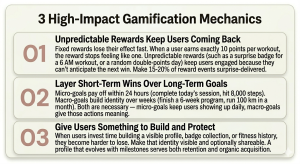
3 High-Impact Gamification Mechanics That Move Retention Numbers
Learn How Gamification Makes Fitness Apps Fun and Engaging
The Technical Foundation: Where Gamification Actually Breaks
Speed of Feedback Determines Whether Rewards Work
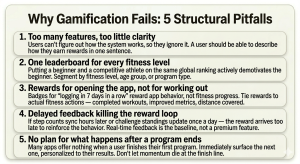
If a user finishes a workout and their points don’t appear for four hours, the reward doesn’t land. The connection between effort and recognition has to be immediate — under 30 seconds for in-session events, under 2 minutes for things like challenge standings. Delayed feedback doesn’t just feel bad; it trains users that the app isn’t reliable, which accelerates churn.
Practically, this means reward delivery needs to happen in real time: points update the moment a session ends, streak status reflects today’s activity, leaderboard positions refresh throughout the day. This isn’t a complex architectural decision — it’s a prioritization one. Real-time feedback needs to be treated as a core requirement, not a nice-to-have.
Push Notifications: Context Over Schedule
Generic push notifications (“Don’t forget to log your workout!”) have open rates around 3.4% in fitness apps — and the ones that do get opened often lead to users turning off notifications entirely. The problem is scheduling: sending at a fixed time regardless of what the user is doing.
Smarter notifications are triggered by the user’s situation — a streak that’s at risk tonight, a challenge that expires tomorrow, a friend who just passed them on the leaderboard, a milestone 2 workouts away. Smaller teams don’t need a full ML system to get there. Start with a rule-based approach using 3–4 signals: has the user worked out today (streak risk), what time do they usually train (time-of-day pattern), how close are they to a reward (goal proximity), and has a friend been active recently (social trigger). Build those four rules first. They will outperform any fixed-schedule notification system by a wide margin, and they give you real behavioral data to train a more sophisticated model later if needed.
Where to start if you’re moving from passive to active: Don’t try to rebuild everything at once. Pick one high-impact change — streak tracking is the fastest to ship and shows results within days. Add real-time reward delivery next. Then layer in contextual notifications. Each step compounds: streaks give you data on user patterns, that data improves your notification targeting, better notifications protect the streak. Start with streaks.
In Practice: How Fitreat Couple Applied These Principles at 80,000+ Users
Fitreat Couple is a nutritionist-led fitness platform built by Mindster, designed for specific health needs — PCOD management, postpartum recovery, and couples fitness. By the time it reached 80,000 global users, three technical failures were directly undermining the gamification layer:
→ 40% step-tracking failure rate on Android and iOS Background syncing with Health Connect and Apple HealthKit kept breaking. Streak data was wrong, challenge standings were stale — which made the entire gamification system untrustworthy.
→ Manual calorie logging was too painful to use daily Users skipped logging because it was tedious. When logging drops off, progress tracking stalls — and so does the daily habit the app depends on.
→ Trainer–client communication was happening on WhatsApp Social accountability — one of the strongest retention drivers — was completely outside the product. None of that engagement was being captured.
Mindster rebuilt the platform in Flutter and Laravel with four dedicated portals — Customer, Trainer, Nutritionist, and Sales — and addressed each failure directly:
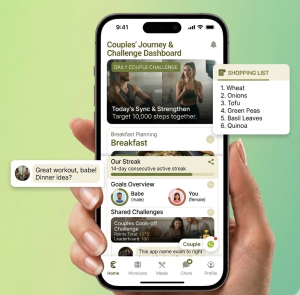
Fitreat Couple — illustrative UI mockup. Read the full case study →
Session-based step tracking switched from unreliable background sync to a foreground native pedometer using Apple HealthKit and Health Connect — taking accuracy from broken to 99.9%. Streak and challenge data became trustworthy. AI meal recognition let users photograph their food instead of logging manually, which brought calorie logging friction close to zero. In-app trainer communication moved all trainer–client conversations inside the product, cutting admin time by 50% and bringing the accountability layer back where it could drive retention.
The takeaway: gamification only works when the underlying product is reliable. A step challenge on a broken step tracker doesn’t retain users — it loses them faster. If you’re refactoring tracking infrastructure, the most common pitfalls are trying to fix background sync without switching to a session-based model (the root cause stays), underestimating how long Health Connect and HealthKit approval cycles take, and optimizing for tracking accuracy in isolation without also updating the UI to reflect real-time data. Fix the data pipeline and the display layer together — one without the other still produces a broken user experience.
Why Gamification Fails: The Five Structural Pitfalls
Losing Users After the First Two Weeks?
That’s almost always a product architecture problem, not a marketing one. Mindster has built and scaled gamified fitness platforms including Fitreat Couple to 80,000+ users. If your retention numbers aren’t where they should be, let’s look at what’s actually breaking.
Talk to the Mindster Team →
FAQ
Why do users stop using fitness apps after two weeks?
The first few days are driven by novelty — the app is new and interesting. Once that fades, most apps have nothing pulling users back. Without active hooks like streaks at risk, expiring challenges, or social accountability, users rely entirely on willpower. That runs out fast. The apps that retain users past two weeks have engineered reasons to return — not just reminders to do so.
How does loss aversion increase workout consistency?
People feel the pain of losing something roughly twice as strongly as the pleasure of gaining something equivalent. A fitness streak uses this directly: once a user has built a 15-day streak, the fear of losing it becomes a stronger motivator than any badge or point reward. Duolingo’s internal data shows streak-holders use the app 3× more frequently than non-streak users. The streak’s power isn’t that it celebrates progress — it’s that losing it hurts.
What is the difference between micro-goals and macro-goals in fitness apps?
Micro-goals are immediate — complete today’s session, hit 8,000 steps before dinner. They give users a win within the same day. Macro-goals are long-range — finish a 6-week program, run 100 km in a month. They give users something to work toward over time. Both matter. Micro-goals keep users showing up. Macro-goals give those daily actions meaning. Apps that only have macro-goals see users drop off when they stop feeling daily progress.
What are variable rewards in fitness gamification?
Variable rewards are prizes that arrive unpredictably, rather than on a fixed schedule. A user who earns exactly 10 points per workout will stop caring about those points within a week — it’s too predictable. But a rare badge that unlocks randomly for a 6 AM workout, or a surprise bonus day? That keeps users curious. Around 15–20% of your reward events should be unpredictable to maintain that effect over time.
How do you design a fitness leaderboard that is not discouraging?
Stop showing everyone on the same global ranking. A beginner who sees they rank 94,000th globally will close the leaderboard and not return to it. Instead, show users only the few people immediately above and below them — and segment by fitness level or program type so they’re comparing against peers. Cohort-based leaderboards increase challenge participation by up to 35% compared to global absolute rankings.

Akhila drives the content strategy at Mindster, combining analytical clarity with a passion for digital product innovation. With a deep focus on mobile app strategy and software solutions, she bridges the gap between engineering complexity and intuitive user experiences. She thoughtfully articulates tech concepts, transforming frameworks, case studies, and digital transformation trends into actionable insights for product teams and business leaders.