

As digital wallets commoditize, platform growth is decoupling from simple transaction volume. This guide outlines the transition from passive wallet infrastructure to AI-driven financial co-pilots. We analyze the shift from reactive payment processing to proactive behavioral analysis, detailing the architectural upgrades, CBUAE compliance integration, and fraud-mitigation frameworks required to drive retention and ARPU in the 2026 fintech landscape.
What Is an AI Financial Co-pilot Platform and How Does It Differ from a Digital Wallet?
An AI financial co-pilot platform is a financial infrastructure layer that uses machine learning and real-time data processing to deliver personalized money management including spending analysis, automated savings, fraud detection, and credit scoring in place of or alongside a standard digital wallet.
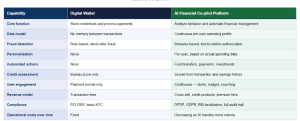
A digital wallet stores payment credentials and processes transactions. Between payments, it does nothing. It does not learn from user behavior, and it does not act unless the user opens the app.
An AI co-pilot platform works continuously. It processes every transaction, builds a spending model for each user, and uses that model to send alerts, trigger automated actions, and flag unusual activity — without waiting for the user to act first.
What your platform gains by adding AI co-pilot capabilities:
- Real-time transaction analysis — every payment is scored and categorized as it happens, not in batch
- User-specific alerts and recommendations — based on each user’s actual spending patterns, not generic rules
- Automated savings — funds move automatically based on triggers the user sets in advance
- Fraud detection before authorization — unusual activity is caught before the payment goes through, not after
- Conversational query interface — users can ask questions about their finances in plain language and get instant answers
- Credit scoring from transaction data — creditworthiness assessed from spending and savings history, not just bureau scores
Why Digital Wallet Infrastructure Is Losing Ground in 2026
Digital wallet platforms are losing users in 2026 because they cannot personalize, cannot prevent fraud before it happens, and give users no reason to engage between transactions, three gaps that directly drive churn, and lower revenue per user.
The global fintech market was valued at $394.88 billion in 2025 and is projected to reach $1.1 trillion by 2032, growing at 16.2% per year. Platforms capturing that growth are winning because they do more with user data — not because they process payments faster.
Four gaps in standard digital wallet infrastructure:
- No user behavioral data.Transaction records exist but are never analyzed per user. Without behavioral data, the platform cannot personalize anything, cannot spot patterns that predict churn, and cannot detect fraud specific to how each user normally spends.
- No reason to engage between payments.Wallet platforms only interact with users at the point of payment. There are no spending alerts, no savings suggestions, no check-ins between transactions. Daily active usage stays low because the app offers nothing in between.
- Data that only covers card payments.Wallet backends see card and UPI transactions. They cannot see rent, loan repayments, SIP contributions, or investment activity. Without a full view of a user’s finances, the platform cannot make relevant product recommendations.
- Fraud systems that alert after the fact.Rule-based fraud systems use fixed thresholds applied the same way to every user. They produce a high number of false alarms, block legitimate payments, and miss new fraud patterns. Fraud losses stay high with no way to reduce them under this setup.
How Does AI Reduce Operational Costs and Increase Revenue for Fintech Platforms?
AI co-pilot platforms reduce operational costs by automating tasks that currently require manual handling such as fund transfers, payment scheduling, and routine support queries, while increasing revenue by identifying and offering the right financial products to each user at the right time.
Finastra’s 2026 financial services report shows that AI in banking drives a 20% reduction in operational costs for platforms that deploy it fully, with early adopters reporting a 15% increase in market share over competitors within 12 months.
Where AI creates direct business value:
- Automated fund management: The system moves spare funds to better-yielding accounts, schedules bill payments on the best date, and executes small recurring investments — cutting the support load from users missing payments or running short
- Targeted product offers: When a user consistently has savings headroom, the platform checks if they qualify for a credit or investment product — increasing revenue per user without additional sales effort
- Lower fraud costs: The system blocks suspicious transactions before they are authorized, reducing chargebacks and the cost of fraud investigations
- Automated answers to routine queries: The AI handles common questions about balances, spending summaries, and bill dates — freeing support staff for cases that need human attention
Banks using AI-assisted workflows report saving individual team members up to 200 hours per year on routine research and reporting tasks.
What Technical Components Does an AI Financial Co-pilot Platform Need?
An AI financial co-pilot platform requires five components: a real-time data pipeline, a per-user spending model, an automated action layer, a fraud detection system based on spending behavior, and a compliance setup covering RBI, DPDP Act, and GDPR requirements.
Real-Time Data Pipeline
The platform must process transaction events as they happen, not in overnight batches. A real-time data pipeline feeds ML models with current data so that fraud detection, spending alerts, and automated actions work on information that is minutes old, not hours.
Platforms still on batch processing cannot deliver any of these features at useful quality. The data infrastructure has to change before AI features can work.
Per-User Spending Model
The platform builds a spending profile for each user — their usual transaction amounts, regular merchants, income timing, and savings patterns. This is what makes personalization more useful than generic. It also powers fraud detection and credit assessment downstream.
Automated Action Layer
This layer executes financial actions on behalf of the user — moving funds, scheduling payments, triggering investment contributions — based on rules the user has agreed to and live account data.
It requires live connections to core banking APIs and payment rails (UPI, IMPS, NEFT), plus a full log of every action taken for audit and reversal purposes.
Fraud Detection Based on Spending Behavior
Rather than fixed rules, the fraud system learns each user’s normal spending behavior — typical transaction sizes, regular locations, usual merchants, and time-of-day patterns. When a transaction falls outside that pattern, it is scored in real time and either blocked or escalated before it settles.
In 2026, some platforms are adding cross-institutional fraud detection, identifying patterns across multiple banks at once. Platforms still on static rule sets are at a disadvantage against organized fraud operating at that scale.
Compliance Setup
Platforms in India must comply with RBI data localization rules, DPDP Act requirements on user consent and data use, and SEBI regulations if investment products are included. Platforms with European users must meet GDPR requirements.
Compliance must be built into the data model from the start — covering how consent is recorded, how long data is kept, and how every automated action is logged. Platforms that try to add compliance later face significant rebuild costs.
AI Financial Co-pilot Platform vs. Digital Wallet: Capability Comparison
What Results Are Fintech Platforms Seeing From AI Co-pilot Deployments in 2026?
Fintech platforms that have deployed AI co-pilot features are reporting lower operational costs, reduced fraud losses, and measurable growth in revenue per user across India, Latin America, and Europe.
Latin America: Fintechs in Colombia using AI financial platforms have cut operating costs by an average of 44%, according to the Finnovista Fintech Radar Colombia 2025 report. 38% of Colombian fintechs are now building their own AI capabilities in-house rather than relying entirely on third-party tools.
India: Platforms connecting to Aadhaar’s identity system are completing KYC checks in seconds and approving loans for first-time borrowers using credit scores built from transaction history. Aadhaar processes over 3 billion payment authentications per month, giving platforms in India a ready infrastructure to build AI features on top of.
Europe: The EU Digital Identity Wallet framework connects payments, identity verification, and financial services in one GDPR-compliant system. Platforms building on this framework skip building their own identity layer and start with a compliance advantage.
Enterprise Banking: Banks with AI-assisted workflows report a 15% increase in market share and a 20% improvement in operational efficiency compared to those that have not deployed AI. Individual bankers using AI tools save up to 200 hours per year on routine tasks.
How Should a Fintech Platform Move From a Digital Wallet to an AI Co-pilot Platform?
The recommended migration path has four phases: build real-time data infrastructure first, then add fraud detection and personalization, then introduce automated actions, then launch new financial products — with compliance built in from phase one.
The most common mistake is adding AI features on top of an existing wallet backend without changing the data infrastructure. This produces poor outputs — alerts that arrive too late, recommendations that do not fit the user, fraud flags that block real payments — and damages user trust before the value is ever delivered.
Phase 1 — Data Infrastructure: Move to a real-time data pipeline. Build per-user spending profiles. Set up consent management, data retention rules, and action logging to meet DPDP and GDPR requirements.
Phase 2 — Fraud Detection and Personalization: Deploy ML models for fraud scoring, spending categorization, and user-specific alerts. Test them against your current rule-based system on live data before fully switching over.
Phase 3 — Automated Actions: Connect the automated action layer to your core banking APIs and payment rails. Start with low-risk automations — savings transfers, payment reminders — before moving to credit decisions or investment execution.
Phase 4 — New Revenue Products: Use the spending data and credit scoring to offer products like BNPL, micro-investments, or personalized insurance to users the AI identifies as eligible and likely to use them.
Is an AI Co-pilot Platform Secure and Compliant at Scale?
AI financial co-pilot platforms in 2026 meet enterprise security requirements through end-to-end encryption, zero-trust access controls, on-device processing where possible, and compliance with RBI guidelines, India’s DPDP Act, and GDPR.
Security and compliance features required for production deployment:
- End-to-end encryption — all financial and behavioral data encrypted in storage and in transit
- Zero-trust access controls — every system requesting user data must be verified continuously, including internal services
- On-device processing — where possible, sensitive calculations run on the user’s device rather than a remote server, limiting exposure
- Multi-layer fraud detection — spending behavior analysis combined with document verification and account takeover detection
- Full action audit log — every automated action recorded with timestamp, trigger, and outcome for compliance review
- Regulatory compliance — built to meet DPDP Act consent rules, RBI data localization requirements, GDPR data minimization standards, and SEBI investment regulations
Platforms that build compliance into the architecture from the start avoid the costly rebuilds that have delayed several fintech AI deployments in 2024 and 2025.
Conclusion: The Shift to Proactive Finance
The era of the passive digital wallet is over. In 2026, simply processing payments is not enough to keep users or grow a business. To stay competitive, fintech platforms must move from being tools that users open only at checkout to AI-powered co-pilots that work around the clock.
By making this shift, your platform moves beyond transaction fees. You gain the ability to stop fraud before it happens, automate chores like savings and bill pay, and offer credit products based on actual behavior rather than outdated scores. This transition turns a basic payment app into a primary financial hub that users rely on every day.
The platforms winning the market right now aren’t just faster; they are smarter. They use data to provide actual value between transactions, ensuring users stay engaged, and operational costs stay low.
Build Your AI Co-pilot with Mindster
Transitioning from a traditional wallet to an AI-driven platform requires a specialized technical stack. Mindster provides engineering expertise to help you build and deploy real-time data pipelines, behavioral fraud systems, and automated financial workflows.
Don’t let legacy infrastructure limit your platform’s potential. Partner with Mindster to upgrade your fintech stack and lead the market.
[Contact Mindster to Start Your Migration]
Frequently Asked Questions (FAQs)
1.What is anAI financial co-pilot platform for fintech businesses?
An AI financial co-pilot platform replaces or extends a digital wallet with ML-driven features — real-time fraud detection, per-user personalization, automated financial actions, and alternative credit scoring — to increase engagement, cut fraud losses, and grow revenue per user.
2.How does an AI co-pilot platform improve user retention compared to a digital wallet?
A digital wallet only engages users when they make a payment. An AI co-pilot platform engages users between payments — through spending alerts, savings updates, and automated actions — giving them a reason to open the app every day.
3.What is the ROI of moving from a digital wallet to an AI co-pilot platform?
Platforms that have made the shift report a 20% reduction in operational costs, a 15% increase in market share, and lower fraud losses. Revenue per user also grows as the platform offers credit, investment, and insurance products to users identified as eligible.
4.How does AI reduce operational costs for a fintech platform?
AI automates tasks that currently require manual work — fund transfers, payment scheduling, routine support queries.As the user base grows, these tasks scale without a proportional increase in staff.
5.What compliance requirements apply to an AI co-pilot platform in India?
Platforms in India must meet RBI data localization and payment processing rules, DPDP Act requirements for user consent and data handling, and SEBI regulations if investment products are offered. Platforms with European users must also comply with GDPR.
6.How does behavior-based fraud detection outperform rule-based systems?
Rule-based systems apply the same fixed thresholds to every user. A behavior-based system learns each user’s normal patterns and detects deviations specific to that person — catching more actual fraud while producing fewer false alarms on legitimate transactions.
7.Can AI credit scoring expand our addressable market in India?
Yes. ML credit scoring uses transaction history, utility payments, and savings behavior to assess creditworthiness — not just a CIBIL score. This opens credit products to users in rural and semi-urban India who have no formal credit history but a clear record of paying on time and saving regularly.
8.What is the recommended migration sequence?
Start with real-time data infrastructure and compliance setup. Add fraud detection and personalization next. Introduce automated actions once data quality is confirmed. Expand into new financial products last.
9.How long does deployment take?
Platforms on modern, API-based infrastructure typically deploy initial AI features in 3 to 6 months. Platforms on older batch-processing systems need to rebuild the data layer first, putting full deployment at 9 to 18 months.
10.What happens to platforms that do not make this shift?
They face growing churn to AI-native competitors, higher fraud losses, and declining revenue per user. By the end of 2026, AI co-pilot features are expected to be a standard requirement. Platforms without them will struggle to compete on user retention or product range.

Akhila drives the content strategy at Mindster, combining analytical clarity with a passion for digital product innovation. With a deep focus on mobile app strategy and software solutions, she bridges the gap between engineering complexity and intuitive user experiences. She thoughtfully articulates tech concepts, transforming frameworks, case studies, and digital transformation trends into actionable insights for product teams and business leaders.