

Generic ERPs like Microsoft Dynamics 365 (D365) struggle with jewelry production because they treat gold and diamonds like static hardware components. They fail to account for invisible leakage (weight loss during polishing/casting) and require complex data entry that halts factory floor velocity. To scale, jewelry manufacturers need mobile-first QR tracking and real-time metal balancing—features generic systems lack by design.
The Critical Gap: Why Jewelry Manufacturing ERP Limitations Sink D365 Projects
Generic ERPs fail in jewelry settings because they cannot manage the high-velocity transition of precious metals across disparate physical states (casting, filing, setting) while maintaining sub-milligram weight accuracy.
Most enterprise resource planning systems, including D365, operate on a “Discrete Manufacturing” logic. This assumes that if you put 10 parts in, you get one finished product out. In jewelry, you put 100 grams of 24k gold in, and after alloying, casting, and polishing, you might only “see” 92 grams in the final ring. D365 treats that missing 8 grams as a “system error” or “inventory variance” rather than a standard, multi-stage production cost.
Why D365 for Jewelry Industry Problems Persist
- Unit of Measure Rigidity: Jewelry requires tracking by weight (grams/carats), pieces, and purity (karatage) simultaneously. Generic systems often struggle to link these variables in a single line item without heavy customization.
- The “Work Center” Fallacy: D365 expects a linear path. Jewelry production is iterative; a piece might go from setting back to polishing three times. Mapping this “loop” in a generic ERP creates massive administrative overhead.
- Data Entry Latency: Expecting a craftsman with polishing compound on their hands to sit at a desktop and navigate five sub-menus in D365 to “complete a job” is unrealistic.
Invisible Leakage: The Silent Profit Killer in Manual Factories
“Invisible Leakage” refers to the unaccounted loss of precious metal during the manufacturing process due to unmonitored dust, structural loss, or theft hidden by paper-based record keeping.
When a factory relies on manual job cards and paper registers, the “allowable loss” becomes a subjective guess. A polisher might return a piece weighing 5.2 grams, claiming the original was 5.8 grams. Without digital, point-to-point tracking, management cannot verify if 0.6 grams is a reasonable loss for that specific design or if gold is walking out the door.
The Paper Register Trap
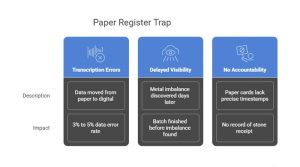
- Transcription Errors: Data moved manually from paper to digital results in a 3% to 5% error rate.
- Delayed Visibility: Metal imbalances are discovered days after a batch is finished.
- No Accountability: Paper cards lack precise timestamps and stone receipt records.
- Transcription Errors: Moving data from a dirty paper card to an Excel sheet or a generic ERP at the end of the shift leads to a 3% to 5% data error rate.
- Delayed Visibility: You only discover a metal imbalance days after the batch is finished.
- No Accountability: Paper cards don’t timestamp the exact second a technician received a specific stone.
Mobile-First QR Tracking vs. Complex ERP Screens
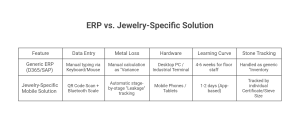
Jewelry-specific manufacturing solutions replace desktop-heavy interfaces with mobile QR scanning to ensure data is captured at the moment of physical transfer.
Factory workers need a tool that functions like a scanner, not an accounting suite. By using ruggedized tablets or mobile devices at every workstation, the “Check-In/Check-Out” process takes three seconds.
The QR Workflow Efficiency
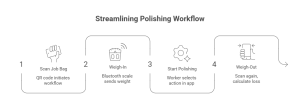
- The Scan: The worker scans the QR code on the job bag.
- The Weigh-In: The integrated Bluetooth scale sends the weight directly to the app.
- The Action: The worker selects “Start Polishing.”
- The Weigh-Out: Once done, the worker scans again and weighs the piece. The system calculates the loss percentage instantly.

ERP Alternatives for Jewellers: Selecting Custom Jewelry Factory Software
Custom jewelry factory software prioritizes the “Job Bag” or “BOM” (Bill of Materials) as a living entity that evolves as stones are picked and metal is cast.
Key Requirements for Jewelry Production Management Systems
- Multi-Level Metal Balancing: The software must track 24k gold issued to the refinery, 18k alloyed grain produced, and the final weight of the cast trees.
- Stone-to-Job Linking: Each diamond or gemstone must be “issued” to a specific job bag with a digital audit trail.
- Vendor Consignment: Many jewelers work with memo stones (consignment). The ERP must separate “Owned Inventory” from “Memo Inventory” for insurance and accounting purposes.
Implementation Checklist for New Systems
- ✅ Scale Integration: Does the software pull data directly from Ohaus or Mettler Toledo scales?
- ✅ Stone Picking Logic: Can the system suggest stones based on the specific sieve size required for a CAD design?
- ✅Image-Centric Bags: Does the job bag display the 3D CAD render so workers can verify the design?
- ✅ Loss Threshold Alerts: Will the system flag a manager if the casting loss exceeds 4.5%?
Comparing Total Cost of Ownership (TCO)
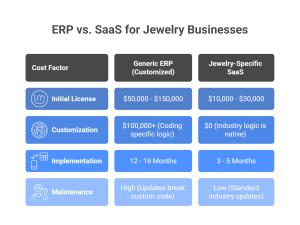
Generic ERPs often appear cheaper in licensing but explode in cost during the “Customization Phase.”
The Verdict: Why Jewelry Factories Must Pivot or Perish
Choosing a generic ERP for jewelry manufacturing is a commitment to permanent administrative friction and avoidable metal loss.
By 2026, the gap between “Digital-First” factories and traditional workshops has widened. Manufacturers still using paper registers or fighting with D365’s rigid architecture are subsidizing their competitors through “Invisible Leakage.” Scaling a jewelry business requires a system that moves at the speed of the workshop, not the pace of an accounting department.
Transitioning to a jewelry-specific production management system isn’t just an IT upgrade; it is a fundamental shift toward total metal security and operational transparency.
Ready to Plug the Leakage in Your Production Line?
Generic systems don’t understand the nuances of casting losses or stone parcel breaking. We do.
Mindster specializes in building high-performance, mobile-first solutions tailored specifically for the jewelry industry. Whether you need to replace a failing legacy ERP or move away from paper-based chaos, our team delivers systems that work for your craftsmen, not against them.
Frequently Asked Questions (FAQ)
What is the biggest limitation of D365 for jewelry makers?
The biggest limitation of D365 is that it cannot natively track “Metal Loss” at each individual production stage without extensive, expensive custom programming.
Why is mobile tracking better than paper job cards?
Mobile tracking provides real-time data timestamps and eliminates the 24-hour delay associated with manual data entry from paper registers.
How does jewelry-specific software reduce “Invisible Leakage”?
It mandates a weigh-in and weigh-out at every workstation, instantly flagging any weight discrepancy that exceeds the predefined allowable loss for that task.
Can generic ERPs handle diamond parcels?
Most generic ERPs struggle with “breaking” parcels (taking 10 stones out of a 100-stone lot) while maintaining accurate average cost and carat weight.
Is jewelry-specific software harder to learn for workers?
No, because it uses simplified mobile interfaces designed for factory floor environments rather than complex accounting screens.

Akhila drives the content strategy at Mindster, combining analytical clarity with a passion for digital product innovation. With a deep focus on mobile app strategy and software solutions, she bridges the gap between engineering complexity and intuitive user experiences. She thoughtfully articulates tech concepts, transforming frameworks, case studies, and digital transformation trends into actionable insights for product teams and business leaders.