

Imagine a customer walks into a pharmacy, waits 20 minutes for a prescription, fumbles for their insurance card, and leaves frustrated — only to forget to refill next month. Now imagine that same customer opening an app, uploading their prescription in seconds, scheduling doorstep delivery, and receiving a refill reminder right on time. That is the power of a pharmacy app, and it is reshaping the entire healthcare retail landscape.
The global pharmacy management software market was valued at over $4.6 billion in 2023 and is projected to grow at a compound annual growth rate (CAGR) of more than 11% through 2030. Behind those numbers is a simple truth: pharmacies that invest in digital platforms are acquiring more customers, retaining them longer, and operating at dramatically lower costs. Those that do not are quietly losing ground.
This blog unpacks everything you need to know, from the types of pharmacy apps and their must-have features, to the measurable ROI and the concrete ways these platforms fuel long-term business growth.
1. The State of Pharmacy Digitization: Why Now?
The pandemic accelerated digital adoption across virtually every industry, but healthcare — and pharmacies in particular — experienced a seismic shift. Patients who once insisted on in-person consultations embraced telehealth and online prescription management out of necessity. Once comfortable with the experience, they never looked back.
Several macro forces are converging to make pharmacy app development not just smart — but essential:
- Aging populations require more frequent medication management and chronic disease monitoring.
- Smartphone penetration has reached levels where mobile-first experiences are the default expectation.
- Regulatory bodies in many regions now support e-prescriptions and digital dispensing records.
- Retail pharmacy giants like CVS, Walgreens, and Amazon Pharmacy have raised consumer expectations across the board.
Independent and mid-sized pharmacy chains that move quickly can carve out significant competitive advantages in their local and regional markets. The window is open — but it will not stay open forever.
2. Types of Pharmacy Apps: Choosing the Right Model
Before discussing features and ROI, it is important to understand that pharmacy apps are not one-size-fits-all. The right model depends on your business structure, target audience, and operational goals.
2.1 On-Demand Pharmacy Delivery Apps
These platforms operate similarly to food delivery app services. Customers browse a catalog, upload prescriptions, and receive medications at their doorstep. They are ideal for pharmacies looking to expand beyond their physical footprint and tap into e-commerce revenue streams. Think of them as the ‘pharmacy Uber Eats’ model — convenience-first, delivery-centric.
2.2 Pharmacy Management Apps
These are internal-facing tools for pharmacists and staff. They handle inventory tracking, prescription verification workflows, billing, regulatory compliance documentation, and staff scheduling. Rather than improving the customer experience directly, they optimize the back-end operations that make a pharmacy profitable and compliant.
2.3 Telemedicine and Consultation Apps
Some pharmacies are evolving into full-spectrum health platforms by embedding virtual consultation features. Patients can speak with a licensed pharmacist or physician, receive a prescription digitally, and fulfill it — all within a single session. This model creates a powerful ecosystem that retains patients across the entire care journey. Explore more.
2.4 Medication Management and Reminder Apps
These patient-centric tools focus on adherence. They send refill reminders, track dosage schedules, and educate users about their medications. For pharmacies that serve chronic disease patients — diabetics, hypertension patients, oncology patients — these apps dramatically improve retention and health outcomes simultaneously.
2.5 Multi-Vendor Marketplace Apps
Designed for pharmacy chains or aggregator businesses, these platforms allow multiple pharmacy branches or independent pharmacies to list products on a single marketplace. Customers get a wider inventory; pharmacies get shared digital infrastructure with individual control over their listings.
3. Key Features That Make a Pharmacy App Successful
A pharmacy app lives or dies by its features. Below are the core capabilities that leading pharmacy apps incorporate — grouped by the user or operational function they serve.
3.1 For Patients and Customers
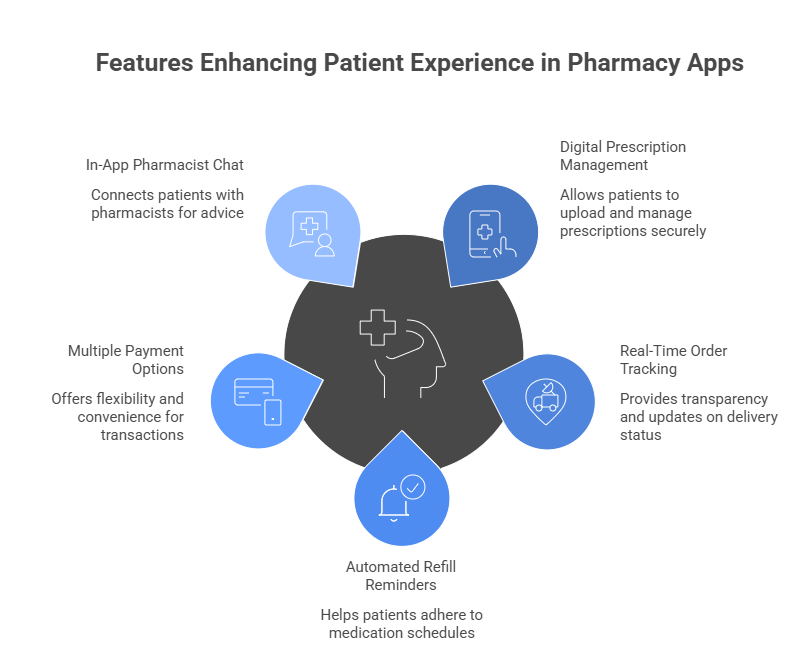
Digital Prescription Upload and Management
Patients should be able to upload a photo of a physical prescription or have e-prescriptions sent directly from a doctor’s system via integration. The app must validate, store, and link prescriptions to user profiles securely. Optical Character Recognition (OCR) technology can auto-extract prescription data and reduce manual entry errors.
Real-Time Order Tracking
Customers expect the same transparency from a pharmacy delivery that they get from an Amazon package. GPS-enabled tracking, status notifications (order received, being prepared, out for delivery), and estimated arrival times are no longer premium features — they are baseline expectations.
Automated Refill Reminders
Medication non-adherence costs the U.S. healthcare system an estimated $300 billion annually. Push notifications, SMS alerts, and in-app reminders tied to a patient’s prescription schedule solve this problem and drive repeat business for the pharmacy. Smart refill suggestions based on consumption history add even more value.
Multiple Payment Options
A frictionless checkout experience requires support for credit and debit cards, digital wallets (Apple Pay, Google Pay), net banking, and increasingly, insurance-linked billing. The ability to apply insurance benefits directly within the app removes a significant barrier to completion for many users.
In-App Pharmacist Chat
Live or asynchronous chat with licensed pharmacists addresses medication questions, potential drug interactions, and dosage clarifications. This feature builds trust, reduces product returns, and positions the pharmacy as a health partner rather than a commodity retailer.
3.2 For Pharmacists and Pharmacy Staff
Prescription Verification Workflow
Pharmacists need a streamlined dashboard to review incoming prescriptions, flag potential drug interactions, verify patient eligibility, and approve or reject orders with clear audit trails. Automation can pre-screen prescriptions for common issues before they reach the pharmacist’s queue, reducing review time significantly.
Inventory Management and Automated Procurement
Real-time inventory visibility is critical. Advanced systems use predictive analytics to flag slow-moving stock, anticipate demand spikes (flu season, allergy season), and generate automated reorder requests when quantities fall below predefined thresholds. This eliminates both stockouts and overstocking — both of which erode profitability.
EHR and Hospital System Integration
Pharmacies that integrate with Electronic Health Record systems and hospital networks gain access to patient medication histories, reducing the risk of dangerous drug interactions and enabling more informed dispensing. HL7 FHIR and API-based integrations are the industry-standard approaches here.
Regulatory Compliance and Reporting
Pharmacy software must comply with HIPAA (in the U.S.), GDPR (in Europe), and regional drug dispensing regulations. Built-in compliance modules generate audit-ready reports, maintain digital records of all dispensed medications, and enforce controlled substance protocols automatically — removing the burden from staff and reducing regulatory risk.
3.3 Advanced and Differentiating Features
AI-Powered Drug Interaction Alerts
Machine learning models trained on clinical databases can identify potentially dangerous drug interactions in milliseconds — even when they involve complex polypharmacy scenarios that a human pharmacist might miss. This feature is simultaneously a patient safety tool and a liability shield.
Loyalty Programs and Personalized Promotions
Pharmacy apps can leverage purchase history data to offer personalized discounts, reward points, and health product recommendations. Gamified loyalty programs — points for refills, bonuses for completing health surveys — increase engagement and dramatically improve customer lifetime value.
Multi-Language Support
For pharmacies serving diverse communities, multi-language interfaces remove a significant adoption barrier. This feature is especially powerful in urban markets and international pharmacy chains where multiple demographic groups are served.
Wearable and IoT Integration
Forward-looking pharmacy platforms are beginning to integrate with wearable health devices. When a patient’s blood glucose reading from a connected glucometer triggers an alert, the pharmacy app can automatically suggest a prescription consultation or reminder. This proactive engagement model dramatically enhances patient outcomes and positions the pharmacy as an active health partner.
4. The ROI Case: Numbers That Justify the Investment
For any business, investment decisions ultimately come down to return on investment. Pharmacy app development requires upfront capital — but the data consistently shows that the returns, both direct and indirect, far exceed the costs. Here is how the math works.
4.1 Labor Cost Reduction Through Automation
Pharmacy automation systems can reduce dispensing errors by up to 85% and cut the time pharmacists spend on administrative tasks by as much as 40%. When pharmacists are freed from routine data entry and manual prescription processing, they can focus on high-value clinical activities — medication therapy management, patient counseling, and immunization services — that generate additional revenue. Studies from pharmacy automation implementations suggest that labor cost savings alone can recover the cost of technology investment within 12 to 18 months.
4.2 Reduced Dispensing Errors and Associated Costs
Medication errors are expensive — not just in terms of patient harm, but in liability, remediation costs, and reputation damage. Automated dispensing systems equipped with barcode verification and AI-driven interaction checks virtually eliminate the most common categories of dispensing errors. For hospital pharmacies and large retail chains, eliminating even a small number of serious errors per year can represent hundreds of thousands of dollars in avoided costs.
4.3 Inventory Optimization and Waste Reduction
Overstocking ties up working capital and creates costly waste when medications approach expiration. Understocking creates stockouts that send customers to competitors. AI-powered inventory management systems have been shown to reduce inventory carrying costs by 15% to 25% by dynamically adjusting par levels based on demand patterns, seasonal trends, and real-time consumption data. For a pharmacy dispensing $10 million in medications annually, this optimization can represent $150,000 to $250,000 in annual savings.
4.4 Increased Revenue Per Customer
App-enabled pharmacies consistently report higher average order values than walk-in customers. The combination of personalized product recommendations, easy OTC browsing, loyalty program incentives, and frictionless reordering creates conditions where customers spend more per visit and visit more frequently. Research in the pharmacy retail space suggests that customers who use a pharmacy’s app spend 20% to 35% more annually than those who interact solely through the physical store.
4.5 Customer Retention and Lifetime Value
Medication adherence reminders and refill automation are retention engines. When a pharmacy app ensures a patient never runs out of their blood pressure medication, that patient stays. The economic value of retaining a single chronic disease patient — who may have five or more recurring prescriptions — over ten years vastly exceeds any individual transaction. Patient acquisition is expensive; retention is where pharmacy profitability is made or lost.
4.6 Data Monetization and Analytics
The aggregate, anonymized data generated by a pharmacy app is extraordinarily valuable. Purchase patterns, adherence rates, geographic demand concentrations, and seasonal trends can inform strategic decisions about store locations, product mix, staffing levels, and marketing spend. Some large pharmacy operators also participate in pharmaceutical research programs using anonymized patient data — a revenue stream unavailable to those without digital infrastructure.
5. How Pharmacy Apps Drive Business Growth
Beyond the measurable ROI, pharmacy apps create structural advantages that compound over time — positioning businesses for sustainable, scalable growth.
5.1 Geographic Expansion Without Physical Infrastructure
A physical pharmacy can serve the population within a few kilometers. A pharmacy app, combined with a robust delivery network, can serve an entire city or region. Some pharmacy operators have used app-first strategies to enter new markets entirely through delivery, testing demand before committing to brick-and-mortar investment. This dramatically lowers the capital risk of geographic expansion.
5.2 New Revenue Streams Beyond Prescriptions
Pharmacy apps open revenue channels that do not exist in traditional retail: subscription refill plans (where patients pay monthly for automated refill management), premium app tiers for enhanced services, affiliate revenue from health and wellness brands, telehealth consultation fees, and even advertising revenue from healthcare product manufacturers. A well-built pharmacy app is not just a sales channel — it is a platform.
5.3 Brand Differentiation in a Crowded Market
In markets saturated with pharmacy options, a superior app experience becomes a key differentiator. Patients choose providers that make their lives easier. A seamless app — with intuitive design, reliable delivery, and proactive health reminders — creates brand preference that is difficult for competitors to erode. The switching costs increase the longer a patient uses the app, as their prescription history, preferences, and refill schedules are embedded in the experience.
5.4 Scaling Through Partnerships
A pharmacy with a robust digital platform becomes an attractive partner for hospitals, insurance companies, corporate employee health programs, and government health initiatives. These B2B relationships — where the pharmacy becomes the preferred dispensing partner for an institution — are high-volume, recurring, and significantly more predictable than retail foot traffic. They are also nearly impossible to pursue without a digital infrastructure that can handle the operational requirements.
5.5 Smarter Marketing Through Data
Traditional pharmacy marketing is largely spray-and-pray — flyers, generic email blasts, in-store promotions. App-enabled pharmacies can segment their customer base with surgical precision: identifying patients due for annual flu shots, diabetics who might benefit from glucose monitoring supplies, or customers who have not placed an order in 60 days. Targeted, personalized outreach consistently outperforms generic campaigns by a factor of three to five times in conversion rates.
6. Building the Tech Stack: What It Takes to Develop a Pharmacy App
Understanding the technical components of a pharmacy app helps decision-makers have more informed conversations with development partners and set realistic expectations for timelines and budgets.
6.1 Technology Foundation
- Frontend: React Native or Flutter for cross-platform mobile apps (iOS and Android from a single codebase), React.js for web interfaces.
- Backend: Node.js, Python (Django/FastAPI), or Java Spring Boot for server-side logic, REST or GraphQL APIs for data communication.
- Database: PostgreSQL for relational data, MongoDB for flexible document storage, Redis for caching and session management.
- Cloud Infrastructure: AWS, Google Cloud, or Azure for scalable hosting, with auto-scaling to handle demand spikes.
- Security: End-to-end encryption, multi-factor authentication, HIPAA-compliant data storage, and regular penetration testing.
6.2 Key Integrations
- EHR/EMR systems via HL7 FHIR APIs (Epic, Cerner, Meditech)
- Payment gateways (Stripe, Braintree, Razorpay)
- Insurance verification APIs for real-time benefit checking
- Logistics and delivery APIs (Shiprocket, FedEx, custom courier networks)
- Push notification services (Firebase Cloud Messaging, OneSignal)
6.3 Development Timeline and Investment
Development costs vary significantly based on complexity, geography of the development team, and feature scope. As a general guide:
- MVP with core features (prescription upload, ordering, tracking): $30,000 – $60,000 | 4–6 months
- Full-featured platform with pharmacist dashboard and inventory management: $80,000 – $150,000 | 8–12 months
- Enterprise-grade platform with AI, EHR integrations, multi-vendor support: $150,000 – $300,000+ | 12–18+ months
These are investment ranges, not costs. When viewed against the revenue uplift, cost savings, and competitive positioning that result, the economics consistently favor building.
7. Compliance and Security: Non-Negotiables in Pharmacy App Development
Pharmacy apps handle some of the most sensitive data a person generates: their health conditions, medications, and insurance information. Compliance is not a checkbox — it is the foundation of trust and a legal requirement.
- HIPAA Compliance (U.S.): All protected health information (PHI) must be encrypted at rest and in transit. Business Associate Agreements (BAAs) must be in place with all third-party service providers who handle PHI.
- GDPR Compliance (EU): Users must provide explicit consent for data collection, have the right to access their data, and have the right to deletion.
- Regional Drug Regulations: Each country and state has specific rules around digital prescription handling, controlled substance tracking, and pharmacist verification requirements.
- SOC 2 Type II Certification: For enterprise-grade platforms, SOC 2 certification demonstrates rigorous security controls to hospital and insurance partners.
Compliance should be built into the architecture from day one — retrofitting security and compliance onto an existing system is exponentially more expensive and risky than designing for it from the start.
8. Real-World Success Stories
The case for pharmacy apps is not theoretical. The market is full of pharmacies that have transformed their businesses through digital investment.
CVS Health
CVS’s mobile app — with prescription refill management, pharmacy chat, and Rx delivery tracking — now serves tens of millions of users. The app has become a central pillar of CVS’s customer retention strategy, with app users demonstrating significantly higher purchase frequency and lifetime value than non-app customers.
1mg (India)
India’s 1mg has grown from a digital pharmacy into one of the country’s leading health platforms, combining medicine delivery, lab test bookings, doctor consultations, and health content — all from a single app. This evolution from transactional to ecosystem is the direction the most ambitious pharmacy apps are heading.
PharmEasy
PharmEasy scaled from a startup to a multi-billion-dollar health tech platform by perfecting the pharmacy delivery model and layering on diagnostics, insurance, and teleconsultation services. Their success demonstrates that a pharmacy app can be the seed from which an entire health ecosystem grows.
9. How to Choose the Right Development Partner
Building a pharmacy app is a high-stakes technical project. Choosing the right development partner is as important as the decision to build. When evaluating partners, look for:
- Demonstrated healthcare experience: They should have built HIPAA-compliant or equivalent health applications before — not just general consumer apps.
- Regulatory knowledge: A good partner understands the compliance landscape in your target market and builds with it in mind.
- Integration expertise: EHR integrations, insurance APIs, and logistics networks require specific technical experience.
- Post-launch support commitment: A pharmacy app requires ongoing maintenance, security updates, and feature iteration.
- Transparent process and communication: Long development timelines require trust. Choose partners who communicate proactively and document clearly.
Conclusion: The Digital Pharmacy Is Not the Future — It Is the Present
Pharmacy app development is no longer a luxury reserved for the largest chains. It is a strategic necessity for any pharmacy business that wants to grow, retain customers, and remain competitive in a market that is rapidly separating into digital haves and have-nots.
The ROI case is compelling: lower operating costs, higher revenue per customer, improved retention, and new revenue streams that did not previously exist. The growth case is equally strong: geographic expansion, B2B partnerships, brand differentiation, and ecosystem-building potential.
The pharmacies that will thrive in the next decade are not necessarily the ones with the largest physical footprints. They are the ones that build the deepest, most useful, and most trusted digital relationships with their patients. A pharmacy app — well-designed, thoughtfully built, and continuously improved — is the foundation of that relationship.
The investment is real. The returns are measurable. The competitive window is open. The only question is whether you will build now — or spend the next five years watching others who did.
Ready to build your pharmacy app? We are here!
FAQ
1. How long does it take to develop a pharmacy app from scratch?
It depends on the complexity of what you’re building. A basic MVP with core features like prescription upload, ordering, and delivery tracking typically takes 4 to 6 months. A full-featured platform with a pharmacist dashboard, inventory management, and payment integrations usually takes 8 to 12 months. Enterprise-grade systems with AI capabilities, EHR integrations, and multi-vendor support can stretch to 18 months or beyond. The key is to start with a well-scoped MVP, validate it with real users, and then iterate — rather than trying to build everything at once.
2. Is a pharmacy app legally compliant with healthcare data regulations?
It can be — but compliance has to be designed in from day one, not added later. In the U.S., any app that handles patient prescription data must be HIPAA-compliant, meaning all protected health information must be encrypted, access must be controlled, and Business Associate Agreements must be signed with every third-party vendor who touches that data. In Europe, GDPR applies. Beyond data privacy, most countries also have specific laws around digital prescriptions, controlled substance tracking, and pharmacist verification. Skipping compliance in early development is one of the most expensive mistakes a pharmacy business can make — retrofitting it is far harder than building it right the first time.
3. Can a small or independent pharmacy afford to build an app?
Yes — and the cost barrier is lower than most people assume. Independent pharmacies do not need to build a custom platform from scratch immediately. White-label pharmacy app solutions exist that can be branded and launched at a fraction of the cost of custom development, typically starting from $5,000 to $15,000. For those ready for a custom build, a focused MVP targeting only the most critical features — say, online ordering and refill reminders — can be built for $30,000 to $60,000. The more relevant question is not whether a small pharmacy can afford to build an app, but whether it can afford not to, as digital-first competitors continue to absorb market share.
4. What is the biggest mistake pharmacies make when developing an app?
The most common and costly mistake is building too much too fast without validating user needs first. Pharmacies often try to launch with every feature imaginable — telemedicine, AI recommendations, loyalty programs, insurance billing — all at once. This inflates costs, delays launch, and often results in a bloated product that patients find confusing. The smarter approach is to identify the one or two pain points that matter most to your specific customer base, solve those exceptionally well in a first version, and expand from there based on real usage data. The second most common mistake is underinvesting in the pharmacist-facing side of the app — if the back-end workflow is clunky, staff will resist adoption and the whole system breaks down.
5. How do pharmacy apps actually make money — beyond just selling medications?
A well-built pharmacy app can generate revenue through multiple channels simultaneously. The obvious one is prescription and OTC product sales. Beyond that, pharmacies can offer subscription-based refill management plans where patients pay a monthly fee for automated dispensing. In-app telehealth consultations with pharmacists or physicians generate consultation fees. Loyalty program tiers — where premium members get priority delivery or exclusive discounts — create recurring subscription revenue. Some platforms earn affiliate revenue by recommending health and wellness products. And at scale, anonymized aggregate data on purchasing patterns and medication adherence can be valuable to pharmaceutical companies and health researchers, subject to strict privacy compliance. The pharmacy app, in its most evolved form, is not just a sales channel — it is a platform with multiple overlapping revenue streams.

Professional content writer Akhila Mathai has over four years of experience. She writes posts about the different mobile app solutions we offer as well as services related to them. Her ability to conduct thorough research and think critically enables her to produce excellent, authentic, and legitimate content. Along with her strong communication abilities, she collaborates well with her teammates to create information that is current and relevant to emerging technology.

