

The future belongs to applications that anticipate user needs, not just respond to them. Artificial intelligence is no longer an optional feature, it’s the fundamental difference between market leaders and forgotten apps.
The Invisible Challenge: Why Most Mobile Apps Fail
A user opens your app once, encounters generic recommendations that don’t match their interests, navigates through irrelevant features, and deletes it. Within minutes, your months of development work are forgotten. This scenario plays out millions of times daily across app stores worldwide.
The problem isn’t poor design or weak functionality. It’s that users expect personalization, intelligence, and anticipation. They’re accustomed to Netflix suggesting their next favorite show, Spotify understanding their musical taste, and Google Maps predicting traffic before they start driving. When standard apps fail to deliver this level of insight, users perceive them as outdated, regardless of actual quality.
The Opportunity: AI as a Business Multiplier
This challenge presents an extraordinary opportunity. Businesses that successfully integrate artificial intelligence into mobile applications don’t just improve user satisfaction—they fundamentally transform business metrics. Companies leveraging AI report:
- 40-60% improvement in user engagement through personalized experiences that feel intuitively designed for each individual
- 25-35% increase in conversion rates when recommendations align precisely with user preferences and intent
- 50% reduction in customer acquisition costs through intelligent targeting and improved word-of-mouth from satisfied users
- 30-40% improvement in retention as applications become more valuable and harder to live without
The Market Reality: Timing Matters
The window for AI adoption in mobile is rapidly closing. Early movers are establishing dominance in their categories. Consider the timeline:
- 2023-2024: AI adoption accelerates as technology becomes more accessible and affordable
- 2025-2026: AI becomes table stakes—competitive disadvantage for apps without intelligent features
- 2027-: Sophisticated AI implementation becomes minimum expectation rather than differentiation
Applications launching today with cutting-edge AI capabilities establish competitive moats that competitors will struggle to overcome. Conversely, apps without AI features will face increasing user acquisition challenges and churn as user expectations evolve.
What This Guide Delivers
This comprehensive guide bridges the gap between understanding AI’s potential and actually implementing it successfully. You’ll discover:
- Real Business Cases: How specific companies leverage AI to drive engagement and revenue, with measurable results
- Implementation Roadmap: Step-by-step processes for integrating AI from initial planning through deployment and optimization
- Financial Framework: Precise cost breakdowns helping you budget accurately and identify where to allocate resources for maximum ROI
- Risk Mitigation: Practical strategies to navigate challenges like data privacy, algorithmic bias, and technical complexity
- Future Preparation: Emerging trends ensuring your investment remains relevant as technology evolves
Whether you’re a founder validating a business idea, a product manager planning your next release, or an enterprise executive evaluating technology investments, this guide provides the insights needed to make informed decisions about artificial intelligence in mobile applications.
Introduction to AI in Mobile Ecosystem
The convergence of artificial intelligence and mobile computing represents one of the most significant technological shifts of our era. Smartphones have evolved from simple communication devices into powerful computing platforms capable of processing complex algorithms in real-time. This evolution enables a new generation of applications that understand user behavior, adapt to individual preferences, and deliver experiences previously impossible to achieve.
Today’s mobile users expect applications to be intuitive, personalized, and predictive. They want technology that anticipates their needs before they explicitly express them. AI makes this possible through sophisticated algorithms that learn from patterns in user data and continuously improve their recommendations and predictions.
The scope of AI in mobile app development:
- Intelligent recommendation engines that boost user engagement and retention
- Natural language interfaces enabling conversational interactions with applications
- Computer vision capabilities for image recognition and augmented reality experiences
- Predictive analytics informing business decisions and user behavior forecasting
- Advanced security systems protecting user data and preventing fraud
Why AI Matters for Modern Apps
The competitive intensity in app markets demands differentiation. Users have access to thousands of applications in every category. Those that survive and thrive are typically the ones offering superior experiences through intelligent features that solve real problems.
Artificial intelligence provides multiple strategic advantages that directly impact business outcomes:
Enhanced User Personalization
Rather than offering identical experiences to all users, AI-powered applications deliver customized content, recommendations, and interfaces tailored to individual preferences. This personalization significantly increases user satisfaction, reduces churn, and drives revenue through targeted upselling and cross-selling.
Operational Efficiency
AI automates traditionally manual processes, from customer support to quality assurance. Chatbots handle routine inquiries without human intervention, while machine learning algorithms identify bugs and performance issues automatically. This efficiency translates directly to reduced costs and faster time-to-market for updates.
Data-Driven Insights
Applications generate vast amounts of user interaction data. AI transforms this raw data into meaningful insights—which features drive engagement, which user segments are most valuable, what price points optimize revenue. These insights guide strategic product decisions and resource allocation.
Competitive Differentiation
In crowded markets, intelligent features create defensible competitive advantages. Applications with sophisticated recommendation systems, natural language understanding, or predictive capabilities attract users seeking premium experiences.
Key Business Metrics Impacted by AI:
- User acquisition costs (reduced through better targeting)
- Customer lifetime value (increased through retention improvements)
- Conversion rates (optimized through personalization)
- Revenue per user (enhanced through intelligent upselling)
- Development costs (reduced through automation)
Global AI Market Expansion
The financial opportunity in AI-powered mobile applications is substantial and growing rapidly. Market analysis reveals accelerating adoption across industries, geographies, and user demographics. This expansion signals both significant opportunity and increasing competitive pressure for businesses.
Market Growth Trajectory
- 2025 Market Size: The global AI-enabled mobile app market is valued at approximately $28.1 billion, representing substantial growth from previous years
- Growth Rate: The market is expanding at a compound annual growth rate of 32.5%, indicating accelerating adoption
- 2034 Projection: Industry analysts project the market will reach $354.1 billion within a decade, representing more than a tenfold increase
Geographic Distribution
AI adoption is not uniform globally. Understanding regional market dynamics helps identify opportunities and understand competitive landscapes:
- Asia-Pacific Dominance: This region leads globally with 55.3% market share and $11.7 billion in current revenue. Dense populations, high smartphone penetration, and tech-savvy consumers drive rapid AI adoption
- North American Market: While smaller in percentage share, North America represents significant value through enterprise AI adoption and premium consumer applications
- European Growth: Stricter data privacy regulations (GDPR) shape AI development approaches, creating differentiation opportunities for privacy-conscious solutions
Industry-Specific Opportunities
- Entertainment leads with 53.6% market share, driven by streaming platforms and social media apps
- AI-enabled social media applications capture 65.1% of their respective market segments
- Gaming applications utilizing AI show 79.7% market engagement levels
- Emerging opportunities in healthcare, fintech, and e-commerce demonstrate expanding use cases
AI Implementation Strategies
Successful AI integration requires understanding how artificial intelligence transforms application architecture, development processes, and user experiences. Strategic implementation goes beyond simply adding AI features—it involves reimagining applications around intelligent capabilities.
Strategic Architecture Decisions
Effective AI implementation begins with strategic architectural choices that influence scalability, performance, and maintainability:
- On-Device vs. Cloud Processing: Determine whether AI models run locally on user devices or remotely on servers, balancing latency, privacy, and computational requirements
- Model Selection: Choose between pre-trained models that work out-of-the-box and custom-trained models optimized for specific use cases
- Data Infrastructure: Design systems to collect, process, and store the high-volume data required for machine learning
- Integration Points: Identify where AI should enhance user experiences versus where it adds unnecessary complexity
Development Process Optimization
AI-powered development processes themselves leverage artificial intelligence to improve efficiency:
- Code generation and completion tools accelerate development velocity
- Automated testing systems identify bugs and performance issues early
- Predictive analytics reveal potential failure points before users encounter them
- Machine learning-driven resource allocation optimizes infrastructure spending
Explore How much does it cost to develop an AI app in 2024?
Key Applications and Use Cases
Artificial intelligence creates value across diverse mobile applications. Understanding specific use cases helps identify opportunities for your organization and anticipates future capabilities users will expect.
Intelligent Recommendation Systems
Perhaps the most widespread AI application in mobile apps, recommendation systems analyze user behavior, content preferences, and social connections to suggest products, content, and experiences. Platforms like Netflix, Spotify, and Amazon attribute significant revenue growth to sophisticated recommendation algorithms.
Voice and Natural Language Interfaces
Virtual assistants powered by natural language processing enable hands-free interaction with applications. Users can perform tasks through conversation rather than navigating complex menus, improving accessibility and user experience.
Computer Vision and Image Analysis
Applications leveraging computer vision can recognize objects in photos, verify user identities through facial recognition, apply real-time filters, and enable augmented reality experiences. These capabilities enhance both consumer and enterprise applications.
Health and Wellness Monitoring
AI-powered health applications track vital signs through wearable devices, detect anomalies that might indicate health issues, and provide personalized wellness recommendations. Early detection capabilities can be life-saving for serious conditions.
Intelligent Input and Communication
Predictive text systems that learn individual typing patterns, auto-correct misspellings, and understand context significantly improve communication speed and accuracy on mobile devices. These systems adapt to user behavior over time, becoming increasingly personalized.
Fraud Prevention and Security
Machine learning algorithms monitor transaction patterns and user behavior to identify fraudulent activities with minimal false positives. Financial applications especially benefit from AI’s ability to detect sophisticated fraud schemes.
Contextual Search and Discovery
Beyond keyword matching, intelligent search systems understand user intent and context. Visual search capabilities allow users to photograph objects and find similar items, enabling discovery that wasn’t previously possible.
Smart Image Capture and Enhancement
Smartphone cameras with AI optimization automatically adjust settings for optimal image quality across diverse lighting conditions, recognize scenes and subjects, apply professional-quality filters, and enhance images after capture.
Core AI Technologies in Apps
Building sophisticated AI applications requires integrating multiple complementary technologies. Understanding these core components helps in making informed technology choices for your projects.
Machine Learning Algorithms
Machine learning represents the foundation of modern AI applications. These algorithms automatically learn patterns from data without explicit programming, enabling systems to improve performance through exposure to more data.
Natural Language Processing
NLP enables applications to understand, interpret, and generate human language. Capabilities range from simple keyword extraction to sophisticated contextual understanding that captures nuance, sentiment, and intent. This technology powers chatbots, translation services, and voice interfaces.
Advanced Analytics and Business Intelligence
Transforming raw application data into business insights requires sophisticated analytics platforms. These systems process massive datasets to identify trends, forecast user behavior, and surface opportunities for optimization.
IoT Device Integration
Smart devices from smartwatches to connected home systems generate continuous streams of data. Applications that integrate this IoT data can provide unprecedented insights into user behavior and enable novel features.
Dynamic User Interface Adaptation
Rather than static interfaces, AI systems can adapt application layouts, navigation structures, and feature visibility based on individual user preferences and behavior patterns. This creates increasingly personalized experiences.
Cloud Infrastructure and Scalability
AI applications require substantial computational resources for model training and real-time inference. Cloud platforms provide scalable infrastructure that grows with application demands without requiring upfront capital investment.
Integration Process and Best Practices
Successful AI integration follows a structured approach that minimizes risk while maximizing business value. This process should be customized to your organization’s capabilities and strategic objectives.
Phase 1: Strategic Planning and Objective Definition
Begin by clearly defining what problems AI will solve and how success will be measured. Vague objectives lead to wasted resources and disappointing results. Establish specific, measurable KPIs for each AI feature before development begins.
Phase 2: Technology and Architecture Selection
Evaluate available AI technologies, frameworks, and service providers. Determine whether to build custom models or leverage pre-trained solutions. Consider factors including cost, performance requirements, data privacy, and integration complexity.
Phase 3: Data Collection and Preparation
Quality data is fundamental to successful AI. Establish processes for systematic data collection, ensuring data represents all user segments and scenarios. Data cleaning and preparation typically consumes 60-70% of project effort but directly determines model performance.
Phase 4: Model Development and Training
Build and train AI models using collected data. This iterative process involves experimentation with different algorithms, tuning of parameters, and validation against diverse test sets. Expect multiple iterations as you balance performance with practical constraints.
Phase 5: Testing, Optimization, and Deployment
Thoroughly test AI models across diverse devices, network conditions, and user segments. Optimize models for mobile performance through techniques like quantization and pruning. Deploy gradually, monitoring real-world performance and gathering user feedback.
Phase 6: Continuous Improvement and Monitoring
AI systems require ongoing monitoring and updates. Track performance metrics continuously, retrain models with new data, and iterate based on user feedback and changing business requirements.
Risks and Mitigation Strategies
AI implementation introduces specific risks that must be carefully managed. Understanding these challenges enables proactive mitigation.
Data Privacy and Security Risks
AI applications process sensitive user data. Breaches could expose personal information and damage user trust. Implement encryption, access controls, and regular security audits. Maintain transparency about data practices and comply with privacy regulations like GDPR.
Development Cost and Resource Requirements
Building sophisticated AI systems requires significant investment in specialized talent, cloud infrastructure, and tools. Manage costs through phased approaches, leveraging pre-trained models, and outsourcing non-core development to cost-effective partners.
Data Quality Limitations
Poor quality training data produces poor performing models. Invest in robust data collection and validation processes. Use techniques like data augmentation and transfer learning to achieve good results with limited data.
Algorithmic Bias and Ethical Concerns
AI systems can perpetuate biases present in training data, leading to unfair or discriminatory outcomes. Actively monitor for bias, involve diverse perspectives in development, and implement fairness checks throughout the development process.
Risk Mitigation Framework:
- Security: Implement encryption, authentication, and access controls
- Financial: Use incremental development, leverage existing solutions
- Technical: Invest in data quality, comprehensive testing
- Ethical: Regular bias audits, diverse team perspectives
Successful AI-Powered Apps
Emerging Trends and Future Outlook
Edge AI and On-Device Processing
Processing AI models on user devices rather than remote servers provides faster response times, improved privacy, and offline functionality. This trend will accelerate as mobile hardware includes dedicated AI processors.
Emotional Intelligence in Applications
Future applications will detect user emotional states through text, voice, facial expressions, and behavioral signals. This capability enables empathetic applications that respond appropriately to user feelings and psychological states.
AI-Enhanced Augmented and Virtual Reality
Combining AI with AR/VR creates immersive experiences that adapt to user preferences, understand physical environments, and provide intelligent guidance. Retail, education, and entertainment applications will particularly benefit from this convergence.
Hyper-Personalization Through Predictive Analytics
Beyond recommending existing products, future AI systems will predict user needs before users consciously recognize them. These predictive capabilities will drive unprecedented personalization across all application categories.
Financial Considerations and Budgeting
Understanding the financial investment required for AI development enables better planning and resource allocation. Costs vary significantly based on project scope, complexity, and team location.
Development Cost Ranges
- Basic AI Features ($8,000-$15,000): Simple recommendation engines, basic chatbots, elementary image filtering. Suitable for MVPs and initial feature testing.
- Moderate AI Integration ($15,000-$25,000): Advanced recommendations, context-aware chatbots, object recognition. Appropriate for growth-stage companies adding sophisticated features.
- Advanced AI Systems ($25,000-$50,000+): Complex personalization, real-time computer vision, predictive modeling. For established companies requiring competitive differentiation.
Financial Considerations and Budgeting
Understanding the financial investment required for AI development enables better planning and resource allocation. Costs vary significantly based on project scope, complexity, and team location.
Development Cost Ranges
- Basic AI Features ($8,000-$15,000): Simple recommendation engines, basic chatbots, elementary image filtering. Suitable for MVPs and initial feature testing.
- Moderate AI Integration ($15,000-$25,000): Advanced recommendations, context-aware chatbots, object recognition. Appropriate for growth-stage companies adding sophisticated features.
- Advanced AI Systems ($25,000-$50,000+): Complex personalization, real-time computer vision, predictive modeling. For established companies requiring competitive differentiation.
Ongoing Operational Costs
AI systems require continuous investment beyond initial development. Annual maintenance and operations typically consume 15-20% of original development costs, including:
- Cloud infrastructure for model hosting and inference
- Model retraining with new data to maintain accuracy
- Monitoring and optimization for performance
- Security updates and compliance management
Cost Optimization Strategies
- Leverage pre-trained models rather than training from scratch (saves 60-70% of time)
- Use cloud-based AI services reducing infrastructure overhead
- Implement phased development, starting with core features then expanding
- Partner with experienced development teams in cost-effective regions
- Utilize open-source tools and frameworks reducing licensing costs
For the majority of companies in these industries, the AI app concepts we looked at in the previous part represent the future. Therefore, it becomes crucial to get in touch with a trustworthy and knowledgeable partner in order to execute the concepts for contemporary AI mobile apps at reasonable costs.
Frequently Asked Questions
How Does AI Work In Mobile Applications?
For a business investor, it is essential to understand how AI operates in mobile applications. The working steps are discussed as follows:
- Gets the input data from the user through an automated interface
- Analyzes data format composition, such as text, image, or audio
- Processes information by running different advanced algorithms
- Trains data to predict results based on user preferences
- Sends the output with personalized features and recommended suggestions
What Is The Maintenance Cost Of AI-Based Mobile Apps?
The maintenance cost ranges from 15% to 20% of the overall development price. For a project cost of $20,000, the maintenance cost is estimated to be between $3,000 and $4,000, covering all relevant issues. It is an important factor that includes feature enhancements and security checks as major cost-affecting parameters.
How Long Does It Take To Develop AI-Powered Mobile Applications?
To create mobile apps with basic AI-enabled features and algorithms, the average time required is between 2 months and 5 months. The overall duration may extend as the AI complexity increases due to the latest Machine Learning features and other advanced algorithms. The development time may reach more than a year due to various market factors.
Which Are The Best AI-Powered Mobile Apps For Image Generation?
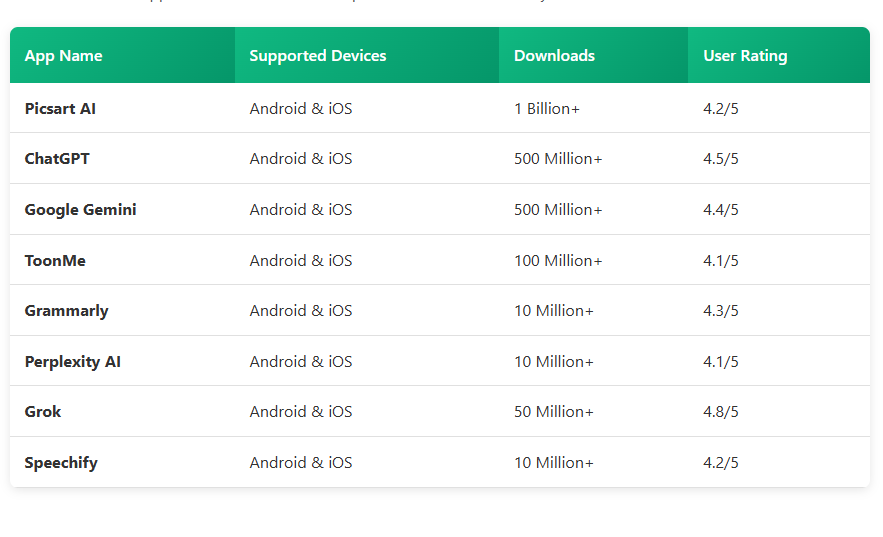
People in the USA and other regions use various AI-powered mobile apps to create multiple images or enhance them with advanced features. Picsart, Remini, Snapchat, and Adobe Express have built-in image modifier services and options. But ChatGPT and Gemini require human prompts with specifications to generate the desired images.
How Do AI In Mobile Apps Ensure User Data Security?
AI is one of the major technologies to prevent fraud and secure mobile applications. It is important to understand how AI ensures data security:
- The technology works on decision trees that detect fake links and threats
- It regularly monitors backdoors to predict the chance of security attacks
- AI uses various learning algorithms that identify risks and send alerts
Is It Easy To Build Mobile Apps With AI-Enabled Features?
Yes, mobile app development with Artificial Intelligence is easy and affordable. Businesses can hire experienced professionals to implement basic AI algorithms and services. These tasks become difficult as the AI gets enhanced due to multiple machine learning and NLP features, making the overall process time-consuming and expensive.

Professional content writer Akhila Mathai has over four years of experience. She writes posts about the different mobile app solutions we offer as well as services related to them. Her ability to conduct thorough research and think critically enables her to produce excellent, authentic, and legitimate content. Along with her strong communication abilities, she collaborates well with her teammates to create information that is current and relevant to emerging technology.

