


Chatbots vs. AI Assistants: Which One is Right for Your Business?
20 Dec 25 
Share To:


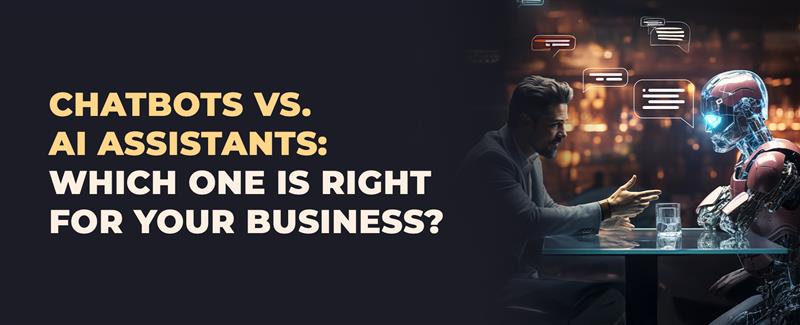
Your customer service team is drowning in repetitive inquiries, the same questions about shipping times, return policies, and password resets, day after day. The solution seems obvious: deploy conversational AI. But here’s where most businesses stumble.
You’ve probably heard pitches from vendors claiming their “AI-powered chatbot” will revolutionize your operations, or seen case studies about “intelligent assistants” transforming customer engagement. The problem? These terms get thrown around interchangeably, yet they represent fundamentally different technologies with vastly different capabilities and price tags.
Choosing wrong doesn’t just mean wasted budget. It means frustrated customers abandoning mid-conversation, employees ignoring tools that don’t actually help them, and executives questioning whether AI was worth the investment at all. The difference between a $5,000 chatbot and a $50,000 AI assistant isn’t just zeroes on an invoice—it’s the gap between automating simple FAQs and genuinely transforming how your business operates.
So which one do you actually need?
Understanding the Core Differences
What is a Chatbot?
A chatbot is a software application designed to simulate human conversation through text or voice interactions. Traditional chatbots operate on rule-based systems, following pre-programmed decision trees and scripted responses. When a user asks a question or makes a request, the chatbot matches keywords or phrases to predetermined responses and flows.
These systems excel at handling straightforward, repetitive tasks within a narrow scope. Think of them as digital receptionists who can answer frequently asked questions, guide users through simple processes, or direct inquiries to the appropriate department. They’re efficient, predictable, and work best when dealing with structured, anticipated interactions.
Modern chatbots have evolved beyond simple rule-based systems to incorporate natural language processing (NLP), allowing them to understand user intent more accurately. However, even advanced chatbots typically operate within defined parameters and struggle when confronted with requests outside their programmed scope.
Also read Know These Latest AI Chatbots Trends & Its Applications
What is an AI Assistant?
AI assistants represent a more sophisticated evolution of conversational technology. Powered by advanced artificial intelligence, machine learning, and large language models, these systems can understand context, learn from interactions, and handle complex, multi-step tasks that require reasoning and decision-making.
Unlike chatbots that follow predetermined scripts, AI assistants can comprehend nuanced language, maintain context across extended conversations, and adapt their responses based on user behavior and preferences. They can integrate with multiple systems, pull information from various sources, and execute tasks that require understanding the bigger picture rather than just matching keywords to responses.
AI assistants are more like digital colleagues who can think, reason, and solve problems rather than simply following instructions. They can handle ambiguous requests, ask clarifying questions when needed, and provide personalized experiences that evolve over time.
Key Capabilities Comparison
| Feature | Chatbots | AI Assistants |
| Technology Base | Rule-based systems with basic NLP | Advanced AI, machine learning, large language models |
| Conversation Style | Linear, scripted responses | Dynamic, context-aware dialogue |
| Learning Ability | Static, requires manual updates | Self-improving through machine learning |
| Task Complexity | Simple, repetitive tasks | Complex, multi-step workflows |
| Context Retention | Limited or none across conversations | Maintains context throughout interactions |
| Personalization | Minimal, template-based | Deep personalization based on user behavior |
| Flexibility | Struggles with unexpected queries | Adapts to varied and ambiguous requests |
| Integration Depth | Basic API connections | Deep, multi-system orchestration |
| Implementation Time | Quick (days to weeks) | Longer (weeks to months) |
| Initial Cost | Lower | Higher |
| Maintenance | Manual script updates | Model monitoring and retraining |
| Best For | High-volume FAQs, simple transactions | Complex problem-solving, personalized service |
Conversation Quality and Flexibility
Chatbots typically engage in linear conversations, guiding users through predetermined paths. If a user deviates from expected inputs or asks something unexpected, traditional chatbots often struggle or fail entirely, responding with generic error messages like “I don’t understand” or “Please rephrase your question.”
AI assistants handle conversational complexity with greater sophistication. They can follow tangential discussions, remember previous exchanges, and understand implied meaning. If someone asks an AI assistant about shipping times, then follows up with “What about returns?” the assistant understands the context without requiring the user to provide complete information again.
Learning and Adaptation
Rule-based chatbots don’t learn from interactions. Every conversation follows the same patterns regardless of how many times similar questions are asked. Updates require manual reprogramming by developers to add new responses or modify existing flows.
AI assistants continuously improve through machine learning. They analyze successful and unsuccessful interactions, identify patterns in user behavior, and refine their responses accordingly. This self-improving capability means the system becomes more effective over time without constant manual intervention.
Task Complexity
Chatbots handle simple, transactional tasks effectively: checking account balances, booking appointments, answering FAQs, or collecting basic information. They’re designed for efficiency in narrow domains where the range of possible interactions is well-defined and limited.
AI assistants manage complex workflows that span multiple systems and require contextual understanding. They can research products based on nuanced preferences, coordinate scheduling across multiple calendars with various constraints, or provide technical troubleshooting that requires diagnostic reasoning.
Integration Capabilities
While both technologies can integrate with business systems, the depth and sophistication differ significantly. Chatbots typically connect to specific databases or APIs to retrieve or submit predetermined data points.
AI assistants can orchestrate complex interactions across multiple platforms, understanding how information from different sources relates and how to combine it meaningfully. They can pull customer history from a CRM, check inventory in real-time, process payment through a gateway, and update multiple systems simultaneously while maintaining conversational flow.
Also How to Choose the Right Chatbot for Your Business: A Simple Guide
Use Cases: When to Choose What
Ideal Scenarios for Chatbots
Chatbots shine in situations requiring consistent, scalable responses to common inquiries. A retail business handling hundreds of “Where is my order?” questions daily benefits enormously from a chatbot that instantly retrieves tracking information. Similarly, restaurants using chatbots for table reservations can automate a straightforward process without human intervention.
Customer service departments dealing with repetitive tier-one support questions (password resets, account information, basic troubleshooting) find chatbots invaluable for triaging inquiries and resolving simple issues before escalating to human agents. Healthcare providers use chatbots for appointment scheduling, prescription refills, and symptom checking within carefully defined parameters.
The financial sector leverages chatbots for account inquiries, fraud alerts, and basic transaction assistance. Educational institutions deploy them for admissions FAQs, campus information, and enrollment processes. In each case, the interactions are relatively predictable, and accuracy is achieved through carefully mapped conversation flows.
Ideal Scenarios for AI Assistants
AI assistants excel when businesses need to handle complex customer journeys that vary significantly between individuals. E-commerce platforms use AI assistants to provide personalized shopping experiences, understanding not just what customers ask for explicitly, but interpreting their broader needs and preferences.
Enterprise organizations implement AI assistants for internal operations, helping employees navigate complex processes, access information across disparate systems, and automate sophisticated workflows. A human resources AI assistant might help employees understand benefits, navigate policy questions, request time off, and troubleshoot issues with all relevant context considered.
Professional services firms use AI assistants for client relationship management, research assistance, and knowledge management, where the value lies in synthesizing information and providing insights rather than simply retrieving data. Financial advisors employ them to analyze market conditions, client portfolios, and regulatory requirements simultaneously.
Healthcare providers leverage AI assistants for care coordination, where understanding patient history, current conditions, treatment plans, and coordination between multiple providers requires sophisticated reasoning beyond simple scripted responses.
Implementation Considerations
Cost and Resources
Chatbots generally require lower upfront investment and can be deployed relatively quickly using existing platforms. Many drag-and-drop chatbot builders enable businesses to launch basic bots without extensive technical expertise. Ongoing costs primarily involve maintenance, content updates, and platform fees.
AI assistants demand greater initial investment in technology, data infrastructure, and integration complexity. They require more sophisticated development, often custom-built to specific business needs, and need quality training data. However, their ability to handle more complex tasks can deliver greater ROI by automating work previously requiring skilled human labor.
Maintenance and Evolution
Maintaining chatbots involves regularly updating conversation flows, adding new scripts, and monitoring for gaps in coverage. As business needs evolve, developers must manually expand the bot’s capabilities.
AI assistants require different maintenance focused on training data quality, model performance monitoring, and periodic retraining. While they self-improve in many ways, they need oversight to ensure accuracy, prevent bias, and maintain alignment with business objectives.
Integration Complexity
Chatbots integrate with limited endpoints for specific data retrieval and submission. Implementation typically involves connecting to existing APIs with straightforward data exchange.
AI assistants require deeper system integration, often needing access to multiple platforms, databases, and services. They benefit from comprehensive data access to provide truly intelligent assistance, which means more complex security considerations and technical architecture.
Making the Right Choice
The decision between chatbots and AI assistants isn’t always binary. Many successful implementations use hybrid approaches, deploying chatbots for routine transactions while reserving AI assistants for complex interactions requiring deeper intelligence.
Consider starting with chatbots if your primary needs involve automating high-volume, repetitive inquiries with straightforward resolutions. This approach delivers quick wins, builds organizational confidence in conversational AI, and establishes foundations for more sophisticated implementations.
Invest in AI assistants when customer or employee interactions require personalization, context awareness, and complex problem-solving. If your competitive advantage depends on superior service quality rather than just efficiency, AI assistants provide the sophistication needed to differentiate.
For many organizations, the optimal path involves beginning with chatbots to automate simple tasks, then gradually introducing AI assistant capabilities as use cases expand and the organization’s AI maturity develops. This phased approach manages risk while building toward more transformative applications.
Looking Forward
As technology evolves, the distinction between chatbots and AI assistants continues to blur. Today’s advanced chatbots incorporate AI capabilities, while AI assistants become more accessible and easier to implement. The key is understanding not just the technology, but your business needs, customer expectations, and strategic objectives.
The right choice depends on where you are in your digital transformation journey, the complexity of problems you’re solving, and the experience you want to deliver. By clearly assessing your requirements against the capabilities of each technology, you can make informed decisions that drive real business value while setting the foundation for future innovation.





Professional content writer Akhila Mathai has over four years of experience. She writes posts about the different mobile app solutions we offer as well as services related to them. Her ability to conduct thorough research and think critically enables her to produce excellent, authentic, and legitimate content. Along with her strong communication abilities, she collaborates well with her teammates to create information that is current and relevant to emerging technology.

Subscribe To Our Newsletter
Check our free newsletter about mobile app development, latest technology updates, fintech, loyalty and more.
- Agentic AI1
- Android Development3
- Artificial Intelligence38
- Autopay1
- Classified App3
- Custom App Development5
- Digital Transformation12
- Doctor Appointment Booking App14
- Dropshipping1
- Ecommerce Apps40
- Education Apps2
- Fintech-Apps38
- Fitness App4
- Flutter4
- Flutter Apps20
- Food Delivery App5
- Grocery App Development1
- Grocery Apps3
- Health Care10
- IoT2
- Loyalty Programs11
- Matrimony Apps1
- Microsoft1
- Mobile App Maintenance2
- Mobile Apps134
- On Demand Marketplace1
- Product Engineering6
- Progressive Web Apps1
- React Native Apps2
- Saas Application2
- Shopify9
- Software Development3
- Taxi Booking Apps7
- Truck Booking App5
- UI UX Design8
- Uncategorized7
- Web App Development1
 Reading Time: 14 minutes
 Reading Time: 4 minutes
 Reading Time: 7 minutes


services
quick links
© 2024. Mindster. All Rights Reserved

Comments